ART WIKI32.963 in sala
MappaCollezioneArtistiMuseiMostreRivista
Accedi

ART WIKI

Dove è appeso il capolavoro, e quando si può entrare.

Collezioni: Art Institute of Chicago, Cleveland Museum of Art, Ermitage, Galleria Tret'jakov, Getty Museum, Harvard Art Museums, Hirshhorn Museum and Sculpture Garden, Metropolitan Museum of Art, Minneapolis Institute of Art, Museo del Louvre, Museo Puškin delle belle arti, Museo russo, Museum of Modern Art, National Gallery of Art, National Museum of Asian Art, National Portrait Gallery, Rijksmuseum, Smithsonian American Art Museum, Statens Museum for Kunst, Victoria and Albert Museum, Villa Getty, Whitney Museum of American Art, Catalogo statale del fondo museale russo (274 musei), Europeana (19 musei), Wikidata (6 musei), Paris Musées (12 musei) e Joconde, la banca dati dei musei del Ministero della Cultura francese (495 musei). Le immagini appartengono ai titolari dei diritti.

Sezioni

  • Mappa
  • Ricerca
  • Collezione
  • Capolavori
  • Esposte ora
  • Artisti

Altro

  • Musei e gallerie
  • Mostre
  • Rivista
  • Da dove vengono i dati
  • Privacy e cookie
HomeMappaCatalogo
  1. Collezione/
  2. Museo Gustave Moreau/
  3. Hélène glorifiée
Hélène glorifiée, Gustave Moreau, 1893 vers
Gustave Moreau, ritrattoGustave MoreauFrancia, 1826–1898

Hélène glorifiée

1893 vers · Painting · 230 × 120 cm

Scheda

1893 vers · a 67 anni
18261898
Numero di inventario
Cat. 217

Nel frattempo, nella vita di Gustave Moreau

Tutta la vita
  1. 1881–1898

    An increasingly reclusive life

    In his later years Moreau withdrew increasingly from society: he did not exhibit at the Salon, refused to exhibit abroad, rarely let visitors into his studio and turned down prestigious offers, including the Les XX exhibition in Brussels (1887) and decorations for the Sorbonne (1891). He was exceptionally erudite, with a personal library of over 1,600 volumes, and lived fairly modestly; Degas described him as a hermit who knows what time the trains leave.

  2. 1888–1898 · Luogo di lavoro

    Paris

  3. October 1891 – January 1892

    Takes over Delaunay’s studio at the École des Beaux-Arts

    On his deathbed Élie Delaunay asked Moreau to succeed him and direct one of the school’s main ateliers. Moreau reluctantly took the class on a temporary basis in October 1891, but in January 1892, at the age of sixty-five, he accepted the appointment of professor and atelier director.

  4. 1891–1898

    Moreau’s atelier: about 125 students

    Between 1891 and 1898 about 125 students passed through Moreau’s studio, and his class attracted the most progressive and adventurous of them. He made no attempt to impose his views, encouraged their own ideas, invited them to his home on Sunday afternoons (though not into his studio) and took them to the Louvre, unheard of at the École; Matisse called showing them the way to the museum an almost revolutionary attitude. Georges Rouault, already a student at the École, was quickly recognised by Moreau as an exceptional talent.

  5. 1891–1898

Altre opere di Gustave Moreau

Tutte le opere

Matisse accepted without an examination: the making of the Fauves

Matisse had been denied admission to the École des Beaux-Arts, but Moreau saw him drawing in the school’s public courtyard and invited him to join his class, exempting him from the entrance examination. Matisse soon became the central figure among a faction of students in Moreau’s studio that developed into the Fauves.

  • 1895

    Turns his townhouse into a museum

    After finishing “Jupiter and Semele” Moreau began his last great project, a museum in his own townhouse, to make his art accessible to all and to ensure it would be preserved for future generations. He sold few works in his lifetime: only three were bought by French museums and none by foreign ones.

  • Si può ammirare?

    Non si sa

    MGM
    Museo Gustave Moreau

    Parigi, Francia

    Il proprietario è noto; non si sa se oggi sia esposta.

    Ultimo cambio di stato
    5 ott 2026
    Fonte
    Il museo
    Sulla mappaPagina del museo

    Che cosa raffigura

    Figure mythologique (Hélène, femme, nu, couronne, apothéose, lyre, soldat, vieux, sculpture, faune, enfant, aile, étoile)

    In catalogo

    DipintiOlioPittura franceseImpressionismoXIX secoloFrancia

    Fonti

    • Museo Gustave Moreau
    • Immagine: Museo Gustave Moreau — © R.G. Ojeda ; Réunion des musées nationaux - utilisation soumise à autorisation; Ministère de la Culture (France), base Joconde
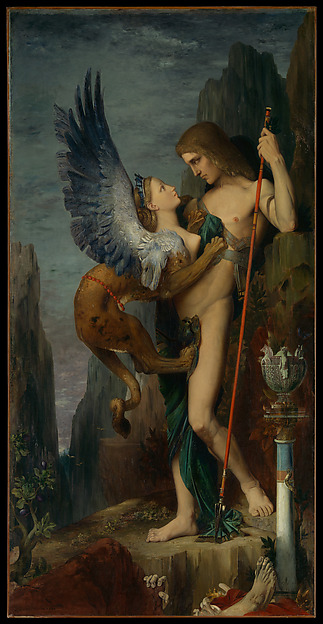
    Oedipus and the Sphinx, Gustave Moreau, 1864

    Edipo e la Sfinge

    1864 · Metropolitan Museum of Art

    Dejanira (Autumn), Gustave Moreau, about 1872–1873

    Dejanira (Autumn)

    about 1872–1873 · Getty Museum

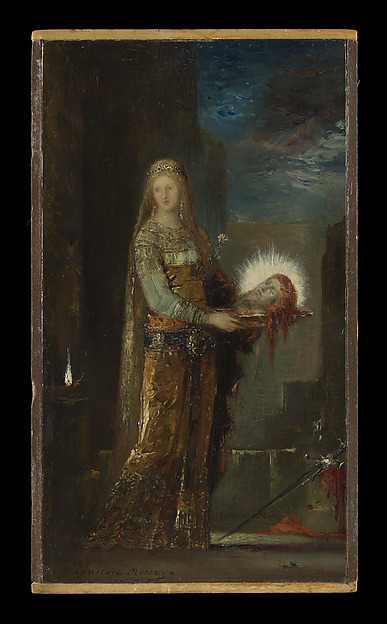
    Salome with the Head of John the Baptist, Gustave Moreau, ca. 1876

    Salome with the Head of John the Baptist

    ca. 1876 · Metropolitan Museum of Art

    Hercules and the Lernaean Hydra, Gustave Moreau, 1875–76

    Hercules and the Lernaean Hydra

    1875–76 · Art Institute of Chicago

    Jacob and the Angel, Gustave Moreau, 1874-1878

    Jacob and the Angel

    1874-1878 · Harvard Art Museums

    The Infant Moses, Gustave Moreau, c. 1876-c. 1878

    The Infant Moses

    c. 1876-c. 1878 · Harvard Art Museums

    The Apparition, Gustave Moreau, 1876-1877

    The Apparition

    1876-1877 · Harvard Art Museums

    The Sirens, Gustave Moreau, 1882

    The Sirens

    1882 · Harvard Art Museums