Eva HesseStati Uniti, 1936–1970
Hang Up
Si può vedere?
Sì, esposta ora
Dove si trova «Hang Up» oggi? Art Institute of Chicago, Sala 297, Chicago. Sì, esposta ora. Verificato 23 novembre 2026.

Chicago, Stati Uniti
Aperto· fino alle 20:00
Esposta al pubblico.
- Verificato
- Ultimo cambio di stato
- Fonte
- Il museo
Sulla scultura
During her short career Eva Hesse explored the expressive, often eccentric possibilities of rigorous, reductive abstraction. She considered Hang Up to be her first significant work of art—the first to achieve the level of "absurdity or extreme feeling" she was seeking.
In the late I960s, at a moment when sculpture was supplanting painting as the avant-garde medium of choice, Hang Up emphasizes painting's most marginal feature, its frame. The frame here is sensitively painted but surrounds only blank wall. Instead it sprouts a generous loop of cord that protrudes at once gracefully and aggressively into the gallery space. Like a body, this strand of industrial tubing even succumbs to gravity, touching the floor.
Art Institute of ChicagoCC BY 4.0
Scheda
- Numero di inventario
- 1988.130
Che cosa raffigura
In catalogo
Fonti
- Art Institute of Chicago
- Immagine: Art Institute of Chicago — © the artist or rights holder
Nella vita di Eva Hesse
Tutta la vita1960–1965
Early work: abstract drawings and paintings
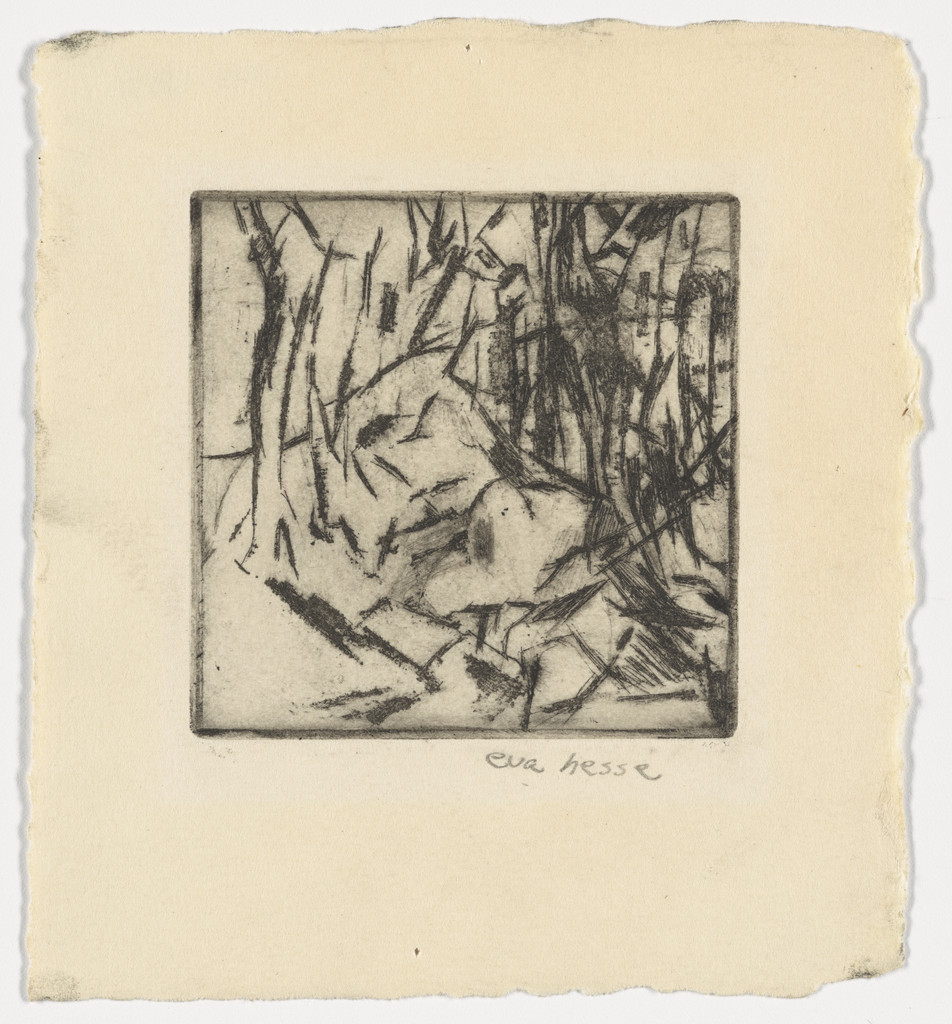
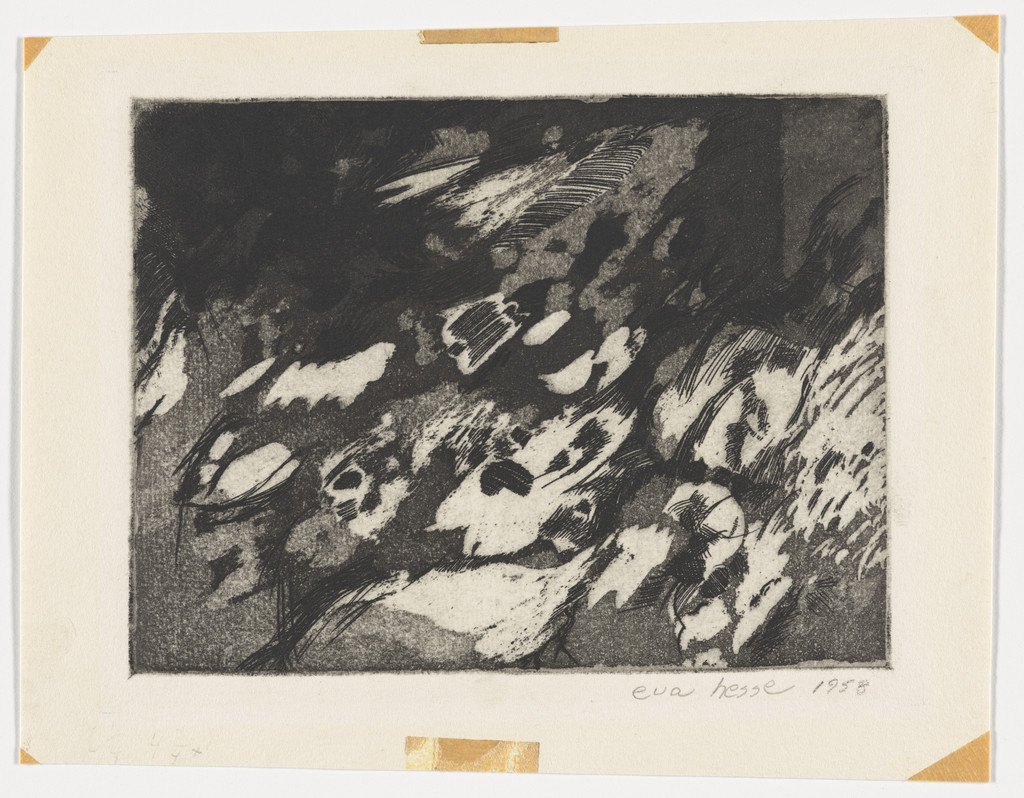
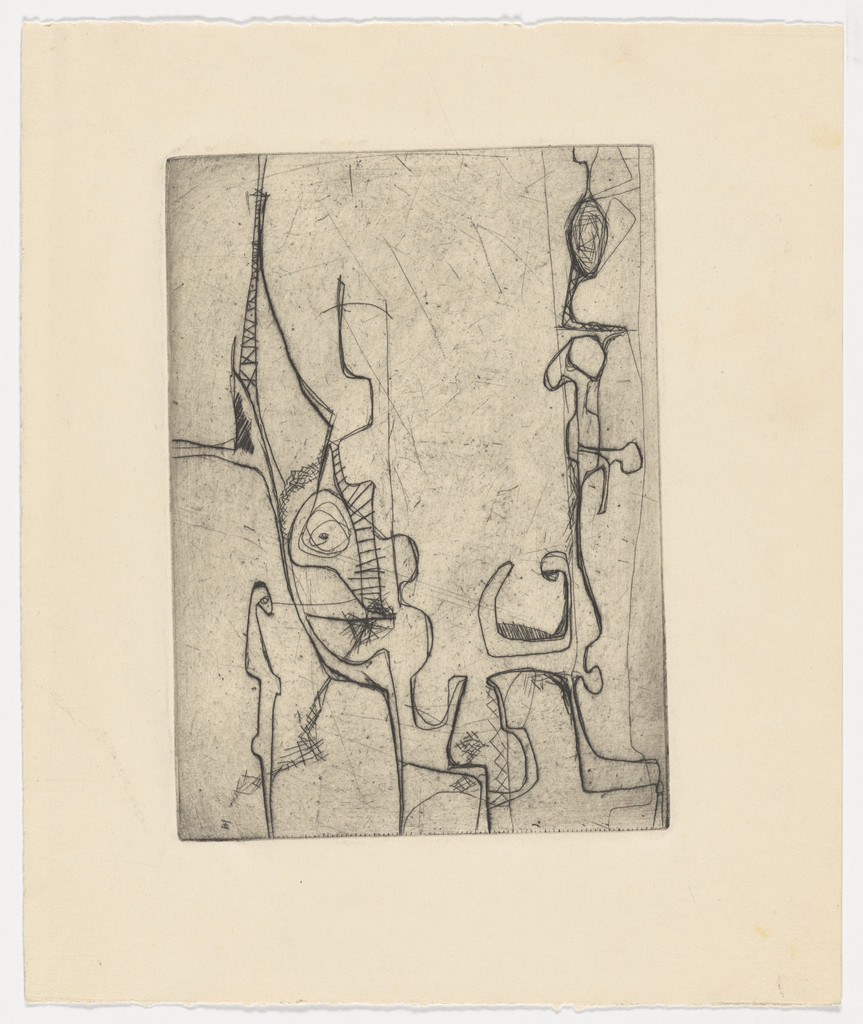
Hesse’s early work (1960–1965) consists mainly of abstract drawings and paintings. She made the drawings as a separate body of work and did not regard them as drafts for her sculptures; in the early 1960s she was influenced by Marcel Duchamp.
1960s
Befriends LeWitt, Judd and Kusama
Back in New York after Yale, she grows close to the young minimalist artists Sol LeWitt, Donald Judd and Yayoi Kusama. Her friendship with LeWitt lasts to the end of her life; they wrote to each other often.
1964–1965
A year in Germany: an abandoned mill in Kettwig
So that Doyle can take up a residency from the German industrialist and collector Friedrich Arnhard Scheidt (a move Eva did not welcome), the couple live and work for about a year in an abandoned textile mill in Kettwig near Essen. The angular forms of the disused machines and tools inspire her mechanical drawings, and the year becomes a turning point: from then on sculpture is the main focus of her work.
1965
Returns to New York and takes up new materials
After the year in Germany she returns to New York in 1965, devotes herself to sculpture and begins experimenting with the unconventional materials that become her signature: latex, fiberglass and plastic.
1965
LeWitt tells her to stop thinking and just do
In 1965 Sol LeWitt, with whom she corresponded often, famously urges a doubting Eva to stop thinking and simply do the work.
1966
Divorce from Tom Doyle
Her marriage to Tom Doyle, which had begun to fall apart already in Germany, ends in divorce.