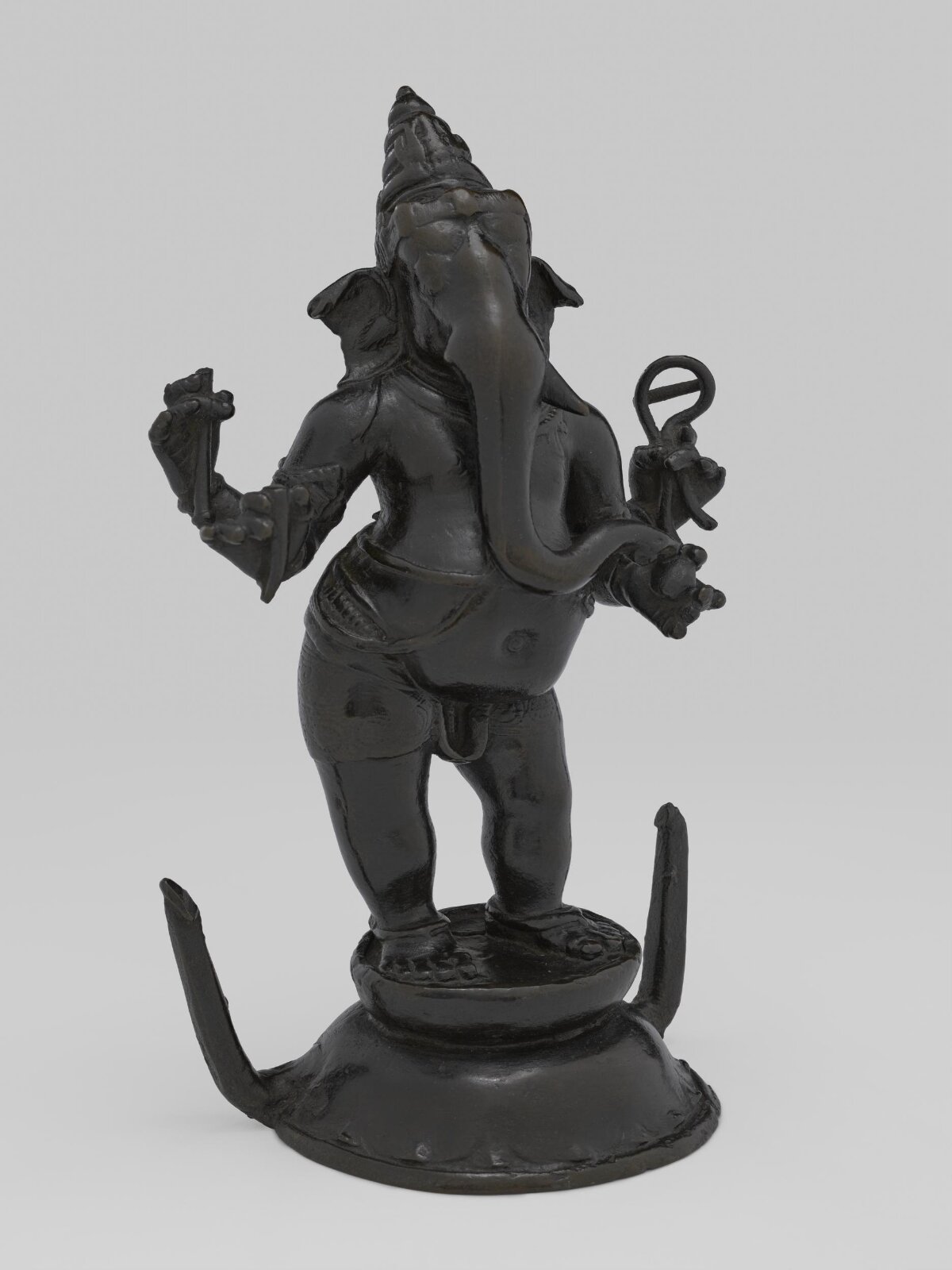
Ganesha
Si può vedere?
Non esposta al momento
Dove si trova «Ganesha» oggi? Collezione: Victoria and Albert Museum, Londra. Non esposta al momento. Verificato 25 settembre 2026.

Londra, Regno Unito
Appartiene alla collezione, ma al momento non è esposta.
- Verificato
- Ultimo cambio di stato
- Fonte
- Il museo
Sulla scultura
Ganesha is the elephant-headed son of Shiva and Parvati. He is represented here in a processional form that would accompany his parents during temple parades, although he would be carried on a separate palanquin.
Leggi
Here Ganesha stands in a relaxed posture with his hip flexed. In this four-armed form, he holds in his upper hands a noose (pasa) and elephant-goad (ankusa). While in his lower left hand he displays one of the delicacies that he enjoys, variously identified as wood-apple (kapittha) or sweetmeats, which he is about to take with his trunk. The fourth hand holds his broken tusk. The reason Ganesha has a broken tusk is explained in a variety of anecdotal stories, but its origins may lie in its resemblance to the plough, as this evokes his early role as a patron of agrarian activity. This role appears to have been displaced in the later medieval period by other functions, notably to serve as the patron and protector of those embarking on new ventures.
This sculpture is a good example of the masterful casting techniques of the Chola period (850-1267 A.D.). It demonstrates the metalworkers’ use of subtle form, simple ornament and restrained surface decoration, along with minimal chased detail.
Ganesha stands on a circular lotus-pedestal that has upright projections which could support an arched surround.
Victoria and Albert Museum
Scheda
- Numero di inventario
- IS.2-1951
Che cosa raffigura
In catalogo
Fonti
- Victoria and Albert Museum
- Immagine: Victoria and Albert Museum — © Victoria and Albert Museum, London