Max ErnstFrancia, 1891–1976
Forest and Sun
Si può vedere?
Sì, esposta ora
Dove si trova «Forest and Sun» oggi? Art Institute of Chicago, Sala 396, Chicago. Sì, esposta ora. Verificato 16 novembre 2026.

Chicago, Stati Uniti
Chiuso· apre alle 11:00
Esposta al pubblico.
- Verificato
- Ultimo cambio di stato
- Fonte
- Il museo
Sul dipinto
Max Ernst constructed a petrified woodland in Forest and Sun, painted in 1927 and now at the Art Institute of Chicago, Chicago. Rubbing a support over textured surfaces, his frottage method, supplied patterns for the trees. Scraping almost-dry paint, which he called grattage, produced the ringed sun. The forest recalls Ernst's childhood mixture of fascination and fear before the woods around his home. He made six versions of this theme. Here the arrangement of trunks suggests the capital M in his name. On view in gallery 396.
Con le parole del museo
Among his many recollections of childhood, Max Ernst often recounted his fear and fascination with the forest that surrounded his home. He wrote of feeling “delight and oppression and what the Romantics called ‘emotion in the face of Nature.’” By expressing his thoughts in these terms, Ernst linked himself with the spiritual landscape tradition of Romanticism, which conceived of an invisible realm at work in the natural world.
Leggi
This dark and mysterious forest scene dates to one of the most creative periods of Ernst’s career. Spurred by the Surrealist leader André Breton’s proclamation of “pure psychic automatism” as an artistic ideal, he developed the innovative technique of frottage, his term for the method of reproducing a relief design (like the surface of a piece of wood) by laying paper or canvas over it and rubbing it with a pencil, charcoal, or another medium. In Forest and Sun Ernst used this technique to create a petrified forest, which he imbued with a sense of primordial otherworldliness. By scraping away almost-dry paint on the canvas (a process he called grattage), the artist produced the encircled sun at the center of the composition. Ernst painted six variations of the forest and sun theme. As in the other five canvases, the tree trunks suggest a letter in the artist’s name: in this case, a capital M.
Art Institute of ChicagoCC BY 4.0
Scheda
- Numero di inventario
- 2007.276
Che cosa raffigura
In catalogo
Esposizioni
Esposta · Sala 396
Art Institute of Chicago · 28 set 2026 — oggi · Verificato
Era esposta · Sala 395
Art Institute of Chicago · 19 ago 2026 — 28 set 2026 · Verificato
Fonti
- Art Institute of Chicago
- Immagine: Art Institute of Chicago — © the artist or rights holder
Nella vita di Max Ernst
Tutta la vita1925
Un contratto con Jacques Viot e uno studio a Montmartre
Tornato a Parigi Ernst firmò un contratto con Jacques Viot che gli permetteva di dipingere a tempo pieno e nel 1925 prese uno studio al 22 di rue Tourlaque a Montmartre. Il contratto finì a giugno con la misteriosa scomparsa di Viot.
1926
«Histoire naturelle»: una cartella di frottage
Presso la stamperia di Jeanne Bucher Ernst pubblicò Histoire naturelle, una cartella di disegni a frottage, con un'introduzione di Hans Arp.
1926
La prima grande mostra alla Galerie van Leer
Nel 1926 la galleria parigina van Leer tenne la prima grande mostra di Ernst; al posto della prefazione il catalogo stampava poesie di Paul Éluard, Benjamin Péret e Robert Desnos.
1926
Il balletto di Diaghilev e lo scandalo di Breton
Nel 1926 Ernst e Joan Miró disegnarono «Romeo e Giulietta» per la compagnia di Sergej Diaghilev; Breton, indignato per il lavoro con i Balletti russi, fece scandalo alla prima e su La Révolution surréaliste lui e Aragon accusarono Ernst e Miró di sminuire l'idea di surrealismo. Il numero successivo, però, ospitò due opere di Ernst con un'apologia di Éluard.
1927
Matrimonio con Marie-Berthe Aurenche
1929
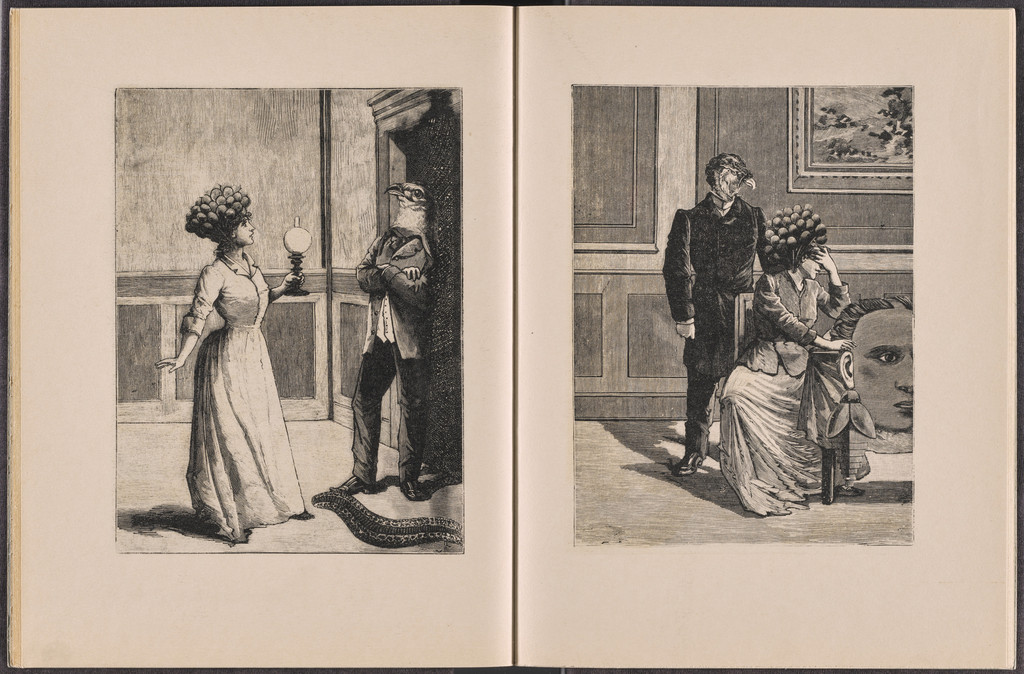
Il romanzo-collage «La Femme 100 têtes»
Nel 1929 uscì il romanzo grafico La Femme 100 têtes, circa 150 disegni con il testo dell'artista e un indirizzo al lettore di André Breton. Uno dei personaggi era Loplop, il capo degli uccelli, che compare più volte nell'opera di Ernst.