 Albrecht DürerGermania, 1471–1528
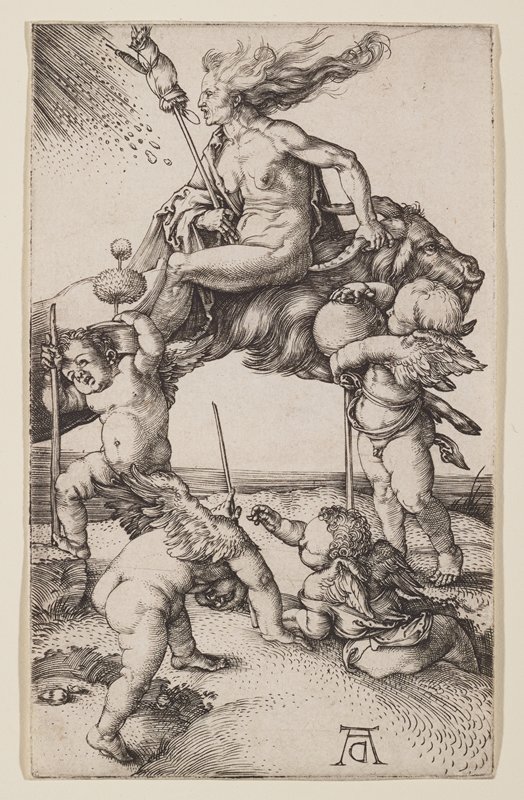
Die Hexe - Witch Riding on a Goat
Si può ammirare?
Al momento non riceve

Minneapolis Institute of Art
Minneapolis, Stati Uniti
Appartiene alla collezione, ma al momento non è esposta.
- Verificato
- Ultimo cambio di stato
- Fonte
- Il museo
Sull’opera
Albrecht Dürer eventually brought a scientific and mathematical mindset to his art, but early in his career, dark and mysterious forces often stoked his imagination. In this engraving, a witch rides backwards on a flying goat, while putti cavort below. One of these capricious baby angels struggles to retain control of the unstable sphere of fate, which can roll in unpredictable directions. Another precariously supports a potted topiary plant, perhaps a symbol of man’s attempts to tame nature. Dürer signed his monogram backwards, confirmation that witchcraft has pushed the world off-kilter.
Minneapolis Institute of Art
Scheda
- Numero di inventario
- 2014.117.2
Che cosa raffigura
In catalogo
Andirivieni
Al momento non esposta
Minneapolis Institute of Art · 29 set 2026 — oggi · Verificato
Al momento non esposta
National Gallery of Art · 29 set 2026 — 29 set 2026 · Verificato
Al momento non esposta
Minneapolis Institute of Art · 28 set 2026 — 29 set 2026 · Verificato
Al momento non esposta
National Gallery of Art · 27 set 2026 — 28 set 2026 · Verificato
Al momento non esposta
Rijksmuseum · 26 set 2026 — 27 set 2026 · Verificato
Al momento non esposta
National Gallery of Art · 26 set 2026 — 26 set 2026 · Verificato
Al momento non esposta
Rijksmuseum · 25 set 2026 — 26 set 2026 · Verificato
Fonti
- Minneapolis Institute of Art
- Immagine: Minneapolis Institute of Art — public domain
Nel frattempo, nella vita di Albrecht Dürer
Tutta la vita1500
Jacopo de' Barbari and the secret of proportion
The Venetian Jacopo de' Barbari, whom Dürer had met in Venice, came to Nuremberg, and Dürer said he learned much from him about perspective, anatomy and proportion. Feeling that de' Barbari would not explain everything he knew, Dürer began studies of his own that became a lifelong preoccupation.
1501–1502
In the circle of Nuremberg's humanists
Through his lifelong friend Willibald Pirckheimer, Dürer entered the circle of Nuremberg's humanists. He engraved illustrations for Conrad Celtis's editions of Hrotsvitha (1501) and of his Four Books of Love (1502), and decorated 14 books in Pirckheimer's library with drawings.
1502
Death of his father
Albrecht Dürer the Elder died, and his son took on the care of his mother and his two younger brothers, Endres and Hans.
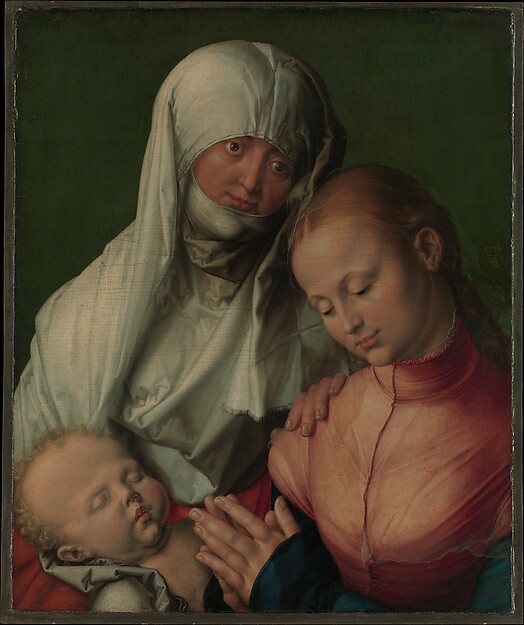
![Madonna and Child [obverse], Albrecht Dürer, c. 1496/1499](https://api.nga.gov/iiif/878db7e6-10ae-4cae-ba5d-6d6f5c413ae8/full/!2400,2400/0/default.jpg)
![Lot and His Daughters [reverse], Albrecht Dürer, c. 1496/1499](https://api.nga.gov/iiif/7565a449-f82a-414b-9bda-c93f55a51b4d/full/!2400,2400/0/default.jpg)