 Max KlingerGermania, 1857–1920
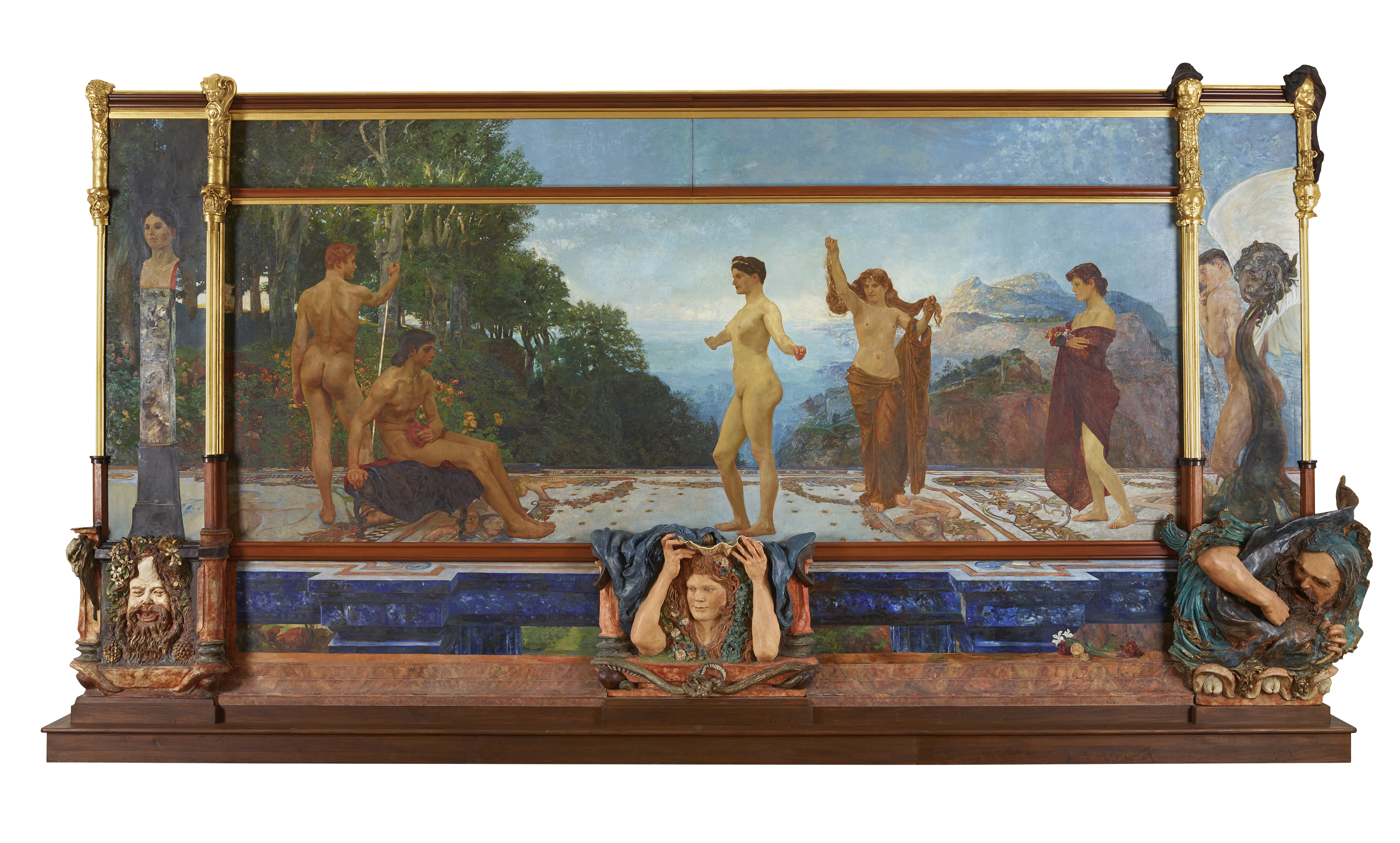
Das Urteil des Paris
Si può vedere?
Non si sa
Dove si trova «Das Urteil des Paris» oggi? Collezione: Österreichische Galerie Belvedere, Vienna. Non si sa.

Vienna, Austria
Il proprietario è noto; non si sa se oggi sia esposta.
- Ultimo cambio di stato
- Fonte
- Il museo
Sul dipinto
Con le parole del museo — in tedesco
Ohne Scheu nähern sich die Göttinnen Venus, Athena und Hera dem Hirten Paris. Sie präsentieren ihre Körper; unverwandt blicken sie auf Paris und den Götterboten Hermes. Hermes nimmt es gelassen, verharrt in selbstverliebter Athletenpose. Paris hingegen scheint vor so viel unverblümt zur Schau getragener Weiblichkeit zurückzuschrecken – wie das männliche Publikum um 1900. „Absolut fremd und verständnislos“ stünden die meisten Männer dem Bild gegenüber, schrieb der erste Besitzer des Bildes Alexander Hummel, während es von Frauen aufrichtig bewundert werde. – Selbstsicher zeigt Klinger die Göttinnen, nicht in lasziven Posen. Vor so viel Selbstbewusstsein musste die Männerwelt einfach kapitulieren.
Österreichische Galerie Belvedere
Scheda
In catalogo
Fonti
- Österreichische Galerie Belvedere
- Immagine: Österreichische Galerie Belvedere — CC BY-SA 4.0
Nella vita di Max Klinger
Tutta la vitasummer 1883
Move to Paris
He moves to Paris, where the poet and critic Jules Laforgue is already championing his prints; he lives there until 1886 or 1887, studies Goya and Daumier at the Louvre and begins sculpting about 1883.
late July 1886
A trip to Italy and the Carrara quarries
At the end of July he leaves Paris for Italy, where he also visits the quarries of Carrara.
1887
Meets Arnold Böcklin
He returns to Berlin, where he meets the Swiss artist Arnold Böcklin and grows spiritually close to him; from September he lives in Leipzig.
1889
Invited to exhibit with Les XX
The members of Les XX (The Twenty) invite Klinger to exhibit his work in their annual winter exhibition in Brussels.
1889
A journey through Belgium and Italy
He travels through Belgium and Italy, visiting Naples, Paestum and Pompeii.
1889–1893
Years in Rome
He settles in Rome and studies the Italian masters: 15th-century artists and works from antiquity are a revelation to him, and he intensifies his studies of anatomy, the nude and the representation of mass and volume — a very productive time. Other accounts say he arrived in Rome already in 1888.