Edgar DegasFrancia, 1834–1917
Dancer at Rest, Hands on Her Hips, Left Leg Forward
Si può vedere?
Sì, esposta ora
Dove si trova «Dancer at Rest, Hands on Her Hips, Left Leg Forward» oggi? National Gallery of Art, Sala 3 · Edificio Ovest, piano terra, Washington. Sì, esposta ora. Verificato 12 ottobre 2026.

Chiuso· apre alle 10:00
Esposta al pubblico.
- Verificato
- Ultimo cambio di stato
- Fonte
- Il museo
Scheda
- Numero di inventario
- 1999.80.24
Che cosa raffigura
In catalogo
Fonti
- National Gallery of Art
- Immagine: National Gallery of Art — Museum open access
Nella vita di Edgar Degas
Tutta la vita1870
A volunteer in the war; a flaw in his eyesight
When the Franco-Prussian War broke out Degas volunteered; at the first shooting practice it turned out that he saw poorly with his right eye. It was the first sign of the macular degeneration that left him almost blind at the end of his life; he was transferred to the artillery and served there to the end of the war.
ottobre 1872 – marzo 1873 · Residenza
New Orleans
1873–1874
His brother's debts: he sells his house and collection
After his father's death Degas learned that his brother René had run up enormous business debts. To save the family's reputation he sold his house and an inherited art collection and for the first time in his life depended on sales of his own work.
1874
The first Impressionist exhibition
Disenchanted with the Salon, Degas joined a group of young artists organizing an independent exhibiting society. He took a leading role in organizing the eight shows of 1874–1886 and exhibited in all but one, despite constant conflicts with the group.
1881
“The Little Dancer of Fourteen Years” on show
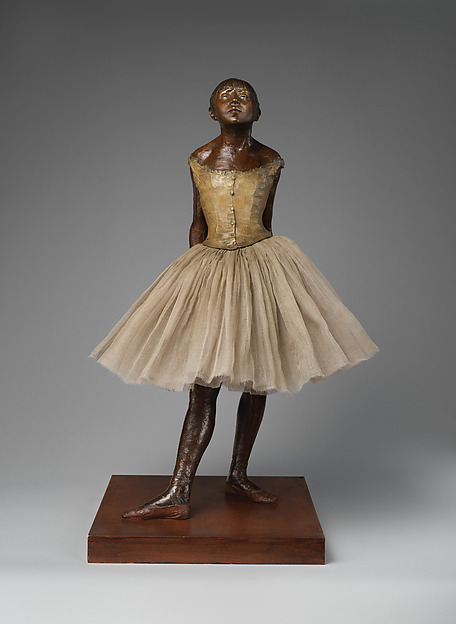
The nearly life-size wax figure with real hair and a cloth tutu, modelled on Marie van Goethem, provoked a strong reaction: critics found its realism extraordinary, but many denounced the dancer as ugly. It was the only sculpture Degas showed in his lifetime.
by 1882
His eyesight sharply worsens
By 1882 Degas's eyesight began to worsen sharply: he turned to pastel and then to sculpture, where he could rely more on touch.