Georgia O'KeeffeStati Uniti, 1887–1986
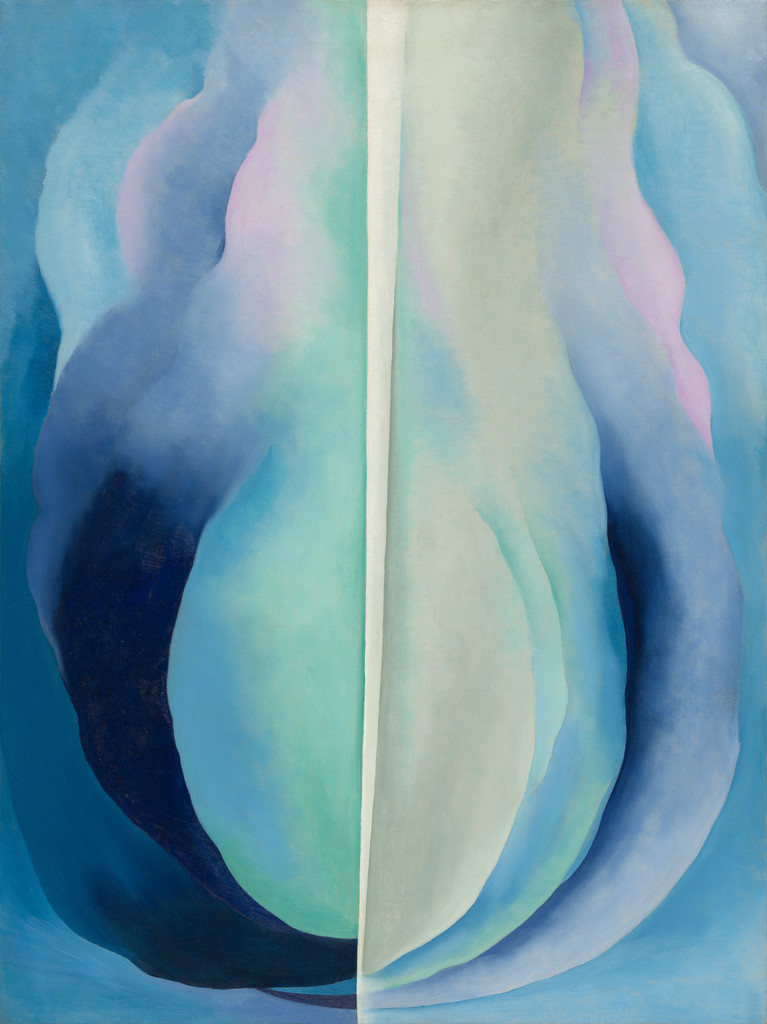
Blue and Green Music
Si può vedere?
Non esposta al momento
Dove si trova «Blue and Green Music» oggi? Collezione: Art Institute of Chicago, Chicago. Non esposta al momento. Verificato 29 settembre 2026.

Chicago, Stati Uniti
Appartiene alla collezione, ma al momento non è esposta.
- Verificato
- Ultimo cambio di stato
- Fonte
- Il museo
Sul dipinto
Blue and Green Music is an oil on canvas painting by the American painter Georgia O'Keeffe, from 1919 to 1921.
Painted during her New York years, Blue and Green Music uses the contrast of hard and soft edges and geometric forms to convey the rhythm and movement of music.
Con le parole del museo
Around 1920 Georgia O’Keeffe painted a number of oils exploring, as she later recalled, “the idea that music could be translated into something for the eye.” In Blue and Green Music, O’Keeffe’s colors and forms simultaneously suggest the natural world and evoke the experience of sound. She was drawn to the theories of the Russian Expressionist painter Vasily Kandinsky, who, in his 1912 text Concerning the Spiritual in Art, argued that visual artists should emulate music in order to achieve pure expression free of literary references.
Art Institute of ChicagoCC BY 4.0
Scheda
- Numero di inventario
- 1969.835
In catalogo
Fonti
- Art Institute of Chicago
- Immagine: Art Institute of Chicago — © the artist or rights holder
Nella vita di Georgia O'Keeffe
Tutta la vita1917
Exhibition of her work organised by Stieglitz
Stieglitz held an exhibition of her work, and O’Keeffe came to New York to see it. From that visit he began to photograph her — and went on doing so for many years, often in the nude.
1918
Stieglitz leaves his family for O’Keeffe
Within a month Stieglitz took the first of many nude photographs of her at his family’s apartment while his wife was away; his wife came home and gave him an ultimatum, and he left at once and moved in with O’Keeffe. The divorce, delayed by his first wife and her family, took six years — until the wedding in December 1924.
from 1918
Meets the modernists of the Stieglitz circle
In New York she came to know the early American modernists of Stieglitz’s circle: the painters Charles Demuth, Arthur Dove, Marsden Hartley and John Marin, and the photographers Paul Strand and Edward Steichen. The photography of Strand and of Stieglitz himself inspired her work.
1918
Moves to New York at Stieglitz’s invitation
Stieglitz invited her to live and work in New York, promising a quiet studio and to underwrite a year of painting; to accept she resigned from teaching at West Texas State. He discouraged her use of watercolour, which was associated with amateur women artists.
February 1921
Her portraits in Stieglitz’s retrospective
Stieglitz’s photographs of O’Keeffe were included in his retrospective exhibition at the Anderson Galleries; many were nudes, and it created a public sensation.
from 1923
Becomes a fashionable, well-paid artist
With Stieglitz’s support her landscapes and still lifes — her flowers above all — began to be shown actively, and she became a fashionable and highly paid artist.