Édouard ManetFrancia, 1832–1883
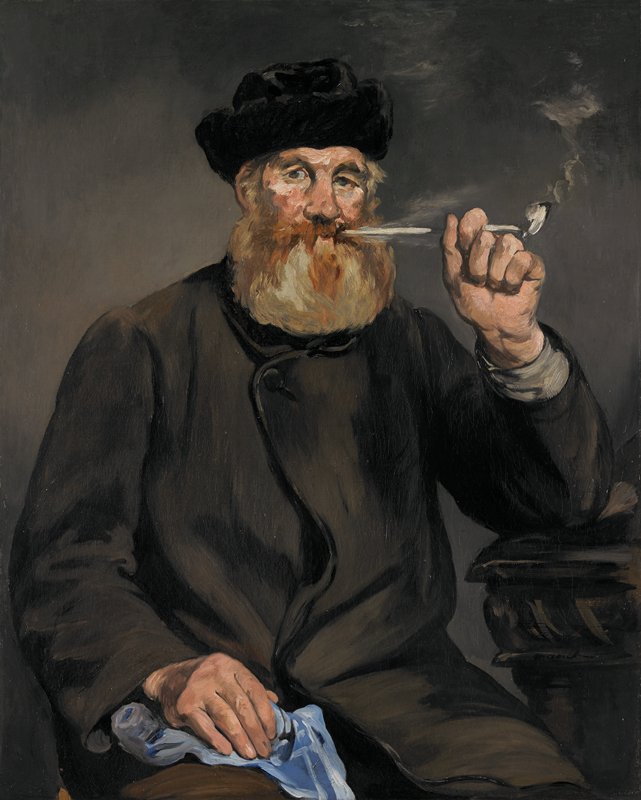
Beggar with a Duffle Coat (Philosopher)
Si può ammirare?
Sì, riceve visite

Chicago, Stati Uniti
Esposta al pubblico.
- Verificato
- Ultimo cambio di stato
- Fonte
- Il museo
Sul dipinto
This painting and Beggar with Oysters were conceived as companion pieces. Édouard Manet exhibited them together in 1872 alongside paintings of an absinthe drinker and a ragpicker (a collector and reseller of discarded fabric and other refuse) under the collective title The Philosophers. When Manet made the paintings, these “beggars,” as they were then referred to, were being pushed to the physical and social margins of Paris as the city rapidly redeveloped to make way for more bourgeois neighborhoods. Although he was born into an upper-class family, Manet was an outsider to the established French art circles and likely identified with these alienated subjects.
Art Institute of ChicagoCC BY 4.0
Scheda
- Numero di inventario
- 1910.304
Che cosa raffigura
In catalogo
Fonti
- Art Institute of Chicago
- Immagine: Art Institute of Chicago — CC0
Nel frattempo, nella vita di Édouard Manet
Tutta la vita1863
“The Luncheon on the Grass” at the Salon des Refusés
The Salon of 1863 rejected “The Luncheon on the Grass” (originally “Le Bain”), and Manet exhibited it at the Salon des Refusés, a parallel exhibition initiated by Napoleon III after a public outcry, the jury having accepted only 2,217 of more than 5,000 submissions. The juxtaposition of dressed men and a nude woman and the sketch-like handling caused a scandal; one critic compared the brushwork to a “floor mop”.
1863
Marries Suzanne Leenhoff
In 1863, a year after his father's death, Manet married Suzanne Leenhoff at a Protestant church: a Dutch-born piano teacher two years his senior with whom he had been romantically involved for about ten years. Auguste Manet had employed her to teach his sons the piano, and she may also have been Auguste's mistress.
1863
Married: Suzanne Manet
1865
“Olympia” at the Salon: a scandal
In 1865 the Salon accepted “Olympia”, and the frank depiction of a self-assured prostitute created a scandal; according to Antonin Proust, only the precautions taken by the administration prevented the painting from being punctured and torn. The popular press caricatured it, while the avant-garde, including Courbet, Cézanne and Monet, championed it.
1867
His own pavilion near the Pont de l'Alma
In 1867, during the World's Fair in Paris, Manet set up his own pavilion near the Pont de l'Alma and showed fifty of his best works of the past ten years. Possibly this step led to his works being accepted at the next two Salons.
1868
Friendship with Berthe Morisot
In 1868 Manet became a friend and colleague of Berthe Morisot; she is credited with convincing him to attempt plein air painting, to which Camille Corot had introduced her. Through Morisot, Manet became friends with Degas, Monet, Renoir, Sisley, Cézanne and Pissarro.