ART WIKI32.963 in sala
MappaCollezioneArtistiMuseiMostreRivista
Accedi

ART WIKI

Dove è appeso il capolavoro, e quando si può entrare.

Collezioni: Art Institute of Chicago, Cleveland Museum of Art, Ermitage, Galleria Tret'jakov, Getty Museum, Harvard Art Museums, Hirshhorn Museum and Sculpture Garden, Metropolitan Museum of Art, Minneapolis Institute of Art, Museo del Louvre, Museo Puškin delle belle arti, Museo russo, Museum of Modern Art, National Gallery of Art, National Museum of Asian Art, National Portrait Gallery, Rijksmuseum, Smithsonian American Art Museum, Statens Museum for Kunst, Victoria and Albert Museum, Villa Getty, Whitney Museum of American Art, Catalogo statale del fondo museale russo (274 musei), Europeana (19 musei), Wikidata (6 musei), Paris Musées (12 musei) e Joconde, la banca dati dei musei del Ministero della Cultura francese (495 musei). Le immagini appartengono ai titolari dei diritti.

Sezioni

  • Mappa
  • Ricerca
  • Collezione
  • Capolavori
  • Esposte ora
  • Artisti

Altro

  • Musei e gallerie
  • Mostre
  • Rivista
  • Da dove vengono i dati
  • Privacy e cookie
HomeMappaCatalogo
  1. Collezione/
  2. Getty Museum/
  3. A Walk at Dusk
A Walk at Dusk, Caspar David Friedrich, about 1830–1835
Caspar David Friedrich, ritrattoCaspar David FriedrichGermania, 1774–1840

A Walk at Dusk

about 1830–1835 · Painting · 33.7 × 43.2 cm

Si può ammirare?

Sì, riceve visite

GM
Getty Museum

Los Angeles, Stati Uniti

SalaMuseum West Pavilion, Gallery W201

Esposta al pubblico. Chi lo garantisce è indicato qui sotto.

Verificato
l’altro ieri
Ultimo cambio di stato
5 ott 2026
Fonte
Il museo
Sulla mappaPagina del museo

Sul dipinto

His head bowed, a man walks alone in the silvery, cold moonlit night while contemplating a megalithic tomb and its implicit message of death. It is winter, and all around him nature is dying. Leafless trees loom behind like specters, but a grove of verdant oaks rises through the mist in the background with the promise of life. The waxing moon, high in the sky, also acts as a counterbalance to death, symbolizing Christ and the promise of rebirth for the artist Caspar David Friedrich. Friedrich was part of the German Romantic movement; his deeply personal and introspective vision addressed Christian themes through analogies based on the cycles of nature. *A Walk at Dusk* was among a small group of works Friedrich completed before he suffered a debilitating stroke in 1835. The painting embodies both the melancholy he experienced during this period and the consolation he found in the Christian faith.

GMGetty Museum

Scheda

about 1830–1835
17741840
Numero di inventario
93.PA.14

In catalogo

DipintiOlioPittura tedescaPittura svedeseRomanticismoXIX secoloGermania

Fonti

  • Getty Museum
  • Immagine: Getty Museum — Open Content

Nel frattempo, nella vita di Caspar David Friedrich

Tutta la vita
  1. 1825–1840

    The fading of his fame

    Over the last fifteen years of his life Friedrich’s reputation steadily declines: as the ideals of early Romanticism go out of fashion he comes to be seen as an eccentric and melancholy figure out of touch with the times, and his patrons gradually fall away. Towards the end he lives in relative poverty and spends long periods, often beginning before sunrise, walking alone through woods and fields.

  2. 1830

    Aphorisms on art

    Friedrich sets down a collection of aphorisms on aesthetics, the sum of his written commentary on art. The artist, he holds, must match natural observation with scrutiny of his own personality: close the bodily eye in order to see the picture first with the spiritual eye, and then bring to the light of day what was seen in the darkness.

  3. 1835

    Money from the Russian royal family and a cure at Teplitz

    Soon after his stroke the Russian royal family purchases a number of his earlier works, and the proceeds allow him to travel to Teplitz, in today’s Czech Republic, to recover.

  4. June 1835

    His first stroke

    Friedrich’s first stroke leaves him with minor limb paralysis and greatly reduces his ability to paint: he can no longer work in oil and is limited to watercolour, sepia and reworking older compositions. His vision remains strong, but his hand has lost its full strength.
Altre opere di Caspar David Friedrich

Tutte le opere
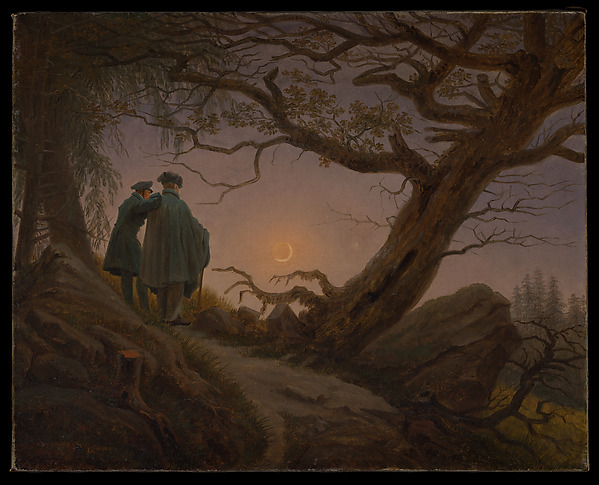
Two Men Contemplating the Moon, Caspar David Friedrich, ca. 1825–30

Two Men Contemplating the Moon

ca. 1825–30 · Metropolitan Museum of Art

Night in a Harbour, Caspar David Friedrich, 1818

Night in a Harbour

1818 · Ermitage

On a Sailing Ship, Caspar David Friedrich, 1818

On a Sailing Ship

1818 · Ermitage

Bord de mer au clair de lune, Friedrich, Caspar David, 1e quart du XIXe siècle (vers 1818)

Bord de mer au clair de lune

1e quart du XIXe siècle (vers 1818) · Museo del Louvre

Morning in the Mountains, Caspar David Friedrich, 1820s

Morning in the Mountains

1820s · Ermitage

Moonrise over the Sea, Caspar David Friedrich, 1821

Moonrise over the Sea

1821 · Ermitage

L'arbre aux corbeaux, Friedrich, Caspar David, 1e quart du XIXe siècle (vers 1822)

L'albero dei corvi

1e quart du XIXe siècle (vers 1822) · Museo del Louvre

Swans in the reeds at the first dawn, Caspar David Friedrich, 1830s

Swans in the reeds at the first dawn

1830s · Ermitage

Sotto lo stesso tetto: Getty Museum

Pagina del museo
Irises, Vincent van Gogh, 1889

Vincent van Gogh

Irises, 1889

The Portal of Rouen Cathedral in Morning Light, Claude Monet, 1894

Claude Monet

The Portal of Rouen Cathedral in Morning Light, 1894

Wheatstacks, Snow Effect, Morning (Meules, Effet de Neige, Le Matin), Claude Monet, 1891

Claude Monet

Wheatstacks, Snow Effect, Morning (Meules, Effet de Neige, Le Matin), 1891

Sunrise (Marine), Claude Monet, 1872 or 1873

Claude Monet

Sunrise (Marine), 1872 or 1873

Still Life with Flowers and Fruit, Claude Monet, 1869

Claude Monet

Still Life with Flowers and Fruit, 1869

Saint Bartholomew, Rembrandt Harmensz. van Rijn, 1661

Rembrandt van Rijn

Saint Bartholomew, 1661

Daniel and Cyrus Before the Idol Bel, Rembrandt Harmensz. van Rijn, 1633

Rembrandt van Rijn

Daniel and Cyrus Before the Idol Bel, 1633

The Abduction of Europa, Rembrandt Harmensz. van Rijn, 1632

Rembrandt van Rijn

Il rapimento di Europa, 1632