Winslow HomerStati Uniti, 1836–1910
A Visit from the Old Mistress
Si può vedere?
Non si sa
Dove si trova «A Visit from the Old Mistress» oggi? Collezione: Smithsonian American Art Museum, Washington. Non si sa.

Washington, Stati Uniti
Il proprietario è noto; non si sa se oggi sia esposta.
- Ultimo cambio di stato
- Fonte
- Il museo
Sul dipinto
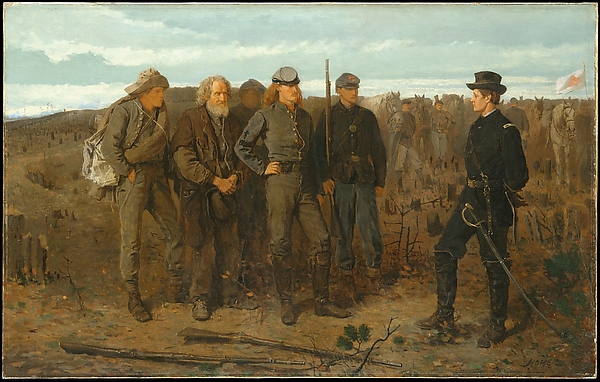
A Visit from the Old Mistress is an 1876 painting by the American artist Winslow Homer. It was one of several works that Homer is thought to have created during a mid-1870s visit to Virginia, where he had served for a time as a Union war correspondent during the American Civil War. Scholars have noted that the painting's composition is taken from Homer's earlier painting Prisoners from the Front, which depicts a group of captive Confederate soldiers defiantly regarding a Union officer. Put on display in the northern states for a northern audience, A Visit from the Old Mistress, along with Homer's other paintings of black southern life from the Reconstruction era, has been praised as an "invaluable record of an important segment of life in Virginia during the Reconstruction."
Con le parole del museo
A Visit from the Old Mistress captures a tentative encounter in the postwar South. The freed slaves are no longer obliged to greet their former mistress with welcoming gestures, and one remains seated as she would not have been allowed to do before the war. Winslow Homer composed the work from sketches he had made while traveling through Virginia; it conveys a silent tension between two communities seeking to understand their future. The formal equivalence between the standing figures suggests the balance that the nation hoped to find in the difficult years of Reconstruction.
Exhibition Label, Smithsonian American Art Museum, 2006
Smithsonian American Art Museum
Scheda
- Numero di inventario
- 1909.7.28
Che cosa raffigura
In catalogo
Fonti
- Smithsonian American Art Museum
- Immagine: Smithsonian American Art Museum — CC0
Nella vita di Winslow Homer
Tutta la vita1875
Gives up illustration for painting
In 1875 Homer, after nearly twenty years as an illustrator, quit commercial illustration and vowed to live on his paintings and watercolours alone. Despite his excellent critical reputation, his finances remained precarious.
1876
The Centennial Exposition in Philadelphia
“Snap the Whip” and “Breezing Up” were shown at the Centennial Exposition; the New York Tribune wrote that it could not remember a picture in any exhibition that could be named alongside “Breezing Up”. Henry James confessed that he detested Homer's subjects of the time, yet “to reward his audacity, he has incontestably succeeded”.
c. 1876
Visits to Virginia
Around 1876 Homer visited Petersburg, Virginia (apparently to see what had become of the lives of former slaves), and painted rural African American life, the most unaffected views of it at the time, such as “Dressing for the Carnival” (1877).
1877
First show at the Boston Art Club
In 1877 Homer exhibited at the Boston Art Club for the first time, with the oil painting “An Afternoon Sun”; from then until 1909 he showed there often.
late 1870s
A recluse in Gloucester
In the late 1870s, whether from disappointments with women or some other emotional turmoil, Homer became reclusive, abandoned urban social life and lived instead in Gloucester, for a while even in the secluded Eastern Point Lighthouse with the keeper's family. Watching the fishermen, the sea and the marine weather, he rediscovered his love of the sea and found a rich source of themes in it.
1878
A productive year at Valentine's farm
Homer spent 1878 as the guest of the industrialist Lawson Valentine at Houghton Farm, his property in the Adirondack Mountains, and it proved a particularly productive year. Valentine, whose paint company employed the artist's brother Charles as a chemist, was an early and important collector of Homer's work and later gave him a studio at the farm.