 John Singleton CopleyStati Uniti, 1738–1815
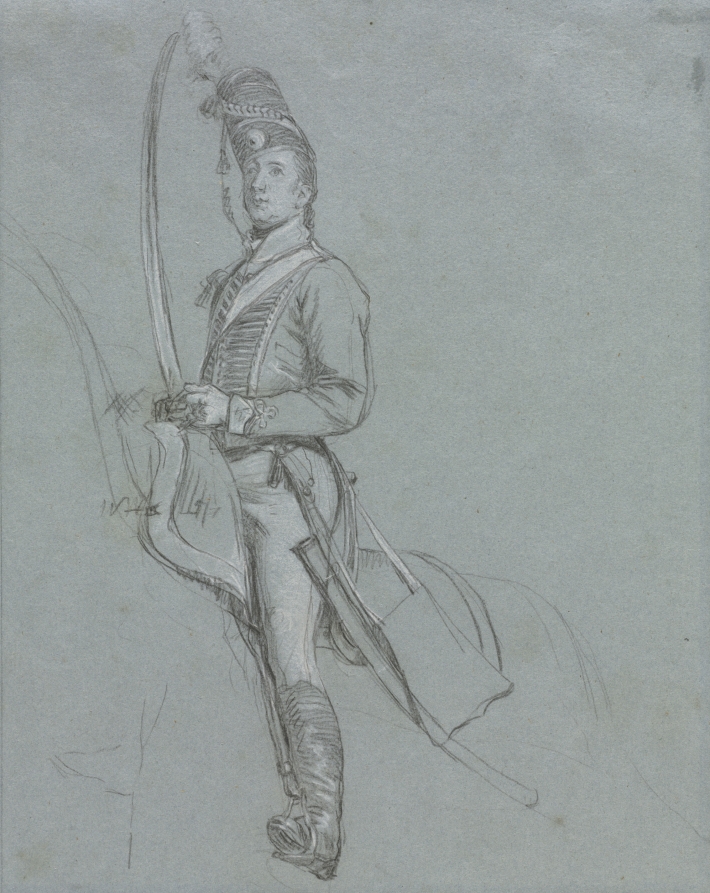
A Hussar Officer on Horseback
Si può vedere?
Non esposta al momento
Dove si trova «A Hussar Officer on Horseback» oggi? Collezione: Cleveland Museum of Art, Cleveland. Non esposta al momento. Verificato 29 settembre 2026.

Cleveland, Stati Uniti
Appartiene alla collezione, ma al momento non è esposta.
- Verificato
- Ultimo cambio di stato
- Fonte
- Il museo
Sull’opera
John Singleton Copley left Boston at the start of the American Revolution in 1775 to pursue his career in England, where he achieved distinction both as a portraitist and a history painter. Following a method often employed in France, Copley generally drew on blue paper to serve as a middle tone, working up the image using black chalk to indicate outlines and shadows, and white chalk for highlights. He made this drawing as an early study for the figure of the prince of Orange in his last major history painting, Battle of the Pyrenees (Museum of Fine Arts, Boston), in 1812–15. The figure is garbed in the uniform of a “hussar,” a light cavalry officer equipped with a saber, regiments of which played an important role in the Napoleonic Wars (1803–15). In the final composition, Copley used the pose not for Orange, but for the Duke of Wellington, changing the facial features and adjusting the position of the figure’s arms.
Cleveland Museum of Art
Scheda
- Numero di inventario
- 1950.216
In catalogo
Fonti
- Cleveland Museum of Art
- Immagine: Cleveland Museum of Art — Museum open access
Nella vita di John Singleton Copley
Tutta la vita1774–1815 · Luogo di lavoro
London
c. 1800 – 1815
Last years: debts and disappointments
The Napoleonic Wars bring hard times, the house on George Street is expensive to keep up, and a talented son’s education is costly. The equestrian portrait of the Prince Regent brings no return and other canvases that took years of labour go unsold; Copley dies heavily in debt.
1810
A bad fall keeps him from painting for a month
In 1810 Copley has a bad fall that keeps him from painting for a month; he incessantly bewails the loss of his Boston property. On 11 December his wife writes that every difficulty of living is increasing while the advantages of his profession are decreasing.
October 1811
Asks his son-in-law for a £600 loan
In distress, Copley writes to Gardiner Greene asking for an additional loan of £600. On 4 March 1812 he adds that he is still pursuing his profession in the hope that a proper amount will be realized from his works, to himself or his family, but that for now all pursuits that are not among the essentials of life are at a stand.
August 1813 – April 1814
His strength fails, but he keeps painting
In August 1813 his wife writes that Copley is still painting but cannot apply himself as closely as he used to; in April 1814, that he enjoys his health but grows rather feeble and dislikes walking more and more, though it is still pleasant for him to go on painting. Among his last completed works are “The Battle of the Pyrenees”, depicting the Duke of Wellington, and “The Siege of Dunkirk”.