 Frederic Edwin ChurchStati Uniti, 1826–1900
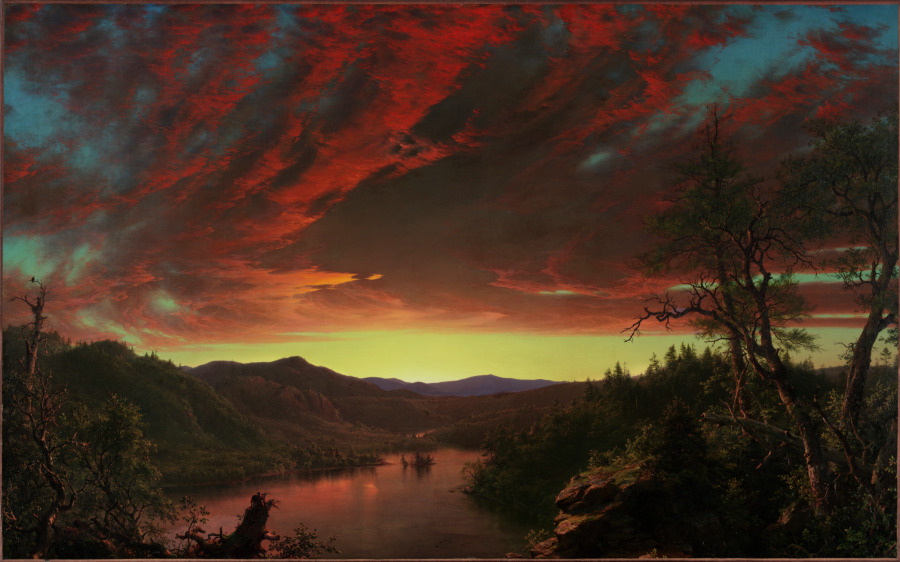
Twilight in the Wilderness
Si può vedere?
Sì, esposta ora
Dove si trova «Twilight in the Wilderness» oggi? Cleveland Museum of Art, 206 American Landscape, Cleveland. Sì, esposta ora. Verificato 29 settembre 2026.

Esposta al pubblico.
- Verificato
- Ultimo cambio di stato
- Fonte
- Il museo
Sul dipinto
Crepuscolo nella natura selvaggia è un dipinto del 1860 del pittore americano Frederic Edwin Church. I boschi degli Stati Uniti nord-orientali sono mostrati contro un sole al tramonto che colora enfaticamente le nuvole. John K. Howat ha descritto il dipinto come «uno dei suoi più belli di sempre» e come «l'esempio più toccante delle raffigurazioni dei boschi nordamericani di Church e la loro rappresentazione più famosa nella pittura del XIX secolo».
Con le parole del museo
In his New York studio, Church painted this spectacular view of a blazing sunset over wilderness near Mount Katahdin in Maine, which he had sketched during a visit nearly two years earlier. Although Church often extolled the grandeur of American landscape in his work, this painting appears to have additional overtones. Created on the eve of the Civil War, the painting's subject can be interpreted as symbolically evoking the coming conflagration. Church's considerable technical skills and clever showmanship contributed to his fame as the premier artist of his generation. Rather than debut this painting in an annual exhibition with works by other artists as was the custom, Church instead exhibited it by itself at a prestigious art gallery. Coaxed by advance publicity and highly favorable press reviews, several hundred spectators flocked to admire it during its seven-week run.
Cleveland Museum of Art
Scheda
- Numero di inventario
- 1965.233
In catalogo
Fonti
- Cleveland Museum of Art
- Immagine: Cleveland Museum of Art — Museum open access
Nella vita di Frederic Edwin Church
Tutta la vita1859
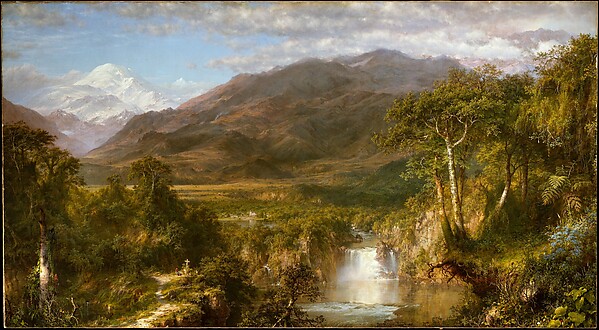
A one-picture show: “The Heart of the Andes” in New York
Thousands paid to see the canvas: its huge floor-standing frame served as a window onto the Andes, visitors sat on benches and studied the details through opera glasses, and Church arranged the room so that light from the skylights fell on the picture. It was an instant success; at this exhibition Church met his future wife, Isabel Carnes.
1859
To the icebergs: Newfoundland and Labrador
His friendship with the Arctic explorer Isaac Israel Hayes stirred Church’s interest in the far north, and with his friend the Rev. Louis Legrand Noble he travelled to Newfoundland and Labrador. Noble chronicled the trip in “After Icebergs with a Painter” (1861), published shortly before “The Icebergs” went on display.
1860
Marries Isabel Carnes and buys a farm on the Hudson
Church bought a farm near Hudson, New York, and married Isabel Mortimer Carnes (born 1836) of Dayton, Ohio. By 1860 he was the most renowned artist in America.