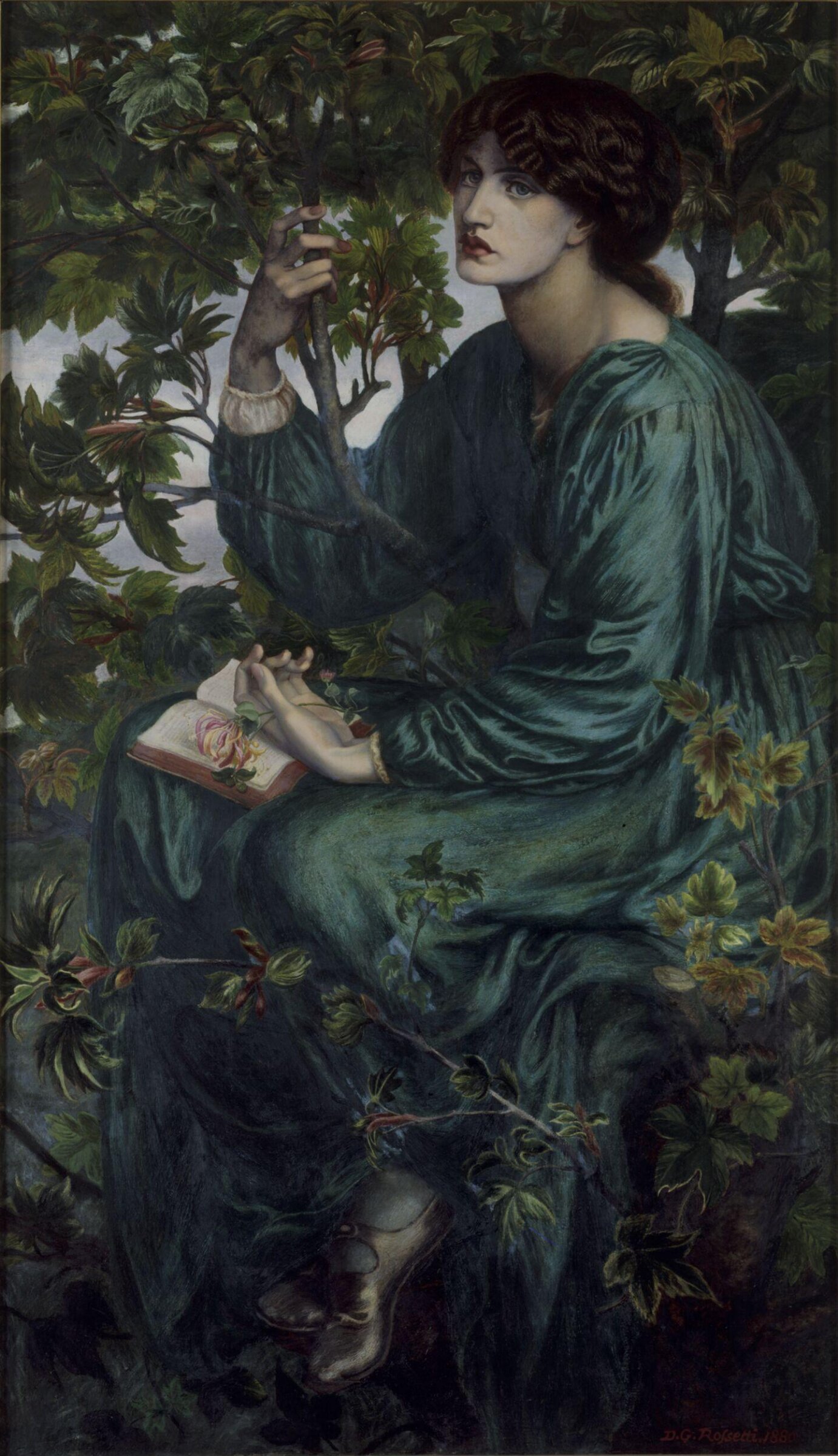
Dante Gabriel RossettiInghilterra, 1828–1882
A Christmas Carol
Si può vedere?
Non esposta al momento
Dove si trova «A Christmas Carol» oggi? Collezione: Harvard Art Museums, Cambridge. Non esposta al momento. Verificato 12 ottobre 2026.

Cambridge, Stati Uniti
Appartiene alla collezione, ma al momento non è esposta.
- Verificato
- Ultimo cambio di stato
- Fonte
- Il museo
Scheda
- Numero di inventario
- 1943.490
In catalogo
Fonti
- Harvard Art Museums
- Immagine: Harvard Art Museums — © President and Fellows of Harvard College
Nella vita di Dante Gabriel Rossetti
Tutta la vita1850s
A new watercolour and pen-and-ink technique
Translations of Italian poetry and Malory’s “Le Morte d’Arthur” inspired Rossetti’s art of the 1850s: he created a method of painting in watercolours with thick pigments mixed with gum to give rich effects like medieval illuminations, and developed a novel pen-and-ink drawing technique.
1856–1857
Meets Morris and Burne-Jones
Edward Burne-Jones and William Morris, who did not know Rossetti but were much influenced by his works, met him by recruiting him as a contributor to their Oxford and Cambridge Magazine, which Morris founded in 1856; in February 1857 Rossetti wrote that they had become very intimate friends of his and called Burne-Jones’s designs marvels of finish.
1857
The Burden sisters sit for the murals
For the Oxford Union murals Rossetti recruited two sisters, Bessie and Jane Burden, as models; Jane became Morris’s wife in 1859.
1857
Illustrations for the “Moxon Tennyson”
In 1857 Rossetti contributed two illustrations to Edward Moxon’s edition of Alfred, Lord Tennyson’s Poems; the publisher had envisioned Royal Academicians as illustrators, but once Millais became involved and recruited Hunt and Rossetti, the whole production of the book was reshaped.
c. 1860
A new course: powerful close-ups of women
Around 1860 Rossetti returned to oil painting, abandoning the dense medieval compositions of the 1850s in favour of powerful close-up images of women in flat pictorial spaces of dense colour; these drew not on medievalism but on the Venetian High Renaissance artists Titian and Veronese, and became a major influence on European Symbolism.
23 maggio 1860
Married: Elizabeth Siddal