 Hubert RobertFrance, 1733–1808
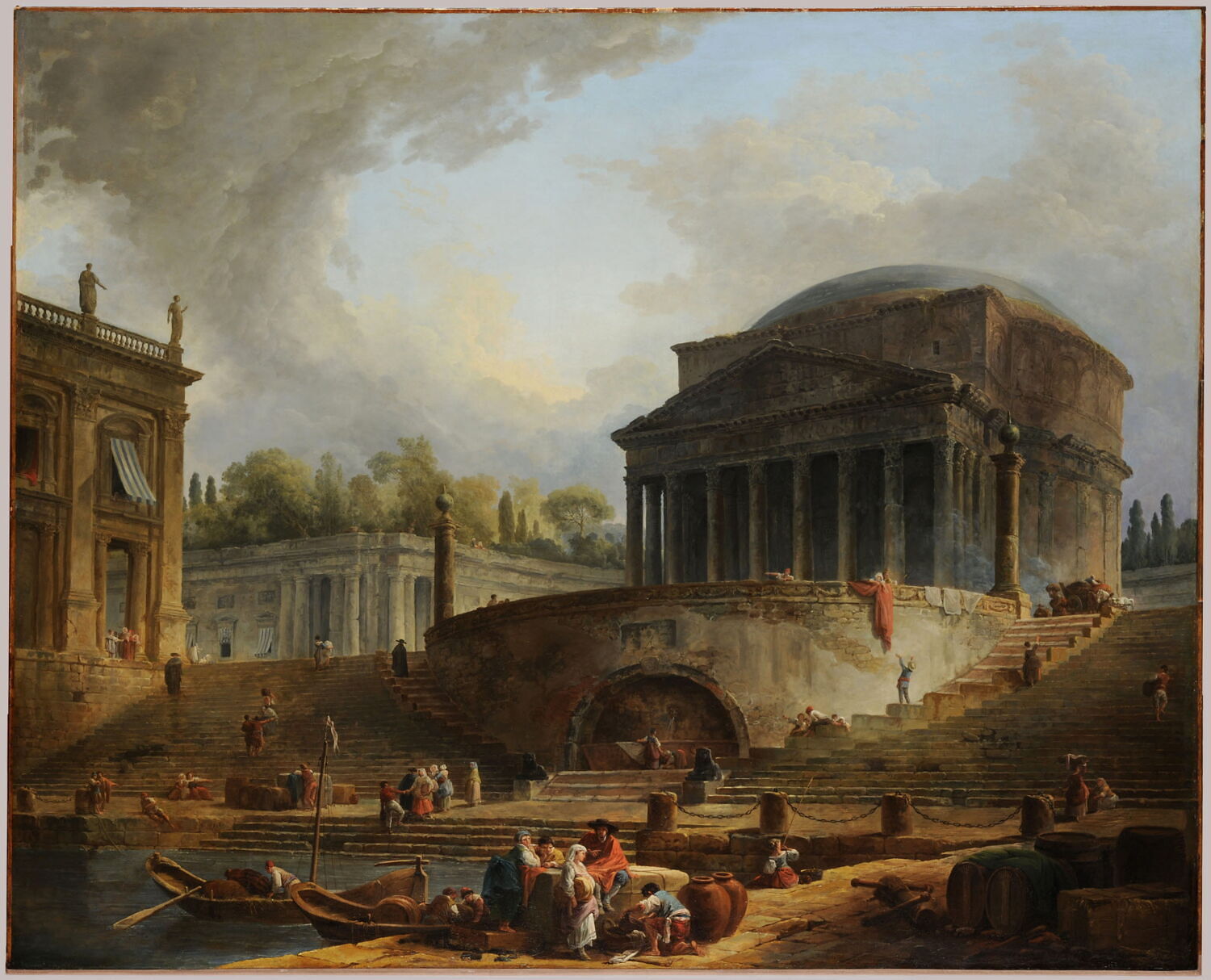
Vue du port de Ripetta, à Rome
Peut-on la voir ?
Inconnu
Où est « Vue du port de Ripetta, à Rome » aujourd’hui ? Collection: Musée du Louvre, Paris. Inconnu.

Paris, France
Le propriétaire est connu ; on ignore si l’œuvre est exposée aujourd’hui.
- Dans cet état depuis
- Source
- Le musée
À propos du tableau
A View of Ripetta is a 1766 landscape painting by the French artist Hubert Robert. A veduta, it depicts the historic Porto di Ripetta, a port that served the city of Rome. In capriccio style, it features the Pantheon immediately behind it. It was exhibited at the Salon of 1767 at the Louvre in Paris. Today it is part of the collection of the Beaux-Arts de Paris, having been acquired in 1884.
Notice
- Numéro d’inventaire
- INV 7635
Au catalogue
Sources
- Musée du Louvre
- Image : Musée du Louvre — © 2013 GrandPalaisRmn (musée du Louvre) / RMN Agence photo
Dans la vie de Hubert Robert
La vie entière1754–1765 · Lieu de travail
Rome
1754–1765
Roman circle: Panini, Piranesi, Fragonard
In Rome Robert studied perspective under the veduta master Giovanni Paolo Panini, met Piranesi, and became friends with Jean-Honoré Fragonard and the Abbé de Saint-Non; with Fragonard he drew from nature in Rome and its environs and stayed for long periods at the Villa d'Este in Tivoli.
1765
Return to Paris
After eleven years in Italy Robert returned to Paris, where his success was swift.
1766 · Adhésion
Académie royale de peinture et de sculpture
1767
Debut at the Paris Salon
Robert presented thirteen paintings and numerous drawings of ruined classical architecture at the Salon, winning critical acclaim; Diderot wrote: "The ideas that ruins awaken in me are grand." He continued to take part in the Salons regularly until 1798.