Untitled
Peut-on la contempler ?
Oui, elle reçoit

Chicago, États-Unis
Présentée au public. Qui s’en porte garant est indiqué ci-dessous.
- Vérifié
- Dans cet état depuis
- Source
- Le musée
À propos du tableau
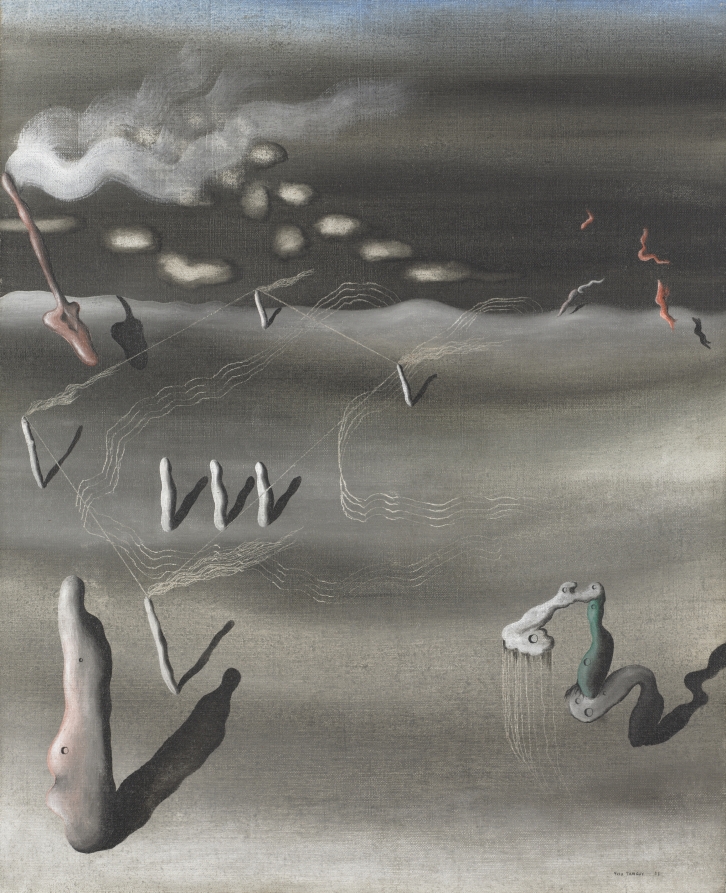
The largely self-taught Yves Tanguy decided to become an artist around 1923, when he was inspired by a painting by Giorgio de Chirico that he saw in a shop window. Tanguy became interested in Surrealism a year later, after reading the periodical La révolution surréaliste. André Breton welcomed him into the Surrealist group in 1925. Inspired by the metaphysical qualities of de Chirico’s work, as well as the biomorphic forms of Jean Arp, Max Ernst, and Joan Miró, Tanguy quickly developed his own fantastic vocabulary of organic, amoeba-like shapes that populate mysterious, dreamlike settings.
Lire la suite
Tanguy painted this primordial landscape on a hinged wooden screen. Little information exists about the circumstances of the work’s making, but the artist probably intended it for a patron’s home, since many Surrealists were interested in the decorative arts and produced folding screens, furniture, and other domestic objects. In this unusual example, although the screen retains the potential to close off the private sphere, it simultaneously opens up more intimate dreams and fantasies to the outside world.
Art Institute of ChicagoCC BY 4.0
Notice
- Numéro d’inventaire
- 1988.434a-b
Ce qu’elle montre
Au catalogue
Sources
- Art Institute of Chicago
- Image : Art Institute of Chicago — © the artist or rights holder
Pendant ce temps, chez Yves Tanguy
La vie entière1927
His first solo exhibition in Paris
Having quickly developed a style of his own, he gives his first solo exhibition in Paris.
1927
Marries Jeannette Ducrocq
Later that same year he marries Jeannette Ducrocq (1896–1977), his first wife.
c. 1927
A contract with Breton for twelve paintings a year
André Breton gives him a contract to paint twelve pieces a year. With a fixed income, Tanguy paints less and ends up creating only eight works for Breton.
3 December 1930
Right-wing activists storm a screening of “L’Âge d’Or”
Activists of the right-wing Ligue des patriotes storm the lobby of the cinema at an early screening of Buñuel and Dalí’s film “L’Âge d’Or” and destroy works by Dalí, Miró, Man Ray and other Surrealists. Tanguy’s painting “Fraud in the Garden” (1930) is among those slashed; it has since been restored.
1930s
His influence on younger Surrealist painters
His style becomes an important influence on several younger painters — Roberto Matta, Wolfgang Paalen, Toyen and Esteban Francés — who adopt a Surrealist style in the 1930s.
1930s
A bohemian life and the failure of his first marriage
Throughout the 1930s Tanguy embraces the bohemian lifestyle of the struggling artist with gusto, which eventually leads to the failure of his first marriage, to Jeannette Ducrocq.