 Albrecht DürerAllemagne, 1471–1528
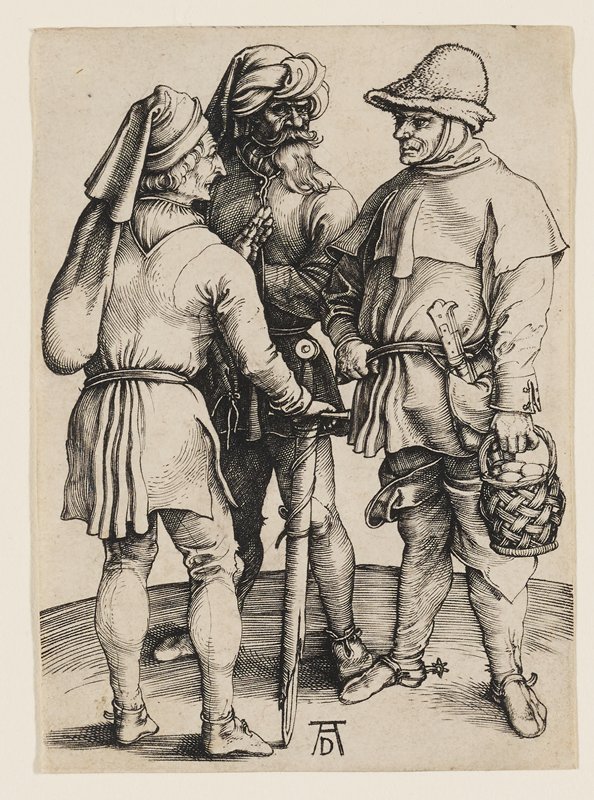
Three Men in Conversation
Peut-on la contempler ?
Elle ne reçoit pas en ce moment

Minneapolis, États-Unis
Elle appartient à la collection, mais n’est pas présentée en ce moment.
- Vérifié
- Dans cet état depuis
- Source
- Le musée
À propos de l’œuvre
Whether or not this engraving refers to contemporary peasant uprisings, as some suggest, Albrecht Dürer treats us to a little absurdity. The man on the left has a sword, prerogative of the nobility but cannot even maintain its sheath. The center man is dressed as an ordinary German peasant but has the beard an turban of a Turk. The assertive man on the right carries a basket of eggs, but his spurs suggest that he may be a knight. This may be a microcosm of the “the world turned upside down, ” a notion stemming from the same strain of thought that bought fear of witches and an impending apocalypse as the year 1500 loomed closer.
Minneapolis Institute of Art
Notice
- Numéro d’inventaire
- P.12, 253
Au catalogue
Sources
- Minneapolis Institute of Art
- Image : Minneapolis Institute of Art — public domain
Pendant ce temps, chez Albrecht Dürer
La vie entière1494–1495
First journey to Italy
Within three months of the wedding Dürer left alone for Italy, perhaps fleeing an outbreak of plague in Nuremberg. Crossing the Alps he made watercolour landscapes; in Venice he studied its art and judged Giovanni Bellini the best of its painters; Mantegna and Pollaiuolo left their mark on him.
1495
Opens his own workshop
Dürer opened his own workshop in Nuremberg, where over the next ten years he created much of his printmaking. His godfather, the publisher Anton Koberger, helped issue the first series; the city's crafts were governed by the Council rather than guilds, leaving him free to try new techniques and sell his own impressions.
1500
Jacopo de' Barbari and the secret of proportion
The Venetian Jacopo de' Barbari, whom Dürer had met in Venice, came to Nuremberg, and Dürer said he learned much from him about perspective, anatomy and proportion. Feeling that de' Barbari would not explain everything he knew, Dürer began studies of his own that became a lifelong preoccupation.
![Madonna and Child [obverse], Albrecht Dürer, c. 1496/1499](https://api.nga.gov/iiif/878db7e6-10ae-4cae-ba5d-6d6f5c413ae8/full/!2400,2400/0/default.jpg)
![Lot and His Daughters [reverse], Albrecht Dürer, c. 1496/1499](https://api.nga.gov/iiif/7565a449-f82a-414b-9bda-c93f55a51b4d/full/!2400,2400/0/default.jpg)