Édouard ManetFrance, 1832–1883
The Rue Mosnier with Flags
Peut-on la voir ?
Oui, exposée actuellement
Où est « The Rue Mosnier with Flags » aujourd’hui ? J. Paul Getty Museum, Museum West Pavilion, Gallery W204, Los Angeles. Oui, exposée actuellement. Vérifié 5 octobre 2026.
Fermé· ouvre à 10:00
Présentée au public.
- Vérifié
- Dans cet état depuis
- Source
- Le musée
À propos du tableau
To commemorate the recent Exposition Universelle, itself a celebration of luxury and prosperity, the French government declared June 30, 1878, a national holiday. The holiday, called the *Fête de la Paix* (Celebration of Peace), also marked France's recovery from the disastrous Franco-Prussian War of 1870-1871 and the bloody, divisive Paris Commune that followed. From his second-floor window, Édouard Manet captured the holiday afternoon with his most precise, staccato brushwork in a patriotic harmony of the reds, whites, and blues of the French flag that waves from the new buildings' windows. The urban street was a principal subject of Impressionist and Modernist painting; many artists aimed to show not only the transformation and growth of the Industrial Age but how it also affected society.
Lire plus
Manet's eyes saw both elegant passengers in hansom cabs and, in the foreground, a worker carrying a ladder. The hunched amputee on crutches, perhaps a war veteran or beggar, passes by fenced-in debris left from the construction of a new train track. Manet's sensitivity to the associated costs and sacrifices tempered his optimistic view of national pride and newfound prosperity.
J. Paul Getty Museum
Notice
- Numéro d’inventaire
- 89.PA.71
Au catalogue
Sources
- J. Paul Getty Museum
- Image : J. Paul Getty Museum — Open Content
Dans la vie de Édouard Manet
La vie entière1870s
Refuses to exhibit with the Impressionists
Although his own work influenced and anticipated the Impressionist style, Manet resisted involvement in Impressionist exhibitions: he did not wish to be seen as the representative of a group identity and held that modern artists should seek to exhibit at the Salon.
1874–1876
The Salon jury rejects his paintings again
In 1874 the jury rejected “Masked Ball at the Opera”, and in 1876 both paintings Manet sent. Independent exhibitions in those years brought nothing but public censure and the mockery of critics.
1879 · Résidence
8th arrondissement of Paris
1879
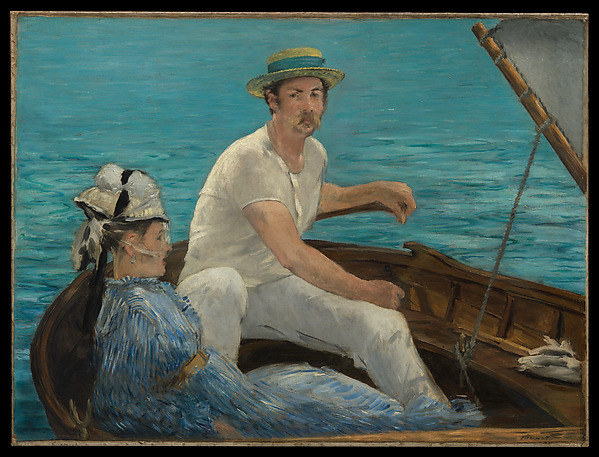
The Salon warmly receives “In the Conservatory” and “In the Boat”
Only in 1879 did the Salon appreciate Manet's perseverance: his canvases “In the Conservatory” and “In the Boat” were received very warmly.
1879
The first attack of rheumatism and ataxia
In September 1879 Manet suffered his first acute attack of rheumatism; it soon turned out that he had ataxia, a disorder of movement coordination. The illness progressed rapidly and limited his creative possibilities.
1879
“The Execution of Maximilian” first shown in New York
In December 1879 the singer Émilie Ambre and her lover Gaston de Beauplan organised in New York the first exhibition of “The Execution of Emperor Maximilian”.