L'Enfant à l'épée
Boy with a Sword
À propos du tableau
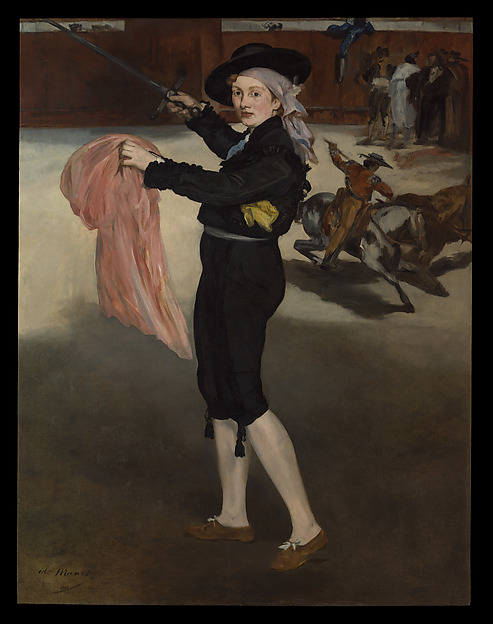
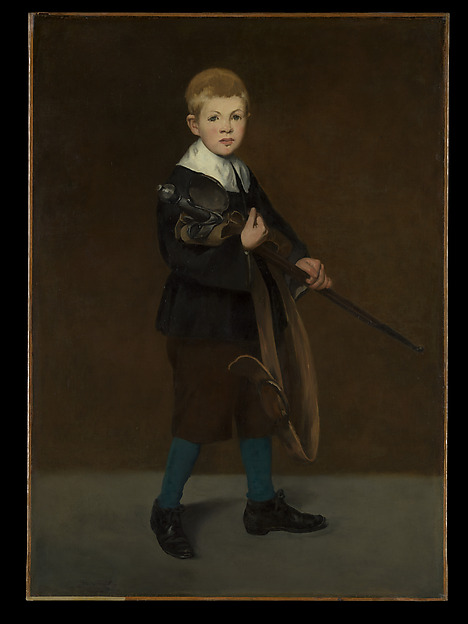
L'Enfant à l'épée est un tableau réalisé par le peintre Édouard Manet en 1861. L'œuvre représente le probable fils naturel de l'artiste, Léon Koëlla-Leenhoff, déguisé en page de la cour d'Espagne du XVIIe siècle. Léon ne fut jamais reconnu par son père. L'épée trop lourde pour l'enfant pourrait à la fois symboliser le père absent et le secret lourd à garder.
Le tableau a été réalisé dans l'atelier de la rue Guyot, aujourd'hui rue Médéric.
Typique de la période hispanisante de Manet, le tableau dénote la très forte influence que Diego Vélasquez et Frans Hals avaient sur lui à cette époque.
En 1889, L'Enfant à l'épée, en compagnie d'une autre toile de l'artiste, La Femme au perroquet, intègrent les collections du Metropolitan Museum of Art, devenant ainsi les premières œuvres de Manet à entrer dans une collection muséale.
Notice
- Numéro d’inventaire
- 89.21.2
Pendant ce temps, chez Édouard Manet
La vie entière1859
“The Absinthe Drinker” rejected; a final break with Couture
In 1859 Manet decided that his education was complete and submitted “The Absinthe Drinker” to the Salon; Couture reacted negatively and Manet finally broke with his teacher. The Salon jury rejected the painting: only Delacroix voted for it, while Couture voted against.
1861
His first participation in the Salon
In 1861 the Salon accepted two canvases by Manet: “Portrait of Monsieur and Madame Manet” and “The Spanish Singer”. Critics received the portrait coldly, while “The Spanish Singer” was admired by Théophile Gautier and, because of its popularity, hung in a more conspicuous place; the work intrigued young artists and brought new business to his studio.
1862
“Music in the Tuileries”: the fury of the public
In 1862 Manet exhibited “Music in the Tuileries” (probably painted in 1860), where the strollers include the poet Baudelaire, the musician Offenbach and the artist himself. It mostly provoked fury: the thick brushstrokes looked crude and unfinished, several visitors threatened to destroy the canvas; Delacroix defended it, and the controversy made Manet a well-known name in Paris.
1863
“The Luncheon on the Grass” at the Salon des Refusés
The Salon of 1863 rejected “The Luncheon on the Grass” (originally “Le Bain”), and Manet exhibited it at the Salon des Refusés, a parallel exhibition initiated by Napoleon III after a public outcry, the jury having accepted only 2,217 of more than 5,000 submissions. The juxtaposition of dressed men and a nude woman and the sketch-like handling caused a scandal; one critic compared the brushwork to a “floor mop”.