 Giovanni Francesco Barbieri, called GuercinoItalie, 1591–1666
Sainte Cécile
Peut-on la contempler ?
Inconnu

Musée du Louvre
Paris, France
Le propriétaire est connu ; on ignore si l’œuvre est exposée aujourd’hui.
- Dans cet état depuis
- Source
- Le musée
À propos du tableau
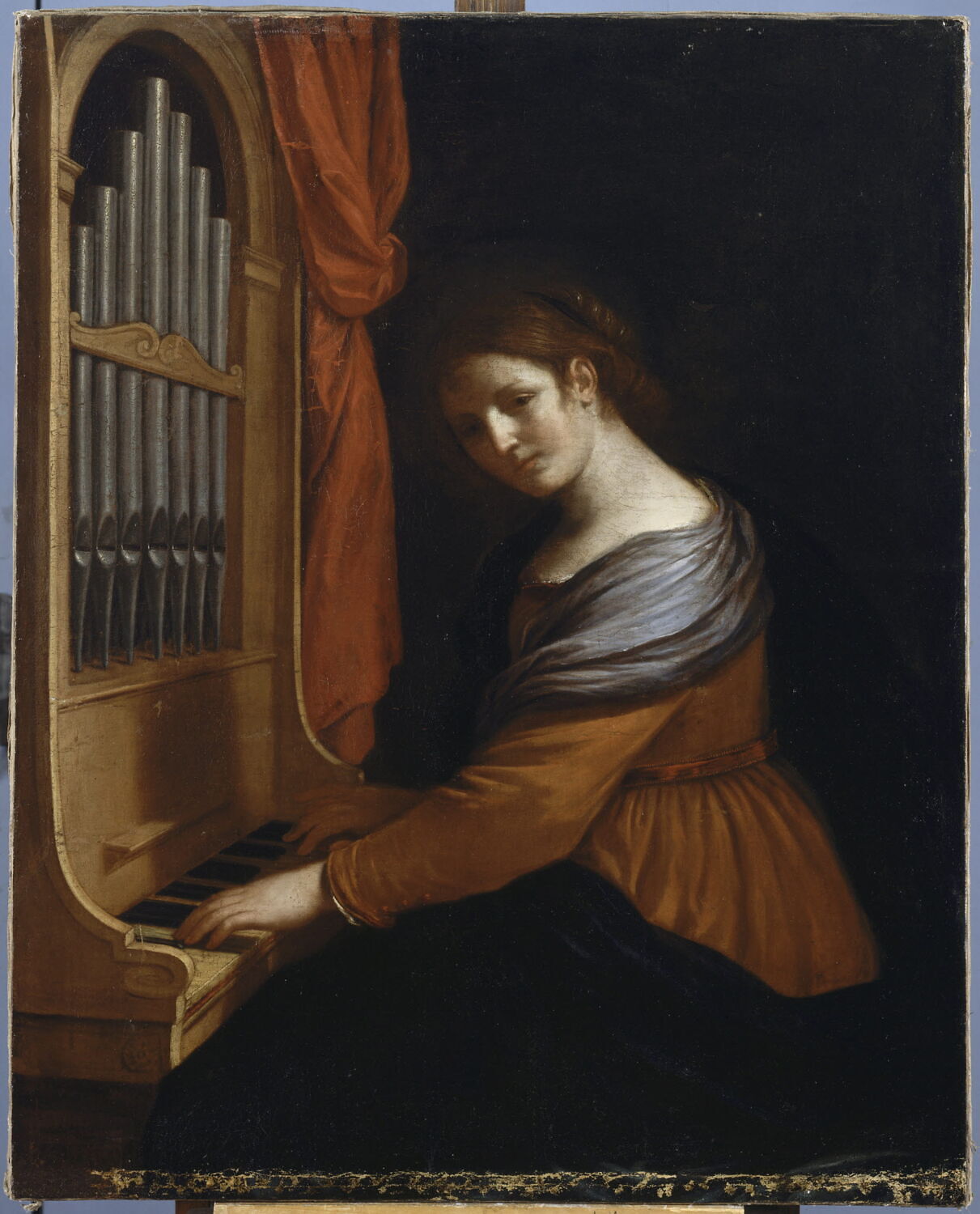
Sainte Cécile est un tableau réalisé vers 1642 par le peintre italien Le Guerchin. De format vertical, cette huile sur toile est une peinture chrétienne qui représente Cécile de Rome jouant de l'orgue devant un fond noir.
Vêtue d'orange et de gris, la jeune femme y figure assise à son instrument, que borde une tenture rouge. Les mains sur le clavier, elle a la tête tournée vers sa gauche pour porter le regard vers le point de vue de l'observateur.
Passée par l'hôtel particulier de Louis Ier Phélypeaux de La Vrillière à Paris, l'œuvre est saisie à la Révolution française. Partie des collections du musée du Louvre, elle se trouve depuis 1995 en dépôt au musée de la Musique. Une autre peinture de l'artiste montrant la sainte davantage absorbée par la musique qu'elle joue fait partie des collections de la Dulwich Picture Gallery, à Londres, au Royaume-Uni.
Notice
- Numéro d’inventaire
- INV 89
Au catalogue
Sources
- Musée du Louvre
- Image : Musée du Louvre — © 1990 GrandPalaisRmn (musée du Louvre) / Photographe inconnu
Pendant ce temps, chez Giovanni Francesco Barbieri, called Guercino
La vie entière1621
Moves to Rome, to the court of Gregory XV
Marchese Enzo Bentivoglio recommended Guercino to the newly elected Pope Gregory XV, the Bolognese Alessandro Ludovisi. His Roman years (1621–1623) were the most productive of his life; the portrait of the pope (now in the Getty Museum) dates from them.
1623
Returns to his native Cento
After the death of Pope Gregory XV, Guercino left Rome and returned to his hometown.
1623
Ottavio Leoni draws his portrait
The portrait emphasises the permanent squint that gave the artist his nickname. Guercino's right eye was apparently 'lazy' and he presumably had monocular vision — which did not stop him conveying depth remarkably well.
1629
The Barbieri household account book begins
From this year Guercino's affairs are recorded in the Libro dei Conti di Casa Barbieri, kept up with his brother Paolo Antonio, a notable still-life painter; the book survives. He worked with extreme rapidity — no fewer than 106 large altarpieces and some 144 other paintings, besides a great many drawings.
1642
Moves to Bologna after Guido Reni's death
After the death of his commercial rival Guido Reni, Guercino moved his busy workshop to Bologna and took over Reni's role as the city's leading painter of sacred subjects. He painted and taught to the end of his life, amassed a notable fortune and, never having married, left it to his nephews and pupils Benedetto Gennari II and Cesare Gennari.
22 décembre 1666
Died