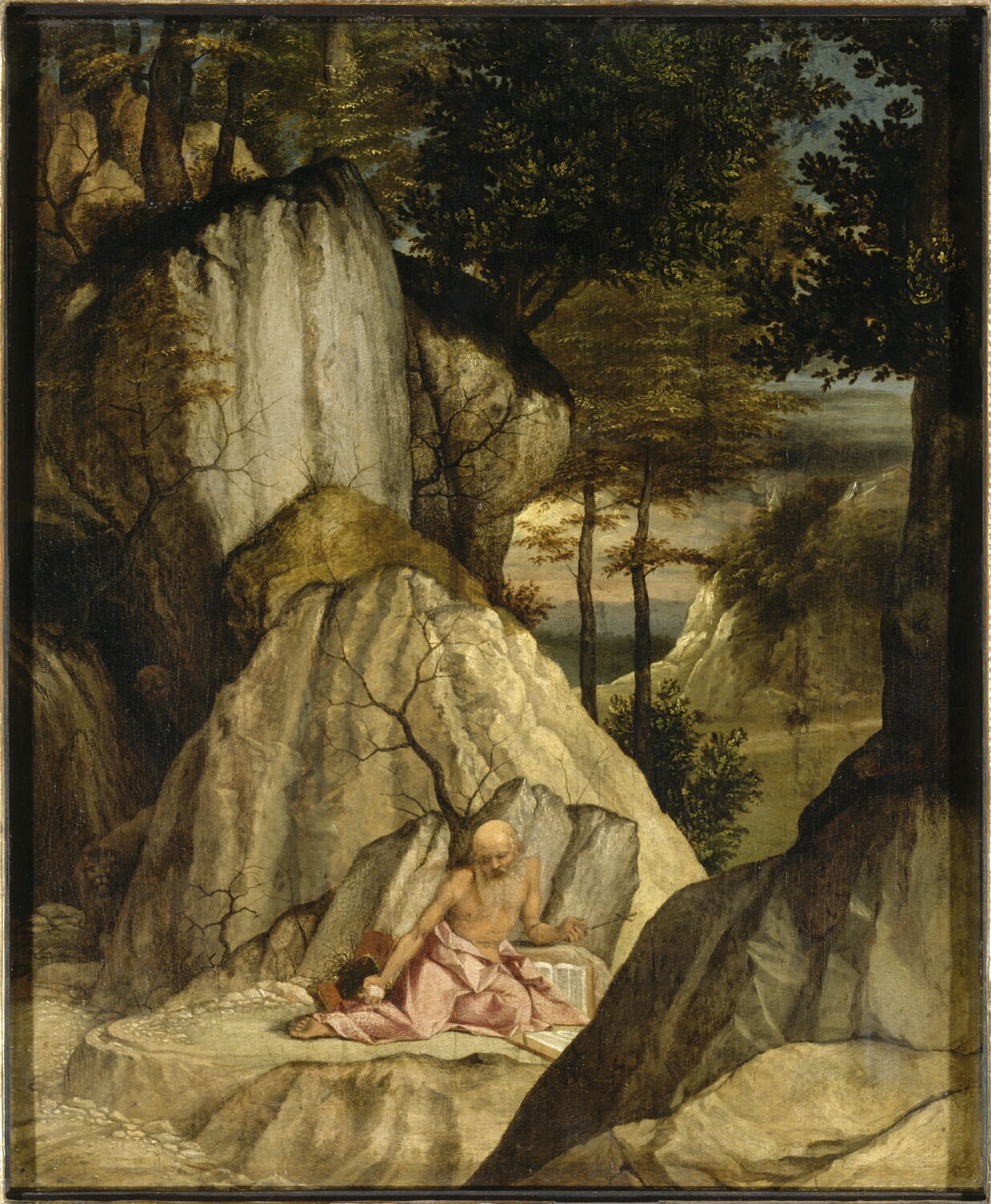
 Lorenzo LottoItalie, 1480–1556
Saint Jérôme pénitent
Peut-on la voir ?
Oui, exposée actuellement
Où est « Saint Jérôme pénitent » aujourd’hui ? Musée du Louvre, Salle 710, Aile Denon, Niveau 1, Paris. Oui, exposée actuellement. Vérifié 26 septembre 2026.

Fermé· ouvre à 9:00
Présentée au public.
- Vérifié
- Dans cet état depuis
- Source
- Le musée
À propos du tableau
Saint Jérôme pénitent est une peinture à l'huile sur bois de 48 × 40 cm réalisée par Lorenzo Lotto, datée d'environ 1506, qui est conservée au musée du Louvre de Paris. L'œuvre est signée (Lotus) et datée, mais le dernier chiffre (150.) est illisible.
Notice
- Numéro d’inventaire
- MI 164
Au catalogue
Sources
- Musée du Louvre
- Image : Musée du Louvre — © 1999 GrandPalaisRmn (musée du Louvre) / Gérard Blot
Dans la vie de Lorenzo Lotto
La vie entière1503
Leaves Venice for Treviso
The young Lotto left Venice, where he would have had to compete with Giorgione, Palma the Elder (Vasari calls Lotto his friend) and Titian, and moved to prosperous Treviso (he is first recorded there as a painter in 1503–1504). Little is known of his training: Bellini's influence is clear, but Bellini was not his teacher; an apprenticeship with Alvise Vivarini is possible.
1506
Invited to Recanati by the Dominicans
Within a few years Lotto had made a considerable name, and the Dominican friars invited him to Recanati in the Marche. He would keep his ties with the order to the end of his days.
1508–1510
Summoned to Rome to decorate the papal apartments
Lotto caught the eye of the papal architect Bramante, who was passing through Loreto, and was invited to Rome to decorate the papal apartments in the Vatican; he worked there with Sodoma and Bramantino, wars in the north kept him from going home, and by other accounts he stayed in Rome in 1509–1512. The paintings were soon destroyed; some accounts say it was to make room for Raphael, others that it was possibly because of Lotto's imitation of Raphael.
18 October 1511
A contract with the Confraternity of the Buon Gesù in Jesi
Lotto undertook to paint a “Deposition” for the church of San Floriano (now in the Jesi art gallery) — it is from this contract that his return to the Marche is known. Judging by his later paintings, he had also been to Perugia and Florence and seen the work of Perugino and Raphael.
1513
Wins a competition and moves to Bergamo
In a competition of sorts among painters, the Dominicans of Bergamo chose Lotto for the high altarpiece of their church of Santi Bartolomeo e Stefano. So began the calmest and most fruitful years of his life: commissions came from wealthy merchants, educated professionals and local aristocrats, and he developed the psychological portrait that reveals the sitter's thoughts and emotions.
1525
Back in Venice, and a quarrel with Fra Damiano
In Venice Lotto first lodged at the Dominican monastery of Santi Giovanni e Paolo but was forced to leave after a few months following a conflict with the intarsia artist Fra Damiano da Bergamo; to cope with his commissions he set up a workshop. Other accounts extend his Bergamo period to 1526.