 Anthony van DyckFlandre, 1599–1641
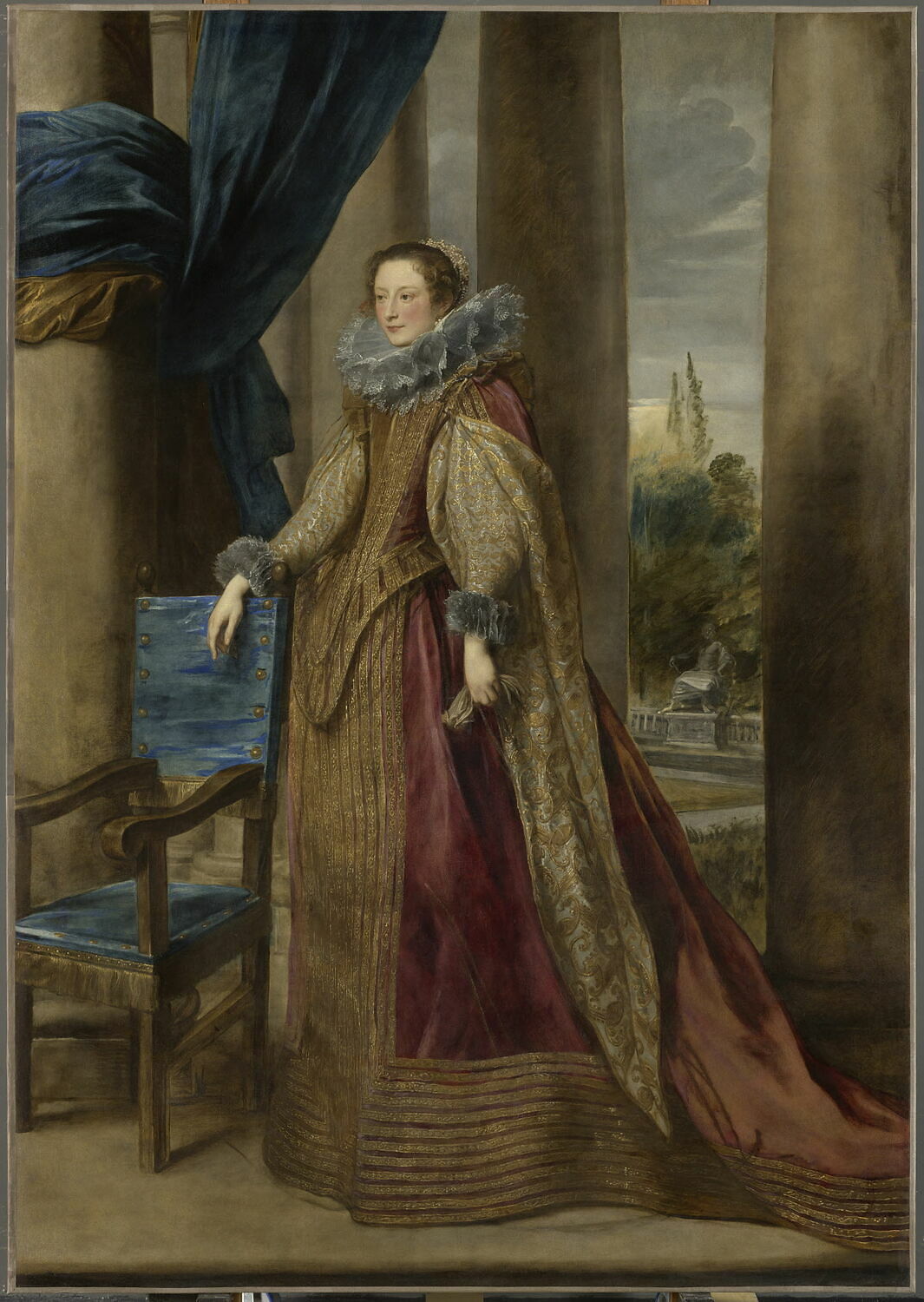
Portrait d'une noble génoise
Peut-on la contempler ?
Oui, elle reçoit

Présentée au public. Qui s’en porte garant est indiqué ci-dessous.
- Vérifié
- Dans cet état depuis
- Source
- Le musée
Notice
- Numéro d’inventaire
- RF 1949 36
Au catalogue
Sources
- Musée du Louvre
- Image : Musée du Louvre — © 2019 GrandPalaisRmn (musée du Louvre) / Mathieu Rabeau
Pendant ce temps, chez Anthony van Dyck
La vie entière1624
Quarantine During the Plague in Palermo
In Palermo Van Dyck found himself in quarantine during the plague of 1624, one of the most severe in Sicily's history; there he created an important series of paintings of Saint Rosalia, the city's patroness, establishing her iconography for the Italian Baroque.
1624
Invitation to Palermo
In April 1624 Emmanuel Philibert of Savoy, Viceroy of Sicily, invited Van Dyck to Palermo to paint his portrait.
1625
Guest of Peiresc in Provence
In 1625 Van Dyck was briefly the guest of the humanist Nicolas-Claude Fabri de Peiresc in Provence.
1626–1632
The Iconography Print Series
After returning to Antwerp, Van Dyck conceived a large series of engraved portraits of his contemporaries, the Iconography; he etched eighteen plates himself, executing the preparatory drawings mainly between 1626 and 1633. The first edition (80 plates) appeared in Antwerp in 1632.
1627
Return to Antwerp
In 1627 Van Dyck returned from Italy to Antwerp, where he remained for five years, creating portraits of the Flemish nobility and large altarpieces, and beginning to work in printmaking.
1629
Beginning of His Relationship with Charles I
Van Dyck's relationship with Charles I began in 1629: through the intermediary Sir Endymion Porter, the king acquired his painting Rinaldo and Armida.