 Édouard ManetFrance, 1832–1883
Olympia
Peut-on la contempler ?
Elle ne reçoit pas en ce moment

Cleveland Museum of Art
Cleveland, États-Unis
Elle appartient à la collection, mais n’est pas présentée en ce moment.
- Vérifié
- Dans cet état depuis
- Source
- Les données de collection du musée lui-même
À propos de l’œuvre
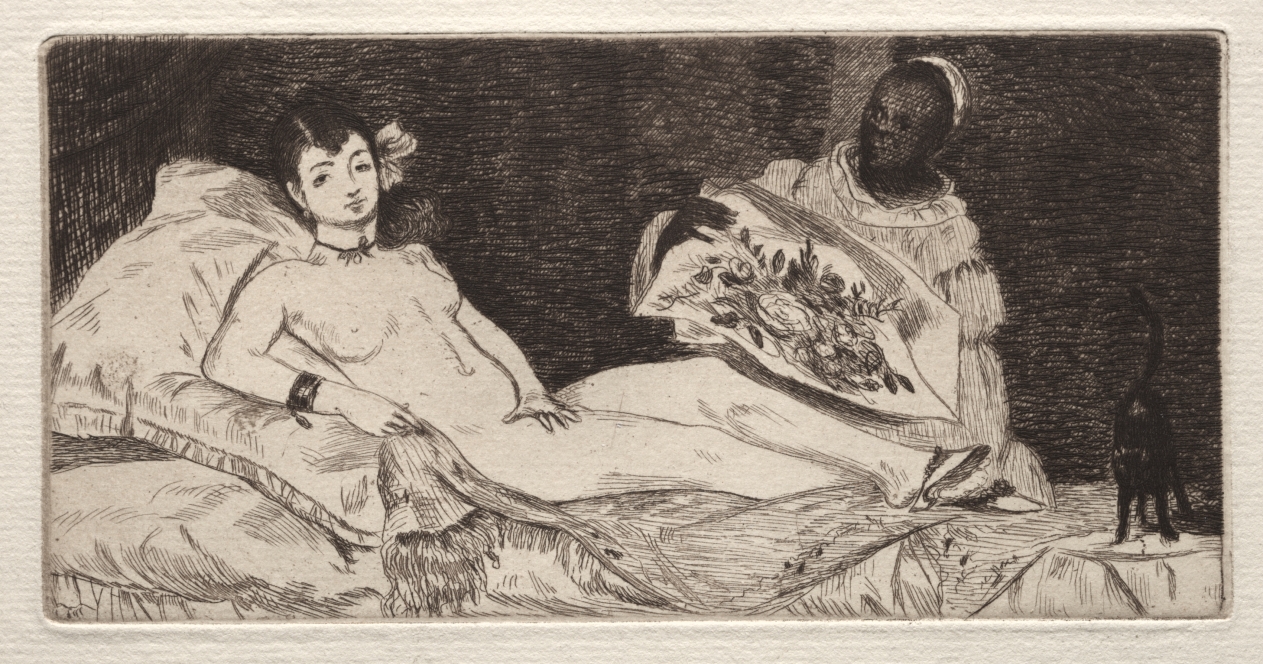
When Edouard Manet’s painting Olympia was exhibited in Paris in 1865, it was met by the critics and general public with jeers, laughter, criticism, and distain. Manet had depicted his model, Victorine Meurent, as a modern day courtesan, confrontational rather than seductive. Manet’s depiction of a prostitute’s body in a contemporary setting was a radical rejection of the idealized beauty of the traditional female nude. Olympia forced recognition of troubled and contradictory attitudes toward prostitution in the mid-19th century, much to the discomfort of contemporary audiences. The artist made this etching to reproduce his controversial painting.
Cleveland Museum of Art
Notice
- Numéro d’inventaire
- 1922.186
Au catalogue
Sources
- Cleveland Museum of Art: the museum's own open data · obtenue il y a 7 jours
- Image : Cleveland Museum of Art — Museum open access
Pendant ce temps, chez Édouard Manet
La vie entière1865
“Olympia” at the Salon: a scandal
In 1865 the Salon accepted “Olympia”, and the frank depiction of a self-assured prostitute created a scandal; according to Antonin Proust, only the precautions taken by the administration prevented the painting from being punctured and torn. The popular press caricatured it, while the avant-garde, including Courbet, Cézanne and Monet, championed it.
after 1865
Café Guerbois and the Batignolles group
After returning from Spain Manet became a regular at the Café Guerbois in the Batignolles quarter, where Fantin-Latour, Whistler, Duranty, Degas, Renoir, Monet and Pissarro gathered, with Émile Zola as Manet's ardent defender. After harsh reproaches from Duranty, Manet challenged him to a duel and wounded him, but they made up and remained good friends until Manet's death.
1865
Flight to Spain: El Greco, Velázquez, Goya
The persecution after “Olympia” forced Manet to flee, almost literally, to Spain, where he spent his time to good purpose, getting to know the works of El Greco, Velázquez and Goya and finding in them a justification of his own aesthetic taste.
1867
His own pavilion near the Pont de l'Alma
In 1867, during the World's Fair in Paris, Manet set up his own pavilion near the Pont de l'Alma and showed fifty of his best works of the past ten years. Possibly this step led to his works being accepted at the next two Salons.
1867
Zola defends Manet in print
In 1867 Émile Zola, who supported Manet publicly in the press, wrote that the public was not accustomed to such simple and direct translations of reality and that this luminous and serious painting interprets nature with a gentle brutality.
1868
Friendship with Berthe Morisot
In 1868 Manet became a friend and colleague of Berthe Morisot; she is credited with convincing him to attempt plein air painting, to which Camille Corot had introduced her. Through Morisot, Manet became friends with Degas, Monet, Renoir, Sisley, Cézanne and Pissarro.