
 Frederic Edwin ChurchÉtats-Unis, 1826–1900
Niagara
Peut-on la contempler ?
Oui, elle reçoit

Présentée au public. Qui s’en porte garant est indiqué ci-dessous.
- Vérifié
- avant-hier
- Dans cet état depuis
- 29 sept. 2026
- Source
- Les données de collection du musée lui-même
About the painting
Niagara est une peinture à l'huile sur toile réalisée en 1857 par l'artiste américain Frederic Edwin Church (1826-1900). Tableau le plus important de l'artiste, il a confirmé sa réputation de meilleur peintre paysagiste américain de l'époque. Dans son histoire des chutes du Niagara, Pierre Berton écrit: « Parmi les centaines de peintures faites de Niagara, avant Church et après lui, celle-ci est, d'un commun accord, la meilleure. »
Notice
- Numéro d’inventaire
- 2014.79.10
What it shows
Au catalogue
Allées et venues
Exposée · Salle 71 · Bâtiment ouest, étage principal
National Gallery of Art · 29 sept. 2026 — aujourd’hui · Vérifié
Exposée · Salle 72 · Bâtiment ouest, étage principal
National Gallery of Art · 19 août 2026 — 29 sept. 2026 · Vérifié
Sources
- National Gallery of Art: the museum's own open data · obtenue il y a 6 jours
- Image : National Gallery of Art — Museum open access
Pendant ce temps, chez Frederic Edwin Church
La vie entière1854–1856
Canada, New England and Mount Desert Island
Church travelled in Canada and New England; like Cole, he was among the first city dwellers to summer on Mount Desert Island in Maine, now Acadia National Park.
1857
Second South American journey, with Louis Rémy Mignot
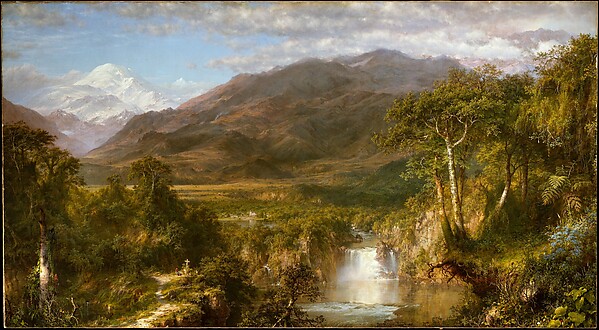
Church returned to South America with the painter Louis Rémy Mignot and added to his sketches; the two journeys produced “The Andes of Ecuador”, “Cayambe”, “The Heart of the Andes” and “Cotopaxi”.
1859
A one-picture show: “The Heart of the Andes” in New York
Thousands paid to see the canvas: its huge floor-standing frame served as a window onto the Andes, visitors sat on benches and studied the details through opera glasses, and Church arranged the room so that light from the skylights fell on the picture. It was an instant success; at this exhibition Church met his future wife, Isabel Carnes.
1859
To the icebergs: Newfoundland and Labrador
His friendship with the Arctic explorer Isaac Israel Hayes stirred Church’s interest in the far north, and with his friend the Rev. Louis Legrand Noble he travelled to Newfoundland and Labrador. Noble chronicled the trip in “After Icebergs with a Painter” (1861), published shortly before “The Icebergs” went on display.



![Ginevra de' Benci [obverse], Leonardo da Vinci, c. 1474/1478](https://api.nga.gov/iiif/8f29e3c9-a289-4d53-abf0-31a66e9e98fa/full/!2400,2400/0/default.jpg)
![Wreath of Laurel, Palm, and Juniper with a Scroll inscribed Virtutem Forma Decorat [reverse], Leonardo da Vinci, c. 1474/1478](https://api.nga.gov/iiif/ff62e8d0-45c4-498f-ad36-6358de827e04/full/!2400,2400/0/default.jpg)


