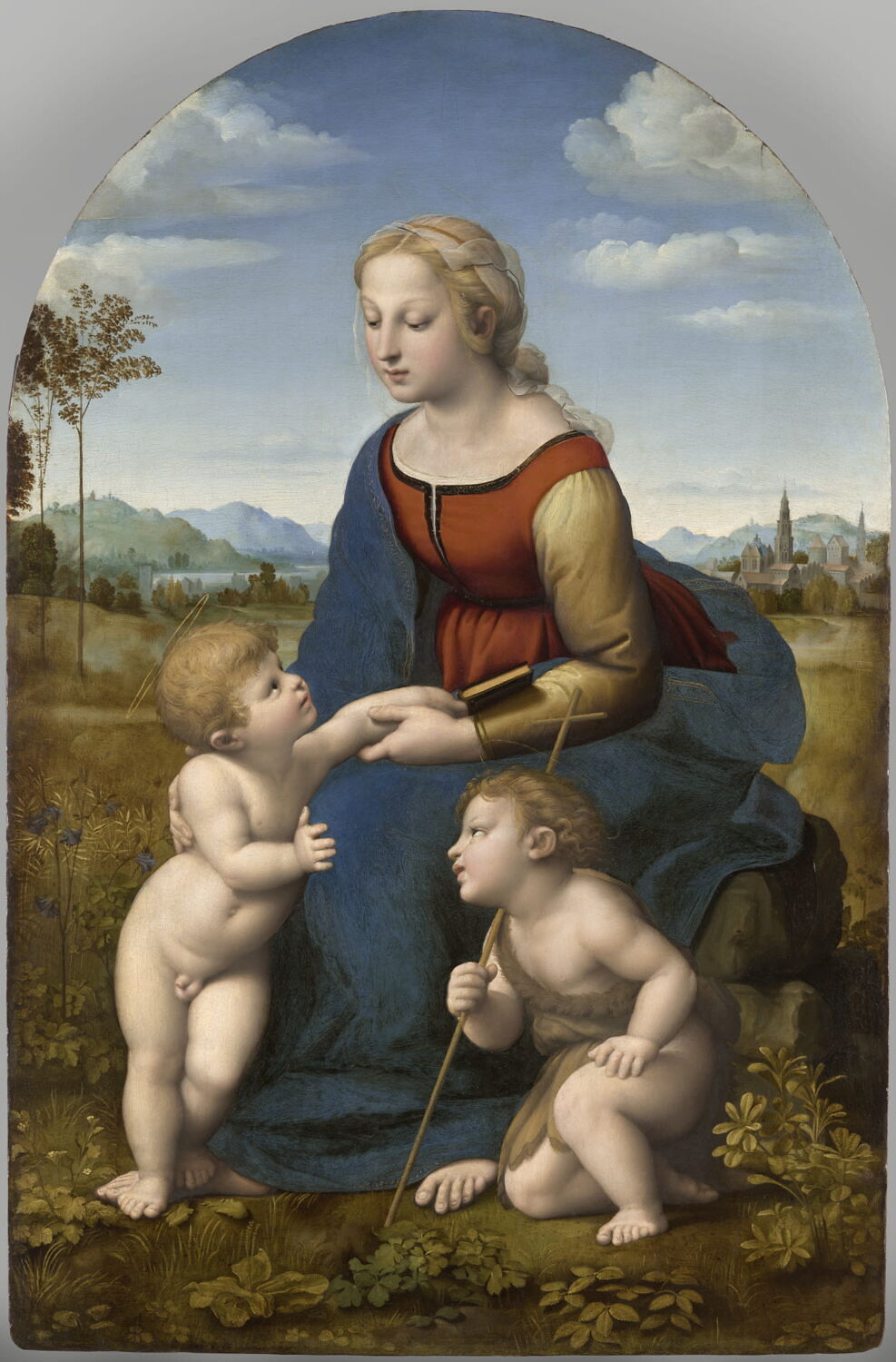
RaphaelItalie, 1483–1520
La Vierge à l'Enfant et saint Joseph
Madonna with Beardless Saint Joseph
Peut-on la voir ?
Oui, exposée actuellement
Où est « La Vierge à l'Enfant et saint Joseph » aujourd’hui ? Musée de l'Ermitage, Salle 229, Saint-Pétersbourg. Oui, exposée actuellement. Vérifié 29 août 2026.

Saint-Pétersbourg, Russie
Fermé· ouvre demain à 12:00
Présentée au public.
- Vérifié
- Dans cet état depuis
- Source
- Le musée
À propos du tableau
La Vierge à l'Enfant et Saint Joseph ou La Vierge à l'Enfant et Saint Joseph glabre est une peinture religieuse de Raphaël (dimensions: 73 × 57 cm). Le tableau est actuellement conservé au musée de l'Ermitage, à Saint-Pétersbourg
Selon le musée — en russe
Рафаэль написал «Святое семейство» во время своего пребывания во Флоренции, возможно, для правителя Урбино Гуидабальдо да Монтефельтро. Пронизанное настроением возвышенной печали, полотно чуждо всему прозаическому и обыденному, что, однако, не лишает героев ощущения естественности. Плавные линии, гармоничное цветовое сочетание и компактная композиция создают ощущение монументальности и величия. Мягкая светотень, моделирующая формы, свидетельствует о влиянии на молодого художника Леонардо да Винчи.
Musée de l'Ermitage
Notice
- Numéro d’inventaire
- ГЭ-91
Au catalogue
Sources
- Musée de l'Ermitage
- Image : Musée de l'Ermitage — Museum open access
Dans la vie de Raphael
La vie entièrec. 1503 – c. 1504 · Lieu de travail
Siena
late 1504
Meets Leonardo and Michelangelo
Having moved to Florence, Raphael met Leonardo da Vinci, Michelangelo and Bartolomeo della Porta and closely studied Leonardo's sfumato. His first Florentine commission, portraits of Agnolo Doni and his wife, was painted under the clear impression of the “Mona Lisa”.
1504
Friendship with Baldassare Castiglione
In Urbino Raphael met the philosopher, writer and patron Count Baldassare Castiglione; they formed a firm friendship and correspondence, including the famous letters about the fresco “The Triumph of Galatea”.
1504
To Florence, to study
The mother of the next Duke of Urbino gave Raphael a letter of recommendation to the Gonfaloniere of Florence: “The bearer of this will be found to be Raphael, painter of Urbino, who, being greatly gifted in his profession has determined to spend some time in Florence to study.” She called him “a sensible and well-mannered young man”.
1507
Meets Donato Bramante
Raphael met the architect Donato Bramante, by an unproven account his relative. Bramante became his adviser and patron and later recommended him to Pope Julius II as the best candidate for work in the Vatican.
1508
Moves to Rome at the invitation of Julius II
The new pope, Julius II, invited Raphael to Rome, perhaps at the suggestion of his architect Bramante, a distant relative of the artist. Unlike Michelangelo, kept waiting for months after his summons, Raphael was immediately commissioned to fresco what was to become the pope's private library, a far larger commission than any he had had before.