 RaphaelItalie, 1483–1520
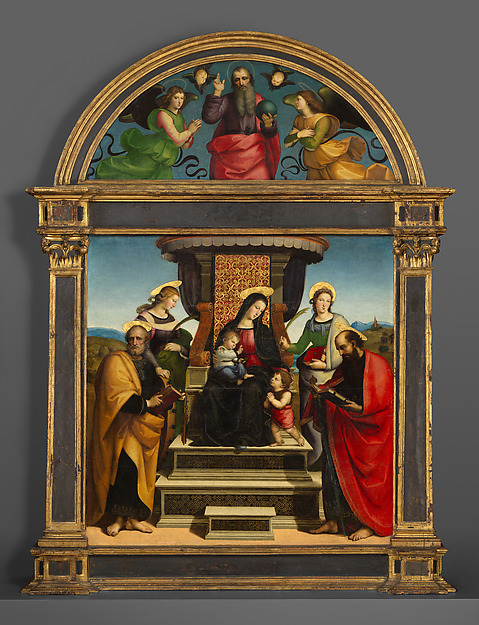
Retable Colonna
Madonna and Child Enthroned with Saints
Peut-on la voir ?
Oui, exposée actuellement
Où est « Retable Colonna » aujourd’hui ? Metropolitan Museum of Art, Salle 609, New York. Oui, exposée actuellement. Vérifié 29 septembre 2026.

New York, États-Unis
Fermé· ouvre demain à 10:00
Présentée au public.
- Vérifié
- Dans cet état depuis
- Source
- Le musée
À propos du tableau
Le Retable Colonna ou encore Vierge à l'Enfant trônant avec saints est une peinture religieuse attribuée à Raphaël dont les principaux éléments sont conservés au Metropolitan Museum of Art.
Notice
- Numéro d’inventaire
- 16.30ab
Ce qu’elle montre
Au catalogue
Sources
- Metropolitan Museum of Art
- Image : Metropolitan Museum of Art — Open Access (CC0)
Dans la vie de Raphael
La vie entièrec. 1501 – c. 1502 · Lieu de travail
Perugia
1502
To Siena at Pinturicchio's invitation
Another pupil of Perugino, Pinturicchio, “being a friend of Raphael and knowing him to be a draughtsman of the highest quality”, invited him to Siena to help with the cartoons, and very likely the designs, for the frescoes of the Piccolomini Library in Siena Cathedral.
c. 1503 – c. 1504 · Lieu de travail
Siena
late 1504
Meets Leonardo and Michelangelo
Having moved to Florence, Raphael met Leonardo da Vinci, Michelangelo and Bartolomeo della Porta and closely studied Leonardo's sfumato. His first Florentine commission, portraits of Agnolo Doni and his wife, was painted under the clear impression of the “Mona Lisa”.
1504
Friendship with Baldassare Castiglione
In Urbino Raphael met the philosopher, writer and patron Count Baldassare Castiglione; they formed a firm friendship and correspondence, including the famous letters about the fresco “The Triumph of Galatea”.
1504
To Florence, to study
The mother of the next Duke of Urbino gave Raphael a letter of recommendation to the Gonfaloniere of Florence: “The bearer of this will be found to be Raphael, painter of Urbino, who, being greatly gifted in his profession has determined to spend some time in Florence to study.” She called him “a sensible and well-mannered young man”.