Henri Edmond CrossFrance, 1856–1910
Les Îles d'Or
Peut-on la voir ?
Inconnu
Où est « Les Îles d'Or » aujourd’hui ? Collection: Musée d'Orsay, Paris. Inconnu.

Paris, France
Le propriétaire est connu ; on ignore si l’œuvre est exposée aujourd’hui.
- Dans cet état depuis
- Source
- Le musée
À propos du tableau
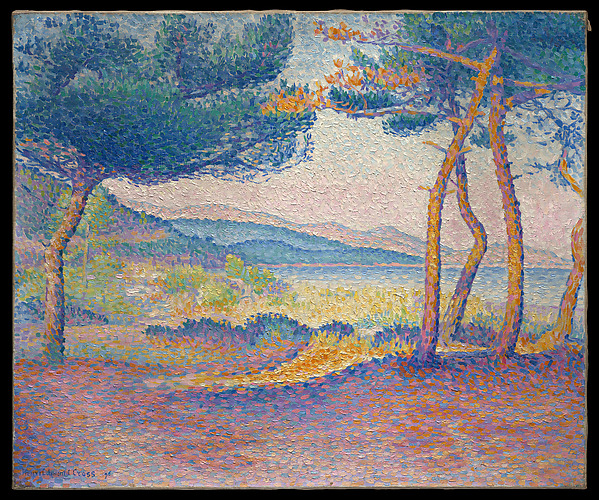
Les Îles d'Or est un tableau réalisé par le peintre français Henri-Edmond Cross entre 1891 et 1892. D'un format vertical presque carré, cette huile sur toile est une marine néo-impressionniste qui représente la mer Méditerranée depuis une plage de sable, avec à l'horizon les îles d'Hyères, à Hyères, dans le Var. L'œuvre rejoint les collections publiques en 1947, lorsqu'elle est acquise par le musée national d'Art moderne, à Paris, à l'occasion de la vente de la collection privée de Félix Fénéon. Elle est affectée depuis 1977 au musée d'Orsay.
Notice
- Numéro d’inventaire
- RF 1977 126
Au catalogue
Sources
- Wikidata
- Image : Musée d'Orsay — Henri-Edmond Cross · Public domain · Wikimedia Commons
Dans la vie de Henri Edmond Cross
La vie entièreearly 1880s
Trouble with his eyes begins
In the early 1880s he begins to have trouble with his eyes, which grows severe by the 1900s; he also suffers increasingly from arthritis. Partly because of these long-running illnesses, Cross’s body of work is relatively small.
1891
Turns to Neo-Impressionism
In 1891 he begins painting in the Neo-Impressionist style and shows his first large piece in this technique at an Indépendants exhibition — a divisionist portrait of Madame Hector France, née Irma Clare.
1891
Moves to the south of France because of rheumatism
Having wintered in the south for years, he moves there for good in 1891 because of rheumatism. He lives first in Cabasson near Le Lavandou, then settles nearby in the small hamlet of Saint-Clair, where he stays for the rest of his life, leaving only for Italy and for the annual Indépendants exhibitions in Paris.
1893
Married: Irma Clare
c. 1895
Moves from Pointillism to a mosaic-like brushstroke
From about 1895 he gradually changes his technique: instead of tiny dots, broad blocky brushstrokes with small areas of bare canvas left between them. The surfaces resemble mosaics, and such paintings are seen as precursors of Fauvism and Cubism.
1898
The first Neo-Impressionist exhibition in Germany
In 1898, together with Signac, Maximilien Luce and Théo van Rysselberghe, he takes part in the first Neo-Impressionist exhibition in Germany, organized by Harry Kessler at the Keller und Reiner Gallery.