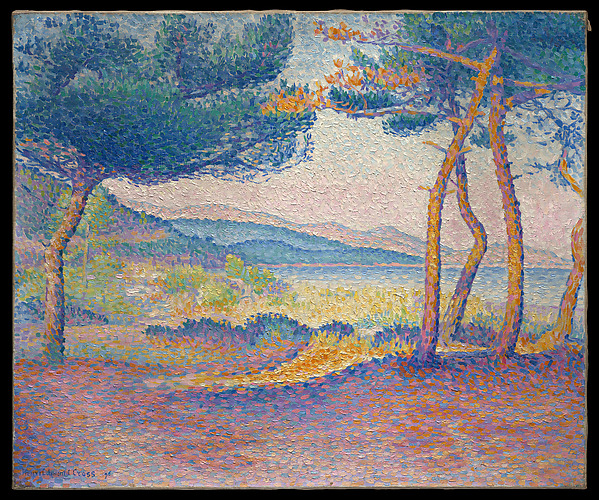
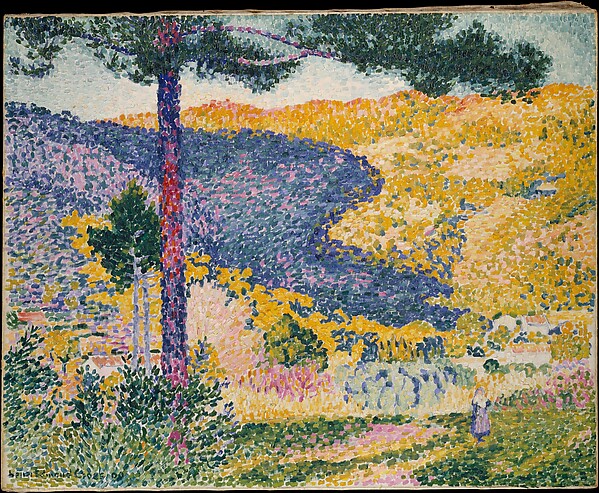
Henri Edmond CrossFrance, 1856–1910
Sketchbook
Peut-on la voir ?
Oui, exposée actuellement
Où est « Sketchbook » aujourd’hui ? Musées d'Art de Harvard, Gallery 3500, floor 3, Special Exhibitions Gallery, Cambridge. Oui, exposée actuellement. Vérifié 29 septembre 2026.

Présentée au public.
- Vérifié
- Dans cet état depuis
- Source
- Le musée
À propos de l’œuvre
The sketchbook came to the Fogg Art Museum as a loose collection of folded pages, with no cover. The consistency of the paper and the media indicates that the sheets were all part of the same sketchbook. The pages were originally sewn together, but there no longer are threads in the sewing holes. The sketchbook was catalogued as if it were bound, with numbers assigned to each page. The present order of the pages, divided into two signatures, was determined by close examination in the Fogg's paper conservation lab, taking into account the size and edges of the sheets, the position and size of the sewing holes, and the offsetting of media onto adjacent pages.
Lire plus
The first signature is 1964.15.1-14 and is made out of six pieces of paper folded together and two loose sheets half the size of the other sheets. After examination, the two half-sized sheets were inserted as pages 6 and 7. The second signature is 1964.15.15-22 and is made out of four pieces of paper folded together. Both signatures have pages with some of the upper edges trimmed, some not. One single sheet might be trimmed at the top and bottom, at one edge, or not at all.
Page 15 contains the watermark A. Lepage Ainé Tochon-Lepage Succr.
Musées d'Art de Harvard
Notice
- Numéro d’inventaire
- 1964.15
Au catalogue
Sources
- Musées d'Art de Harvard
- Image : Musées d'Art de Harvard — © President and Fellows of Harvard College
Dans la vie de Henri Edmond Cross
La vie entière1890s
Meets Fénéon, Gide and Verhaeren
In the 1890s he works alongside Signac and gets to know the writers and critics Félix Fénéon, André Gide and Emile Verhaeren.
c. 1895
Moves from Pointillism to a mosaic-like brushstroke
From about 1895 he gradually changes his technique: instead of tiny dots, broad blocky brushstrokes with small areas of bare canvas left between them. The surfaces resemble mosaics, and such paintings are seen as precursors of Fauvism and Cubism.
1895
Shows at La Libre Esthétique at Maus’s invitation
Octave Maus, who had earlier invited him to the annual exhibitions of Les XX, invites him to the Libre Esthétique show; Cross takes part again in 1897, 1901, 1904, 1908 and 1909.
1896
Lithograph “The Wanderer” for an anarchist journal
The lithograph “L’Errant” (“The Wanderer”), his first work with a publisher, appeared anonymously in Jean Grave’s anarchist journal Les Temps Nouveaux. Like Signac and Pissarro, Cross held anarchist principles, and they shaped his choice of subjects — scenes of a utopian world.
1898
The first Neo-Impressionist exhibition in Germany
In 1898, together with Signac, Maximilien Luce and Théo van Rysselberghe, he takes part in the first Neo-Impressionist exhibition in Germany, organized by Harry Kessler at the Keller und Reiner Gallery.