 Pierre-Auguste RenoirFrance, 1841–1919
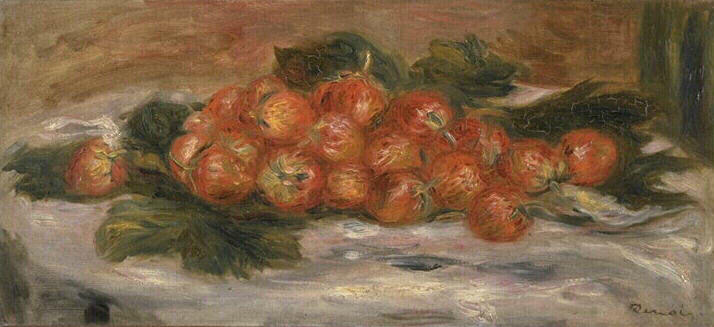
Les fraises
Peut-on la voir ?
Inconnu
Où est « Les fraises » aujourd’hui ? Collection: Musée des Beaux-Arts de Bordeaux, Bordeaux. Inconnu.
Bordeaux, France
Le propriétaire est connu ; on ignore si l’œuvre est exposée aujourd’hui.
- Dans cet état depuis
- Source
- Le musée
À propos du tableau
Les Fraises est le titre d'une nature morte, une peinture à l'huile sur toile de 20 × 43 cm (avec cadre: 39,5 × 61,5 × 6,5 cm) réalisée par le peintre français Auguste Renoir (1841-1919). Datée de 1908 elle est conservée au Musée des Beaux-Arts de Bordeaux.
Elle représente des fraises des bois posées sur un linge blanc et l'œuvre est signée en bas à droite. Elle a fait partie de la collection d'Eugène Blot avant d'être vendue à Frédéric Lung en 1933.
En 1961, le tableau fait partie du legs Lung aux musées nationaux. L’œuvre est entrée en dépôt au musée des Beaux-Arts de Bordeaux en 1961.
Elle a été exposée à Rome en 1999 et à Osaka en l'an 2000.
Notice
- Numéro d’inventaire
- Bx D 1961 12 36
Ce qu’elle montre
Au catalogue
Sources
- Musée des Beaux-Arts de Bordeaux
- Image : Musée des Beaux-Arts de Bordeaux — © Lysiane Gauthier; Ministère de la Culture (France), base Joconde
Dans la vie de Pierre-Auguste Renoir
La vie entière1862–1864 · Formation
Beaux-Arts de Paris
1873
Founding the society of the future Impressionists
Renoir and his friends created the Anonymous Cooperative Society of Artists, Painters, Sculptors and Engravers — the future Impressionist group.
15 April – 15 May 1874
First Impressionist exhibition
Renoir took an active part in organizing the exhibition and showed a pastel and six paintings, among them "The Dancer" and "La Loge" (The Theater Box). It was at his suggestion that the catalogue carried the title of Monet's painting "Impression, Sunrise," which gave rise to the word "Impressionists."
1879
Triumph at the Salon of 1879
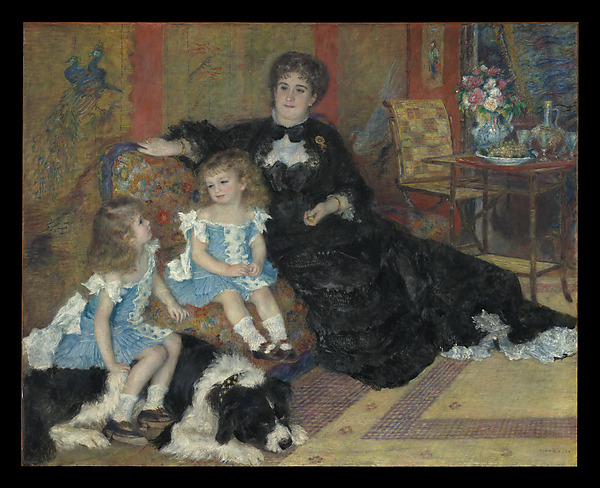
Presenting "Portrait of Madame Charpentier and Her Children" and the full-length "Portrait of the Actress Jeanne Samary," Renoir won universal recognition, and with it financial independence.
1881
Algeria, Madrid, Italy
Renoir traveled to Algeria, the land of Delacroix, then to Madrid to see the works of Velázquez, and to Italy, where he saw Titian in Florence and Raphael in Rome. The journey convinced him that with Impressionism he had "reached the limit," and turned him toward classicism.
1883–1890
The "Ingres" period
Impressed by the classics of the Italian Renaissance and by Ingres, Renoir effectively broke with Impressionism: his lines became crisp, his colors more restrained and cooler. The artist himself called this period "sour"; it includes "Dance in the Country," "Dance in the City" and "Dance at Bougival."