 TitianItalie, 1490–1576
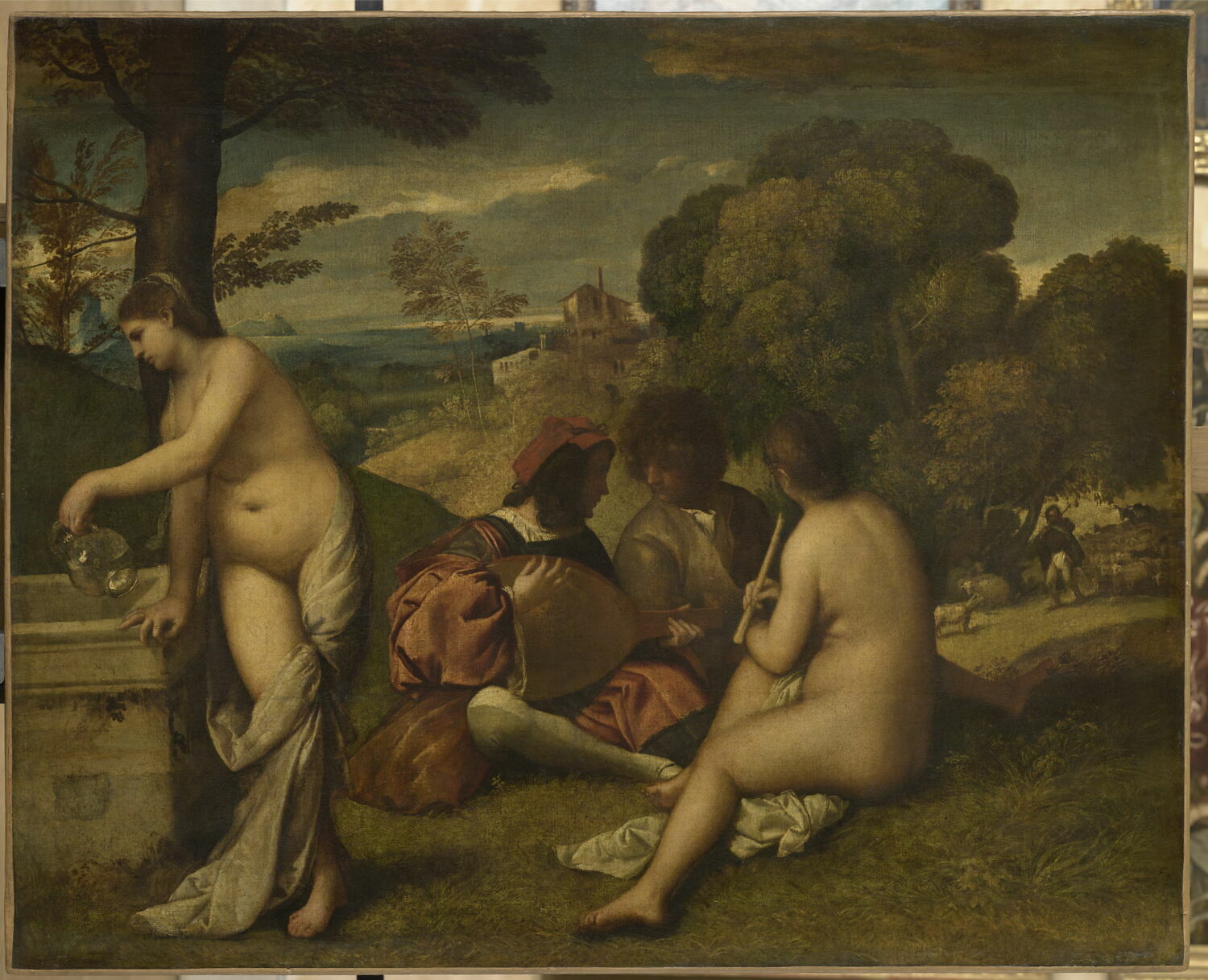
Le Concert champêtre
Peut-on la contempler ?
Elle ne reçoit pas en ce moment

Paris, France
Elle appartient à la collection, mais n’est pas présentée en ce moment.
- Vérifié
- Dans cet état depuis
- Source
- Le musée
À propos du tableau
Le Concert champêtre est un tableau peint vers 1509, aujourd’hui conservé dans les collections du département des Peintures du musée du Louvre.
Notice
- Numéro d’inventaire
- INV 71
Au catalogue
Sources
- Musée du Louvre
- Image : Musée du Louvre — © 2016 GrandPalaisRmn (musée du Louvre) / Michel Urtado
Pendant ce temps, chez Titian
La vie entièrec. 1500
Leaves for Venice as a boy: apprentice to Zuccato
According to Ludovico Dolce, the boy was sent at the age of nine, with his brother Francesco, to live with an uncle in Venice and apprentice to Sebastiano Zuccato; leaving Zuccato, he briefly transferred to the studio of Gentile Bellini. Vasari tells it differently, with Titian studying first under Giovanni Bellini, and there is no documentation of his work before 1510.
1510
Giorgione dies; Titian finishes his paintings
In 1510 the plague raging in Venice took the life of Giorgione. Titian finished the pictures his friend had left incomplete, for example the “Sleeping Venus” and the “Pastoral Concert”, and, as is generally accepted, emerged from his shadow only after this death.
31 May 1513
A petition to the Council of Ten: a battle canvas and a sansaria
On 31 May 1513 Titian petitioned the Council of Ten for a commission to paint a great battle scene for the Doge's Palace (completed only in 1538) and for the next available sansaria, a broker's patent at the Fondaco dei Tedeschi worth 120 ducats a year. The request was granted but reversed in March 1514, and he did not obtain the patent upon Bellini's death in late 1516; the appointment was withheld until 1523.
1516–1517
First Painter of the Republic of Venice
After the death of Giovanni Bellini, the “patriarch of Venetian painting”, in November 1516 Titian was given the title of First Painter of the Republic (he had petitioned for the post as early as 1513). The title carried a decent salary but obliged him to paint portraits of newly elected doges for a symbolic fee; Titian kept it until his death.
1525
Marries Cecilia, the mother of his sons
Cecilia, a barber's daughter from Pieve di Cadore, had been Titian's housekeeper and for some five years his mistress, and had already borne him two sons, Pomponio and Orazio. In 1525, when she fell seriously ill, Titian married her to legitimise the children; Cecilia recovered, and the marriage was a happy one.
1527
Aretino, Sansovino and the “triumvirate”
In March 1527 the satirist Pietro Aretino arrived in Venice: he became friends with Titian and with Jacopo Sansovino, and the three were popularly known as “the triumvirate”, becoming the centre of the city's artistic establishment. Aretino enlisted both in pursuing the patronage of Federico II Gonzaga, and by the autumn of 1527 the Marquis of Mantua had received from Titian a portrait of Aretino (lost); important commissions and an introduction to Emperor Charles V followed.