 Simon VouetFrance, 1590–1649
La Paix
Peut-on la contempler ?
Nous l’ignorons : le musée garde le silence

Musée du Louvre
Paris, France
Le propriétaire est connu. Si elle est exposée aujourd’hui, le musée ne le dit pas, et l’on ne nous a pas appris à deviner.
- Dans cet état depuis
- Source
- Les données de collection du musée lui-même
About the painting
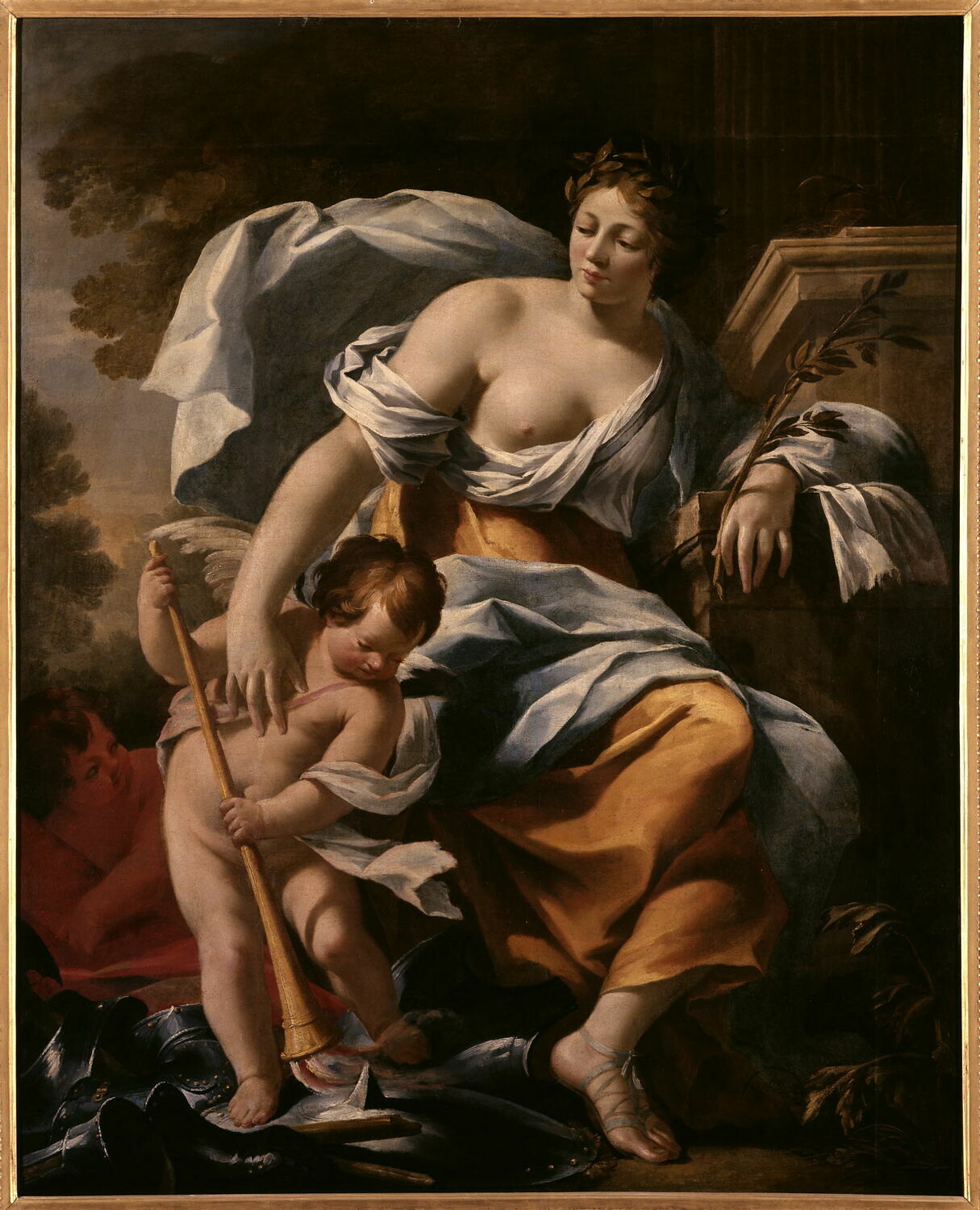
La Paix est un tableau réalisé au XVIIe siècle par un peintre français. De format vertical, cette huile sur toile est une allégorie qui représente la Paix sous les traits d'une jeune femme tenant un rameau d'olivier à côté d'un angelot qui enflamme des armes à l'aide d'une torche.
L'œuvre provient peut-être du château de Saint-Germain-en-Laye, à Saint-Germain-en-Laye, dans les Yvelines. Désormais partie des collections du musée du Louvre, à Paris, elle est considérée par celui-ci comme de la main de Simon Vouet. Conservée depuis 1804 au musée d'Arts de Nantes, à Nantes, dans la Loire-Atlantique, elle est attribuée par cet autre musée d'art à François Tortebat, qui l'aurait peinte vers 1640-1660.
Notice
- Numéro d’inventaire
- inv 736
Au catalogue
Sources
- Musée du Louvre: the museum's own open data · obtenue il y a 6 jours
- Image : Musée du Louvre — © 1999 GrandPalaisRmn (musée du Louvre) / Gérard Blot
Pendant ce temps, chez Simon Vouet
La vie entièrec. 1604
At 14 paints a commissioned portrait in London
Simon learned the rudiments of art from his father, the painter Laurent Vouet, whom Henri IV made a court painter; helping him, the son mastered the craft early. At fourteen he travelled to England and painted a commissioned portrait of a noble lady in London.
early 1614
Settles in Rome
In Rome Vouet fell under the influence of Caravaggio, drew a pension from the French king and found patrons in Cardinal Barberini (elected Pope Urban VIII in 1623), Cassiano dal Pozzo, Giordano Orsini and Vincenzo Giustiniani. From here he visited Bologna and the Carracci academy, Milan and Naples.
1624
Head of the Accademia di San Luca in Rome
His immense success in Rome brought Vouet election as principe (president) of the Accademia di San Luca.
avril 1626
Married: Virginia Vezzi
1627
Returns to Paris at the summons of Louis XIII
At the royal summons Vouet returned to France; Louis XIII commissioned from him portraits, tapestry cartoons and paintings for the Louvre, the Palais du Luxembourg and the Château de Saint-Germain-en-Laye. As one art historian writes, French art was then “painfully provincial”, and Vouet, introducing the latest Italian fashions, brought Paris up to date.
30 juin 1649
Died