 Boris Kustodiev1878–1927
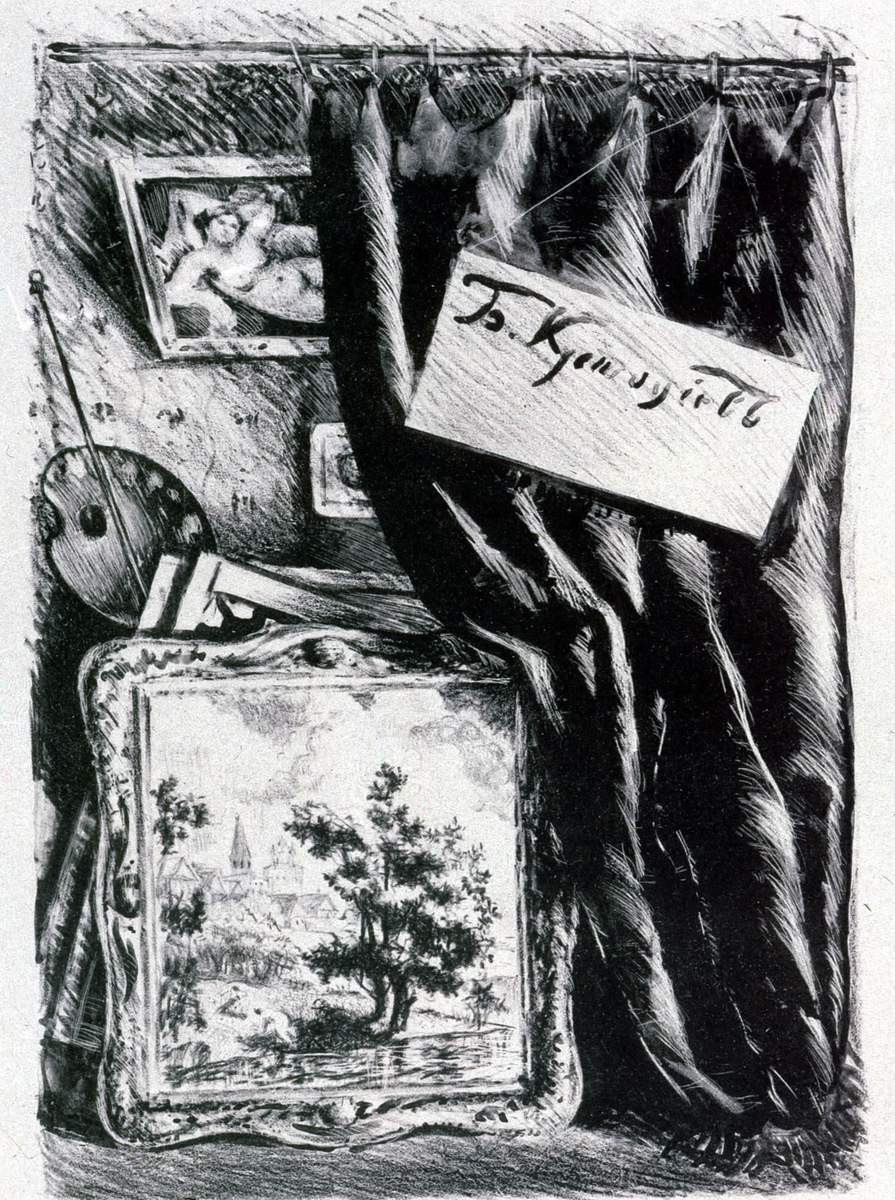
Фронтиспис
Peut-on la contempler ?
Inconnu

Saint-Pétersbourg, Russie
Le propriétaire est connu ; on ignore si l’œuvre est exposée aujourd’hui.
- Dans cet état depuis
- Source
- Le musée
À propos de l’œuvre
Selon le musée — en russe
Создан для монографии В. В. Воинова о художнике, помещен в качестве шмуцтитула к альбому репродукций (см.: Воинов В. В. Б. М. Кустодиев. Л.: ГИЗ, 1925). Также известен под названиями: «Занавеска», «Натюрморт», «В мастерской Б. М. Кустодиева».
Musée russe
Notice
- Numéro d’inventaire
- С.Гр.-11754
Ce qu’elle montre
Au catalogue
Sources
- Musée russe
- Image : Musée russe — © State Russian Museum
Pendant ce temps, chez Boris Kustodiev
La vie entière1918–1921
Opera designs: “The Snow Maiden”, “The Tsar's Bride”
His opera designs were a success: “The Snow Maiden” for the Bolshoi Theatre (1918, never staged), “The Tsar's Bride” at the Bolshoi Opera Theatre of the People's House (1920), and set and costume designs for Serov's “The Power of the Fiend” at the former Mariinsky Theatre (1921).
1922
Illustrates Zamyatin's “How the Monk Erasmus Was Healed”
Kustodiev designed a separate illustrated edition of Yevgeny Zamyatin's story “How the Monk Erasmus Was Healed”. Zamyatin recalled that a seemingly insoluble task was solved with remarkable elegance, tact and a great sense of humour.
1922–1923
Illustrates Leskov
With his fine feeling for line, Kustodiev illustrated Leskov's “The Darner” (1922) and “Lady Macbeth of the Mtsensk District” (1923); he also worked in lithography and linocut.
1923
Joins the Association of Artists of Revolutionary Russia
Kustodiev joined the Association of Artists of Revolutionary Russia, and continued to paint, make engravings, illustrate books and design for the theatre until his death.