Francis PicabiaFrance, 1879–1953
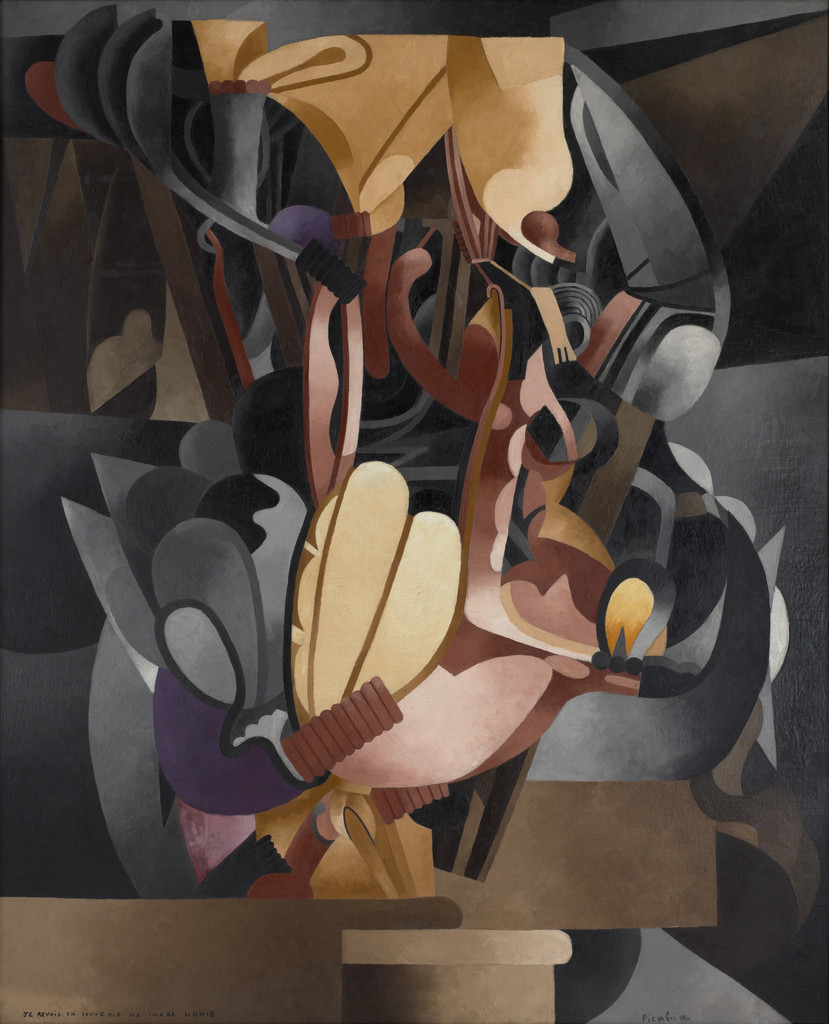
Edtaonisl (Ecclesiastic)
Peut-on la contempler ?
Oui, elle reçoit

Art Institute of Chicago
Salle393Chicago, États-Unis
Présentée au public. Qui s’en porte garant est indiqué ci-dessous.
- Vérifié
- avant-hier
- Dans cet état depuis
- 28 sept. 2026
- Source
- Les données de collection du musée lui-même
About the painting
In 1911 Francis Picabia met Marcel Duchamp, who had devised a unique style of painting that combined Cubist elements with pseudodiagrams in humorous compositions. Stimulated by Duchamp’s example, Picabia pioneered a new, colorful, and intellectual visual language, of which Edtaonisl is a prime example.
Read on
This picture relates to Picabia’s experience aboard a transatlantic ship in 1913, on his way to the opening of the Armory Show, North America’s first major exhibition of modern art. Picabia was amused by two fellow passengers—a Polish dancer named Stacia Napierskowska and a Dominican priest who could not resist the temptation of watching her rehearse with her troupe. While the tumultuous shapes in this work suggest fragments of bodies and nautical architecture, the depiction of specific forms is less important than the effective expression of contrast and rocking motion, which evokes the sensations of dance and a ship moving through rolling seas. On the top right of the canvas, Picabia painted the word Edtaonisl—an acronym made by alternating the letters of the French words étoile (star) and dans[e] (dance), a process analogous to the artist’s shattering and recombining of forms. He subtitled the work Ecclesiastic, hinting at the juxtaposition of the spiritual and the sensual.
Art Institute of ChicagoCC BY 4.0
Notice
- Numéro d’inventaire
- 1953.622
What it shows
Au catalogue
Sources
- Art Institute of Chicago: the museum's own open data · obtenue il y a 6 jours
- Image : Art Institute of Chicago — © the artist or rights holder
Pendant ce temps, chez Francis Picabia
La vie entièrec. 1911
The Puteaux Group: friendship with Apollinaire
Around 1911 Picabia joined the Puteaux Group, whose members he had met at Jacques Villon's studio; there he became friends with Marcel Duchamp and close friends with Guillaume Apollinaire, while the group also included Gleizes, La Fresnaye, Léger and Metzinger.
1913
The only Cubist at the Armory Show
The wealthy Picabia was the only Cubist to attend the Armory Show in New York in person, where he showed four paintings; the press was largely hostile, but he was widely interviewed and at once became a major name in New York's art circles.
17 March – 5 April 1913
Solo show at Stieglitz's gallery 291
Alfred Stieglitz gave him the solo show Exhibition of New York Studies by Francis Picabia at his gallery 291 — abstract works made over a few months in New York under the impression of Kandinsky and other abstract art at the Armory Show.
1915
The start of his “machinist” period
From 1915 Picabia made and exhibited drawings and prints of mysterious machines and apparatuses — “mechanical portraits” inspired by Duchamp's “machine style”; the magazine 291 devoted an entire issue to him, and he met Man Ray.
June 1915
En route to Cuba, he stays on in New York
In wartime Picabia set out for Cuba to buy molasses for a friend who ran a sugar refinery, but after landing in New York in June 1915 he stayed on to work and did not return to France until the war was over. In these years drugs and alcohol undermined his health: he suffered from dropsy and tachycardia.
1915–1917
Leading New York Dada with Duchamp
Throughout his three years in New York Picabia mixed closely with avant-garde artists and, together with Marcel Duchamp, headed the New York section of the Dada movement.