ART WIKI32 963 en salle
CarteCollectionArtistesMuséesExpositionsJournal
Connexion

ART WIKI

Où est accroché le chef-d’œuvre, et quand on vous laisse entrer.

Collections : Art Institute of Chicago, Cleveland Museum of Art, Galerie Tretiakov, Hirshhorn Museum and Sculpture Garden, J. Paul Getty Museum, Metropolitan Museum of Art, Minneapolis Institute of Art, Musée de l'Ermitage, Musée des Beaux-Arts Pouchkine, Musée du Louvre, musée national d'art asiatique, Musée russe, Musées d'Art de Harvard, Museum of Modern Art, National Gallery of Art, National Portrait Gallery, Rijksmuseum Amsterdam, Smithsonian American Art Museum, Statens Museum for Kunst, Victoria and Albert Museum, Villa Getty, Whitney Museum of American Art, Catalogue d’État du fonds muséal de Russie (274 musées), Europeana (19 musées), Wikidata (6 musées), Paris Musées (12 musées) et Joconde, la base des musées du ministère de la Culture (495 musées). Les images appartiennent à leurs ayants droit.

Rubriques

  • Carte
  • Recherche
  • Collection
  • Chefs-d’œuvre
  • Exposées en ce moment
  • Artistes

Et aussi

  • Musées et galeries
  • Expositions
  • Journal
  • D’où viennent les données
  • Confidentialité et cookies
AccueilCarteCatalogue
  1. Collection/
  2. Minneapolis Institute of Art/
  3. Downtrodden
Downtrodden, Käthe Kollwitz, 1900
Käthe Kollwitz, portraitKäthe KollwitzAllemagne, 1867–1945

Downtrodden

1900 · Prints, Works on Paper

Peut-on la contempler ?

Elle ne reçoit pas en ce moment

Minneapolis Institute of Art

Minneapolis, États-Unis

Elle appartient à la collection, mais n’est pas présentée en ce moment.

Vérifié
il y a 3 jours
Dans cet état depuis
25 sept. 2026
Source
Le musée
Sur la cartePage du musée

À propos de l’œuvre

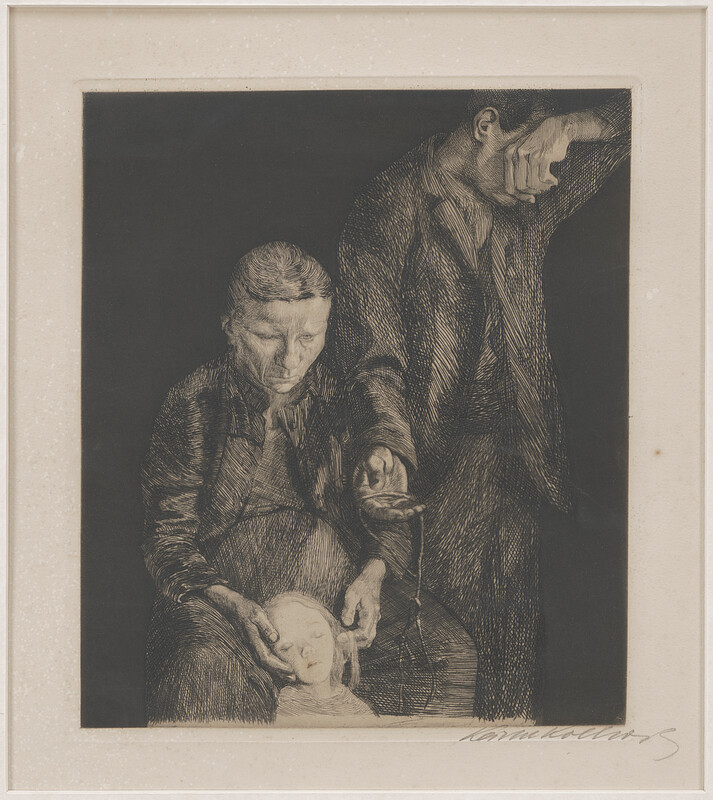
A care-worn couple grieve for a sick or dead child. The man stands leaning against a wall, his face buried in his left arm, while his right is slightly extended in a gesture of supplication or benediction. The woman leans over slightly, using her hands to support the head of the limp child. Käthe Kollwitz originally intended this image to serve as the left panel of a 34-inch-wide triptych, whose central panel featured a naked male corpse laid out on a cloth-covered slab (derived from Hans Holbein’s famous painting of the dead Christ in the Kunstmuseum Basel) with another sword-bearing figure leaning over him. The right wing of the triptych showed nude women, one bound to a tree trunk, one embracing the trunk, and another seeming to mourn the others while imploring the viewer.

Lire la suite

Kollwitz credited the symbolist Max Klinger with inspiring much of her interest in printmaking, and the triptych shows her employing his brand of hyperdramatic otherworldliness. The result was an odd juxtaposition of melodrama in the center and right sections versus the restrained tragedy of the left. After printing just a few impressions of the full composition, Kollwitz cut the plate, separating the left section from the others. She then went on to print editions of the separate plates. This impression of the left section shows the inner drama that Kollwitz would continue to pursue throughout her career.

Minneapolis Institute of Art

Notice

1900 · à 33 ans
18671945
Numéro d’inventaire
2023.57.7

Au catalogue

EstampesEau-forteImpressionnismeModernismeXXe siècleAllemagne

Sources

  • Minneapolis Institute of Art
  • Image : Minneapolis Institute of Art — public domain

Pendant ce temps, chez Käthe Kollwitz

La vie entière
  1. 1898

    “The Weavers” at the Great Berlin Art Exhibition

    In 1898 the cycle was shown publicly at the Great Berlin Art Exhibition and was widely acclaimed.

  2. 1898

    The Kaiser refuses a gold medal to a woman

    Adolph Menzel nominated her work for the gold medal of the 1898 Great Berlin Art Exhibition, but Kaiser Wilhelm II withheld his approval, saying that a medal for a woman would be going too far and that orders and medals belonged on the breasts of worthy men.

  3. 1898–1903

    Teaches at the Women’s Art School

    From 1898 to 1903 she taught at the Women’s Art School in Berlin.
Autres œuvres : Käthe Kollwitz

Toutes les œuvres
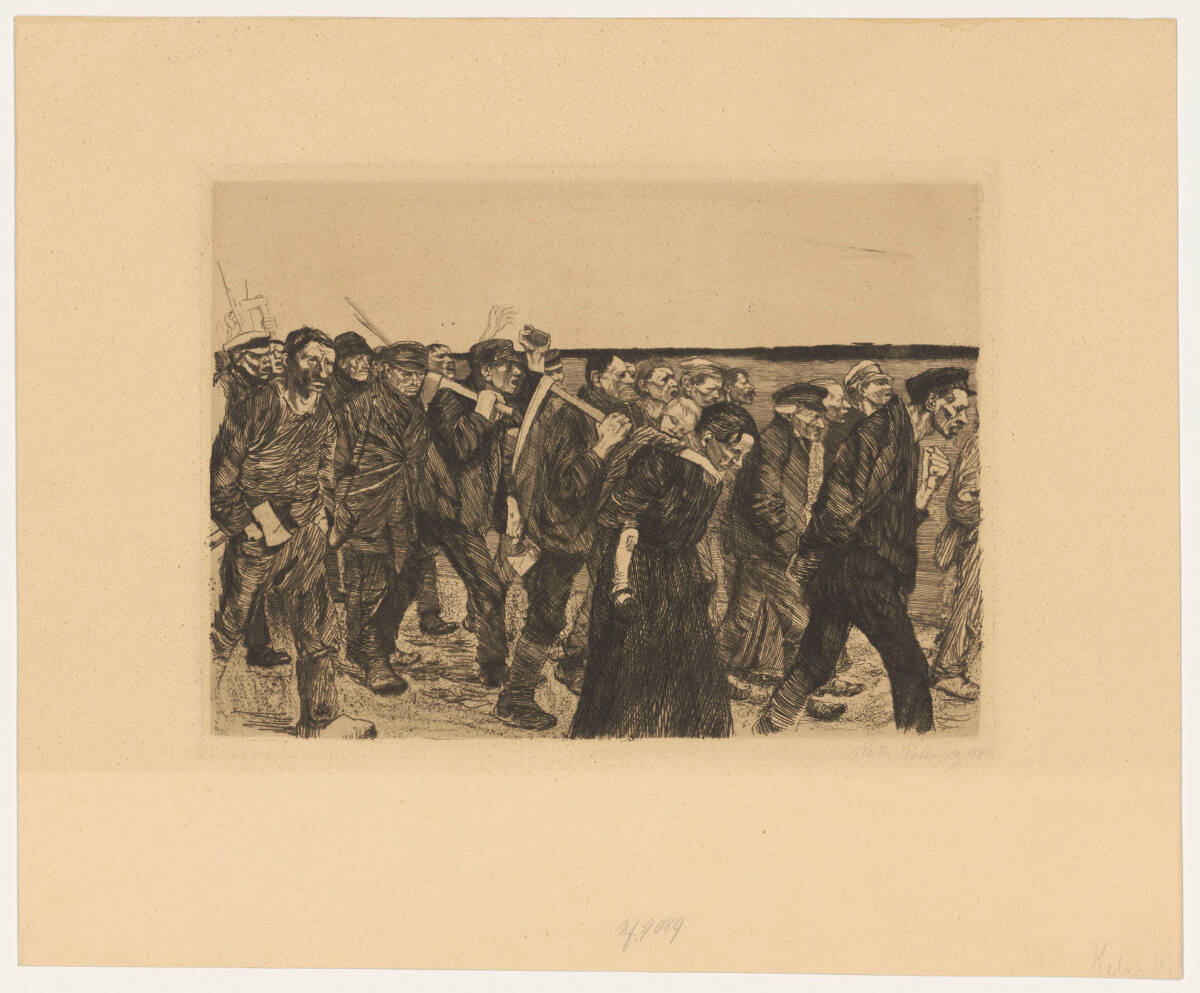
Weberzug (Ein Weberaufstand, Blatt 4), Käthe Kollwitz

Weberzug (Ein Weberaufstand, Blatt 4)

Albertina

Tod (Ein Weberaufstand; Blatt 2), Käthe Kollwitz

Tod (Ein Weberaufstand; Blatt 2)

Albertina

Not (Ein Weberaufstand; Blatt 1), Käthe Kollwitz

Not (Ein Weberaufstand; Blatt 1)

Albertina

Beim Arzt (Drei Flugblätter gegen den Wucher, Blatt 3), Käthe Kollwitz

Beim Arzt (Drei Flugblätter gegen den Wucher, Blatt 3)

Albertina

Beratung (Ein Weberaufstand; Blatt 3), Käthe Kollwitz

Beratung (Ein Weberaufstand; Blatt 3)

Albertina

Die Carmagnole, Käthe Kollwitz

Die Carmagnole

Albertina

Zertretene, Käthe Kollwitz

Zertretene

Kupferstich-Kabinett

Selbstbildnis und Studie zu einer Szene aus Germinal, Käthe Kollwitz

Selbstbildnis und Studie zu einer Szene aus Germinal

Kupferstich-Kabinett

Sous le même toit : Minneapolis Institute of Art

Page du musée
Olive Trees, Vincent van Gogh, 1889

Vincent van Gogh

Olive Trees, 1889

Grainstack, Sun in the Mist, Claude Monet, 1891

Claude Monet

Grainstack, Sun in the Mist, 1891

Lucretia, Rembrandt van Rijn, 1666

Rembrandt van Rijn

Lucretia, 1666

Self-Portrait with Dr. Arrieta, Francisco José de Goya y Lucientes, 1820

Francisco de Goya

Goya et son médecin, 1820

Study for Improvisation V, Vassily Kandinsky, 1910

Vasily Kandinsky

Study for Improvisation V, 1910

Tahitian Landscape, Paul Gauguin, 1891

Paul Gauguin

Tahitian Landscape, 1891

Chestnut Trees at Jas de Bouffan, Paul Cézanne, c. 1885–86

Paul Cézanne

Chestnut Trees at Jas de Bouffan, c. 1885–86

The Union of England and Scotland (Charles I as the Prince of Wales), Peter Paul Rubens, 1633–34

Peter Paul Rubens

The Union of England and Scotland (Charles I as the Prince of Wales), 1633–34