 Gustave CourbetFrance, 1819–1877
Château d’Ornans
Peut-on la voir ?
Pas exposée actuellement
Où est « Château d’Ornans » aujourd’hui ? Collection: Minneapolis Institute of Art, Minneapolis. Pas exposée actuellement. Vérifié 29 septembre 2026.

Minneapolis, États-Unis
Elle appartient à la collection, mais n’est pas présentée en ce moment.
- Vérifié
- Dans cet état depuis
- Source
- Le musée
À propos du tableau
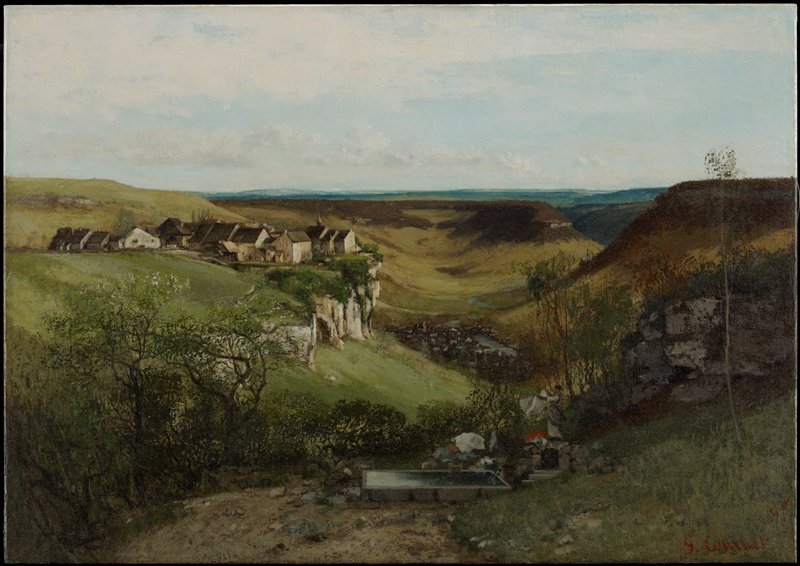
Le Château d'Ornans est un tableau réalisé par le peintre français Gustave Courbet en 1855.
De format horizontal, cette peinture à l'huile sur toile est une peinture de paysage qui représente une vue du promontoire sur lequel se trouvent le hameau et les ruines du château d'Ornans (à gauche) qui surplombe la ville d'Ornans dans la vallée de la Loue (centre droit). Au premier plan, on voit le lavoir du château appelé la fontaine aux vipères par Courbet (en référence aux commères qui y lavaient leur linge).
Le tableau est exposé depuis 1972 au Minneapolis Institute of Art (Minnesota).
Selon le musée
The country around his native town of Ornans, in eastern France, inspired most of Gustave Courbet's paintings. Like his contemporaries who worked near Barbizon, Courbet revitalized the landscape tradition with views of distinctive regional features observed at first hand. The town of Ornans appears in the valley below.
Minneapolis Institute of Art
Notice
- Numéro d’inventaire
- 72.66
Au catalogue
Sources
- Minneapolis Institute of Art
- Image : Minneapolis Institute of Art — public domain
Dans la vie de Gustave Courbet
La vie entière1855
Stages the “Pavilion of Realism”
Refusing to accept the jury's decision, Courbet asked museums and private owners to lend his paintings, had a separate building erected and showed about forty canvases there, without state permission, under the Second Empire. The public was baffled and laughed at the “crude art”, and the critics mocked him; the paintings were appreciated by Delacroix and Baudelaire.
1855
The “Realist Manifesto” in the exhibition catalogue
The catalogue of the Pavilion of Realism opened with a manifesto in which Courbet claimed the right to artistic freedom and the right to show his works to the public on his own. He defined his aim as conveying the customs, ideas and appearance of his time, to be not only a painter but a man as well: to “create living art”.
1855
The Exposition Universelle jury turns down three paintings
Courbet submitted fourteen paintings to the Salon of 1855, part of the Exposition Universelle; three were rejected “for lack of space”, among them the monumental “A Burial at Ornans” and “The Artist's Studio”.
1855
Empress Eugénie before “The Bathers”
According to Proudhon's recollection, Empress Eugénie, visiting the Pavilion of Realism, stopped before Courbet's “Bathers”, with its robustly peasant-like nude body shown without the usual idealization, and exclaimed, “Is this a Percheron too?” She had just been looking at Rosa Bonheur's “Horse Fair”.
1857
Salon of 1857: “Young Ladies on the Banks of the Seine”
At the Salon of 1857 Courbet showed six paintings, among them “Young Ladies on the Banks of the Seine (Summer)”, painted the year before, and the first of his many hunting scenes. Modern women casually displaying their undergarments caused a scandal; pairing sensational works with hunting scenes secured Courbet both notoriety and sales.