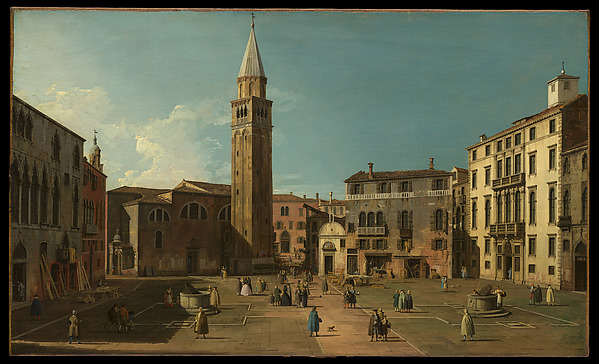
 CanalettoItalie, 1697–1768
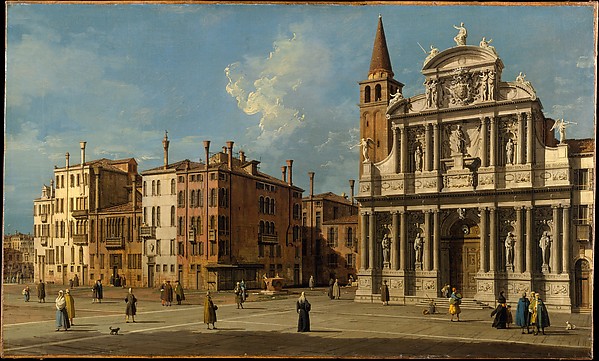
Campo Sant'Angelo, Venice
Peut-on la voir ?
Oui, exposée actuellement
Où est « Campo Sant'Angelo, Venice » aujourd’hui ? Metropolitan Museum of Art, Salle 644, New York. Oui, exposée actuellement. Vérifié 29 septembre 2026.

New York, États-Unis
Fermé· ouvre à 10:00
Présentée au public.
- Vérifié
- Dans cet état depuis
- Source
- Le musée
Notice
- Numéro d’inventaire
- 2019.141.5
Ce qu’elle montre
Au catalogue
Sources
- Metropolitan Museum of Art
- Image : Metropolitan Museum of Art — Open Access (CC0)
Dans la vie de Canaletto
La vie entière1720–1746 · Lieu de travail
Venice
late 1720s
Owen Swiny urges him to paint views for tourists
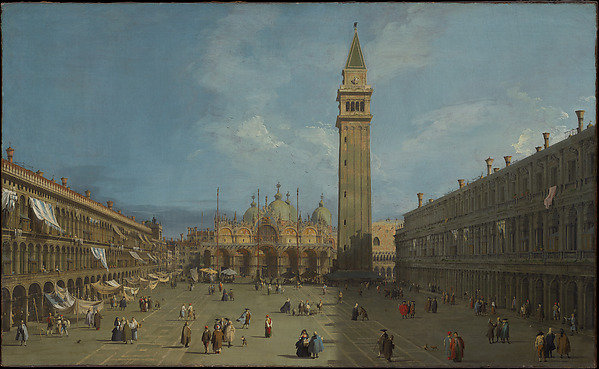
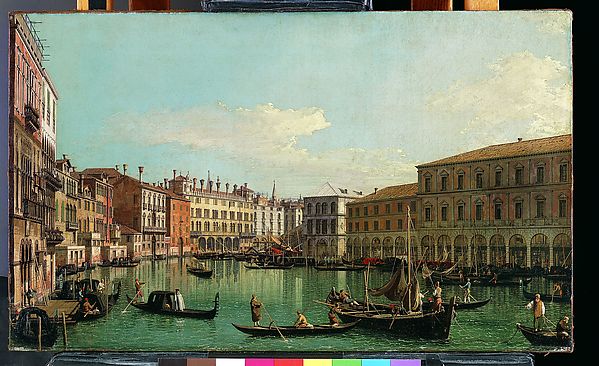
Many of Canaletto's pictures are sold to Englishmen on their Grand Tour, first through the agency of Owen Swiny, who in the late 1720s encourages him to paint small topographical views of Venice with a commercial appeal for tourists and foreign visitors to the city.
until 1728
The association with Joseph Smith begins
Sometime before 1728 Canaletto begins his association with Joseph Smith, an English businessman and collector living in Venice, who is appointed British Consul there in 1744; Smith will become the artist's principal agent and patron.
1728–1735
Visentini's etchings after thirty-eight of Canaletto's views
In 1728–35 Smith arranges for thirty-eight of Canaletto's painted vedute to be reproduced in etchings by Antonio Visentini and published under the title “Urbis Venetiarum Prospectus Celebriores ex Antonii Canal”.
c. 1729 – 1735
Smith as agent: a “market of taste” for the Venetian veduta
Joseph Smith — a banker, art dealer and later British consul in Venice — creates a “market of taste” for the Venetian veduta among British aristocrats touring Italy and, as Canaletto's commercial agent from about 1729 to 1735, in effect controls the artist's work to the benefit of them both. Among the young painter's buyers is also the Prince of Liechtenstein.
1740s
The War of the Austrian Succession: the British stop coming
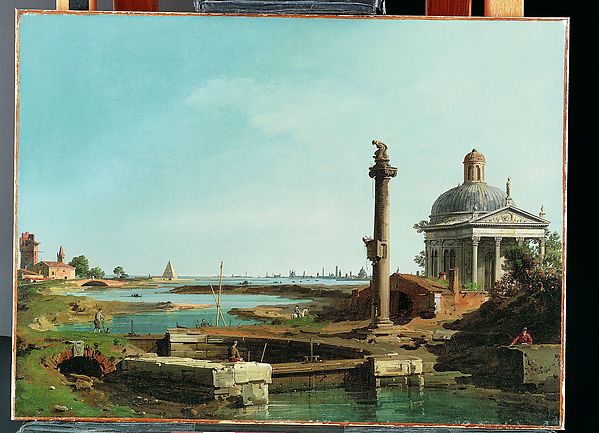
In the 1740s Canaletto's market is disrupted when the War of the Austrian Succession reduces the number of British visitors to Venice. Smith arranges for the publication of a series of etchings of “capricci” (architectural fantasies), but the returns are not high enough.





![[Landschaft mit einem viereckigen Turm; Landscape with a Square Tower; Paysage à la tour carrée], Rembrandt, 1650](https://diglib.hab.de/varia/haum/rembrandt-ab3-0251/max/000001.jpg)
![[Landschaft mit einem viereckigen Turm; Landscape with a Square Tower; Paysage à la tour carrée], Rembrandt, 1650](https://diglib.hab.de/varia/haum/rembrandt-v3-4664/max/000001.jpg)
![Church Tower; A Sketch of a Fan [recto], Paul Gauguin, 1884-1888](https://api.nga.gov/iiif/d5079873-1b1d-4e5a-aa58-fbcd9406adf4/full/!2400,2400/0/default.jpg)