Paul KleeAllemagne, 1879–1940
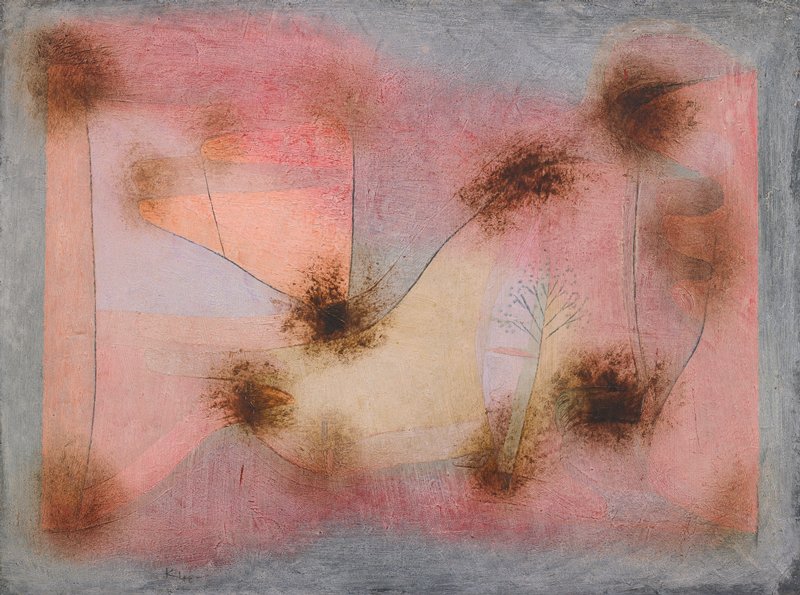
Cacti
Peut-on la voir ?
Inconnu
Où est « Cacti » aujourd’hui ? Collection: Lenbachhaus, Munich. On ignore si elle est exposée aujourd’hui.
Munich, Allemagne
Le propriétaire est connu ; on ignore si l’œuvre est exposée aujourd’hui.
- Dans cet état depuis
- Source
- Le musée
Notice
- Numéro d’inventaire
- G 12840
Au catalogue
Sources
- Wikidata
- Image : Lenbachhaus — Paul Klee · Public domain · Wikimedia Commons
Dans la vie de Paul Klee
La vie entière1910
First solo exhibition, in Bern
Klee’s first solo exhibition, “56 Works by Klee”, opened in Bern; his watercolours, etchings and drawings were then shown in Zurich, Winterthur and Basel. His style was so unusual even for avant-garde artists that both critics and painters were bewildered.
1911
Meeting Alfred Kubin
In December 1910 Alfred Kubin asked Klee to select prints for his collection, and in January 1911 they met in person: Klee shared his plan to illustrate Voltaire’s “Candide”, and Kubin, who greatly liked his sarcasm and irony, became one of the artist’s first significant collectors. At Kubin’s suggestion Klee became a founder of the Munich artists’ society Sema (whose members also included Egon Schiele, Max Oppenheimer, Edwin Scharff and Robert Genin), and in the same year, through Kubin, he met the art critic Wilhelm Hausenstein.
autumn 1911
Meeting Macke and Kandinsky; the “Blue Rider”
In the autumn of 1911 Klee met August Macke and Wassily Kandinsky; of Kandinsky he noted that he felt a deep trust in him and saw an exceptionally beautiful and lucid mind. In the winter he joined the editorial team of the almanac “Der Blaue Reiter”, founded by Kandinsky and Franz Marc, and within a few months became one of its most important and independent members, though never fully integrated.
12 February – 18 March 1912
The second “Blue Rider” exhibition: 17 drawings
Seventeen of Klee’s graphic works were shown at the second exhibition of the “Blue Rider” editors, at Hans Goltz’s Munich gallery; it was called “Black-White” because it included only graphic works and watercolours. His ink drawing “Steinhauer” was also reproduced in the almanac, whose only issue appeared in May 1912; Klee’s meeting with Hans Arp dates from the same period.
11 April 1912
Robert Delaunay’s studio: discovering abstraction
On 11 April Klee visited Robert Delaunay’s studio in Paris and discovered abstract painting detached from natural forms; his understanding of light and colour changed substantially. In December he began translating Delaunay’s essay “On Light” (La Lumière) for Herwarth Walden’s magazine Der Sturm, and in 1914, under Delaunay’s influence, he painted “Abstraction. Coloured Circles Interwoven with Coloured Ribbons”.
from 3 April 1914
Tunisia with Macke and Moilliet: Klee the painter
On 3 April 1914 Klee set out from Bern with August Macke and Louis Moilliet, via Lyon and Marseille to Tunisia — Saint-Germain, Sidi Bou Said, Carthage, Hammamet, Kairouan — and he alone of the three kept a diary. Struck by the light, Klee wrote that colour had taken possession of him for ever and that he was a painter; back home he painted his first purely abstract work, “In the Style of Kairouan”, built of coloured rectangles and a few circles.