ART WIKI32 979 en salle
CarteCollectionArtistesMuséesExpositionsJournal
Connexion

ART WIKI

Où est accroché le chef-d’œuvre, et quand on vous laisse entrer.

Collections : Art Institute of Chicago, Cleveland Museum of Art, Galerie Tretiakov, Hirshhorn Museum and Sculpture Garden, J. Paul Getty Museum, Metropolitan Museum of Art, Minneapolis Institute of Art, Musée de l'Ermitage, Musée des Beaux-Arts Pouchkine, Musée du Louvre, musée national d'art asiatique, Musée russe, Musées d'Art de Harvard, Museum of Modern Art, National Gallery of Art, National Portrait Gallery, Rijksmuseum Amsterdam, Smithsonian American Art Museum, Statens Museum for Kunst, Victoria and Albert Museum, Villa Getty, Whitney Museum of American Art, Catalogue d’État du fonds muséal de Russie (274 musées), Europeana (19 musées), Wikidata (6 musées), Paris Musées (12 musées) et Joconde, la base des musées du ministère de la Culture (495 musées). Les images appartiennent à leurs ayants droit.

Rubriques

  • Carte
  • Recherche
  • Collection
  • Chefs-d’œuvre
  • Exposées en ce moment
  • Artistes

Et aussi

  • Musées et galeries
  • Expositions
  • Journal
  • D’où viennent les données
  • Confidentialité et cookies
AccueilCarteCatalogue
  1. Collection/
  2. Art Institute of Chicago/
  3. In the Magic Mirror
In the Magic Mirror, Paul Klee, 1934
Paul Klee, portraitPaul KleeAllemagne, 1879–1940

In the Magic Mirror

1934 · Painting

À propos du tableau

Dans le miroir magique est une peinture à l'huile abstraite réalisée en 1934 par l'artiste allemand Paul Klee, basé en Suisse. Elle fait partie de la collection de l'Art Institute of Chicago.

Wikipédia · CC BY-SA

Selon le musée

In the Magic Mirror reflects the disillusionment that colored much of Paul Klee's work following the Nazi takeover of Germany in 1933 and the artist's subsequent move to his native Switzerland.

Illustrating what Klee called his method of "taking a line for a walk," a meandering red line twists and turns down the center of the canvas, delineating the features of a face. The tight curves on the brow suggest the figure is concentrating, while the tension between the nose and mouth, which pull in opposite directions, conveys anxiety. In contrast to the cheerful pink cheeks, the figure's tear-shaped eyes communicate distress. The thinly painted, ghostly outline of the head and shoulders is in contrast to the crisp rendering of the face. Klee paints the heart, the true creative center, black, thereby suggesting the pall that settled over this figure, and by extension, the artist at this time.

Art Institute of Chicago · CC BY 4.0

Notice

1934 · à 55 ans
18791940
Numéro d’inventaire
1991.321

Pendant ce temps, chez Paul Klee

La vie entière
  1. 1933

    Nazi harassment, a house search and dismissal

    When the Nazis came to power a campaign of persecution was launched against Klee: the press called him a “typical Galician Jew”, his flat in Dessau was searched, and in Düsseldorf he was barred from work until he produced documents proving Aryan descent. He was forced to give up his professorship.

  2. late 1933

    Emigration to Switzerland

    At the end of 1933, at his wife’s insistence, Klee left Germany and returned to Bern. He applied for Swiss citizenship, but a positive answer came only after his death.

  3. 1933–1934

    Shows in London and Paris, and a meeting with Picasso

    In 1933–34 Klee had shows in London and Paris and finally met Pablo Picasso, whom he greatly admired.

  4. 1935

    A large exhibition in Bern: 273 works

    A large Klee exhibition in Bern showed 273 works.

  5. 1935

    The first signs of scleroderma

    In 1935, two years after moving to Switzerland, signs of scleroderma were found in Klee — an autoimmune disease that hardens connective tissue; it later proved fatal and made swallowing very difficult. The pain he endured seems to be reflected in his late works.

  6. 1936–1939

Autres œuvres : Paul Klee

Toutes les œuvres

Dans la même salle · Research Center Franke Reading Room, Art Institute of Chicago

Page du musée

From 25 works in 1936 to 1,254 in 1939

After falling ill Klee turned to simpler, larger designs with heavier lines, geometric forms and fewer, larger blocks of colour, and his output rose: about 25 works in 1936, 264 in 1937, 489 in 1938 and 1,254 in 1939, a career high. His health recovered somewhat and he was encouraged by a visit from Kandinsky and Picasso.

Peut-on la contempler ?

Oui, elle reçoit

Art Institute of Chicago

Chicago, États-Unis

SalleResearch Center Franke Reading Room

Présentée au public. Qui s’en porte garant est indiqué ci-dessous.

Vérifié
il y a 3 jours
Dans cet état depuis
19 août 2026
Source
Le musée
Sur la cartePage du musée

Au catalogue

PeinturesHuilePeinture allemandeModernismeXXe siècleAllemagne

Sources

  • Art Institute of Chicago
  • Image : Art Institute of Chicago — © the artist or rights holder
New House in the Suburbs, Paul Klee, 1924

New House in the Suburbs

1924 · National Gallery of Art

May Picture, Paul Klee, 1925

May Picture

1925 · Metropolitan Museum of Art

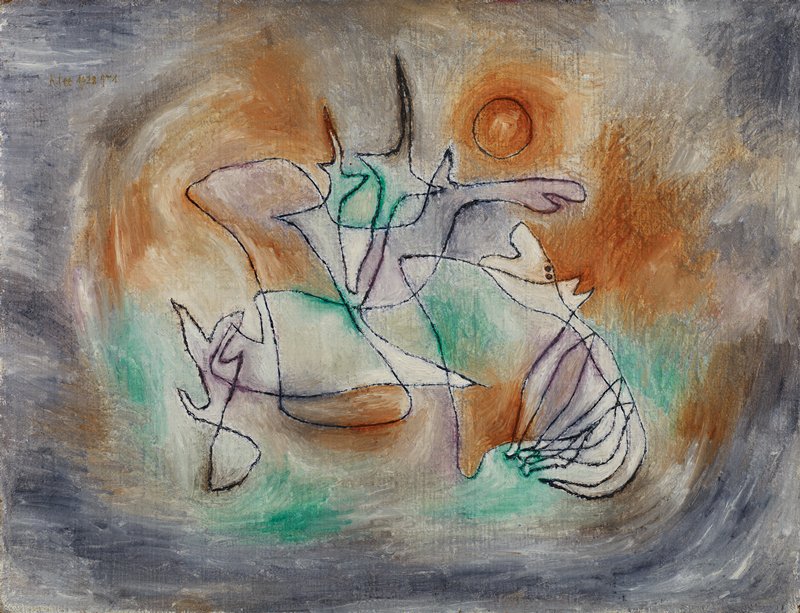
Howling Dog, Paul Klee, 1928

Howling Dog

1928 · Minneapolis Institute of Art

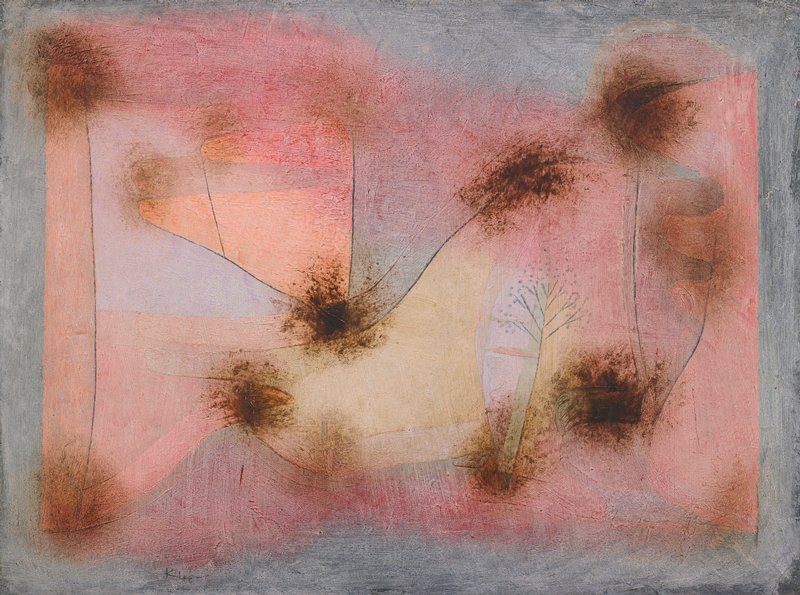
Hardy Plants, Paul Klee, 1934

Hardy Plants

1934 · Minneapolis Institute of Art

Stakim, Paul Klee, c. 1928

Stakim

c. 1928 · Art Institute of Chicago

Fleeing Ghost, Paul Klee, 1929

Fleeing Ghost

1929 · Art Institute of Chicago

Auslöschendes Licht, Paul Klee

Auslöschendes Licht

Albertina

Tragödie auf Stelzen (Grotesktänzer-Stelzenläufer), Paul Klee

Tragödie auf Stelzen (Grotesktänzer-Stelzenläufer)

Albertina

Veranda Post (Òpó Ògògá), Olowe of Ise, 1910-14

Olowe of Ise

Veranda Post (Òpó Ògògá), 1910-14

Passing Through the Opposite of What It Approaches, Chapter 25 (Portrait of Anne Rorimer), R. H.  Quaytman, 2012

R. H. Quaytman

Passing Through the Opposite of What It Approaches, Chapter 25 (Portrait of Anne Rorimer), 2012

The Maple Tree with Pine, Sylvia Plimack Mangold, 2005

Sylvia Plimack Mangold

The Maple Tree with Pine, 2005

Correct Me If I'm Wrong, Amy Sillman, 1999

Amy Sillman

Correct Me If I'm Wrong, 1999

Blue Note, Judith Godwin, 1982

Judith Godwin

Blue Note, 1982

Cloudy Night, a Picture That Can Be Hung Upside Down, Roger Brown, 1978

Roger Brown

Cloudy Night, a Picture That Can Be Hung Upside Down, 1978

Eucalol, Ellen Lanyon, 1977

Ellen Lanyon

Eucalol, 1977

Clay Lake, Morning Sundown, Irving Petlin, 1975

Irving Petlin

Clay Lake, Morning Sundown, 1975