
 TitianItalia, 1490–1576
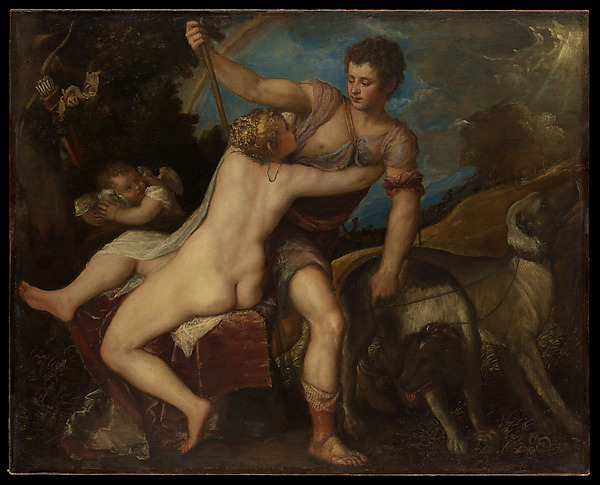
Venus and Adonis
¿Se puede contemplar?
Sí, recibe visitas

Expuesta al público. Quién lo avala figura más abajo.
- Comprobado
- En este estado desde
- Fuente
- El museo
Sobre el cuadro
A composition of Venus and Adonis by the Venetian Renaissance artist Titian has been painted a number of times, by Titian himself, by his studio assistants and by others. In all there are some thirty versions that may date from the 16th century, the nudity of Venus undoubtedly accounting for this popularity. It is unclear which of the surviving versions, if any, is the original or prime version, and a matter of debate how much involvement Titian himself had with surviving versions. There is a precise date for only one version, that in the Prado in Madrid, which is documented in correspondence between Titian and Philip II of Spain in 1554. However, this appears to be a later repetition of a composition first painted a considerable time earlier, possibly as early as the 1520s.
Seguir leyendo
The Prado version is set at dawn and shows the young Adonis pulling himself away from Venus, his lover. He carries a feathered spear or "dart", a weapon often used in hunting in the 16th century. The leads of his three hounds are wound around his arm at right. Under the trees behind them at left Cupid lies asleep, with his bow and quiver of arrows hanging from a tree; this is not a time for love. High in the sky, a figure rides a chariot; this is either Venus from later in the story, or Apollo or Sol, representing the dawn. Venus sits on a rock covered with a rich tablecloth with gold braid edges and buttons (not a military jacket, as sometimes thought). Adonis has a horn hanging from his belt; his dress is classical, taken from Roman sculptures.
It is thought that the Roman poet Ovid was the main source, though other literary and visual sources have been suggested. In Book X of Ovid's Metamorphoses Adonis is a beautiful youth, a royal orphan, who spends his time hunting. Venus falls in love with him after one of Cupid's arrows hits her by mistake. They hunt together, but she avoids the fiercer animals, and warns him about them, citing the story of Atalanta. One day Adonis hunts alone and is gored by a wounded wild boar. Venus, in the sky in her chariot, hears his cries but cannot save him. In some versions, the death of Adonis is shown in the distance to the right. In Ovid, it is Venus who leaves first, and Adonis pulling himself away seems to be Titian's invention, for which some criticized him.
Two basic types of the composition were described by Harold Wethey, who called them the "Prado" and "Farnese" types; the Prado type is most common and is described above. Alternative terms are the "three-dog" and "two-dog" types. They are in most respects the same, but the Farnese type has a tighter crop on the subject and a wider shape, losing most of the sky. Adonis' raised hand is just below the picture edge, so the feathers on the spear are not seen, nor is the chariot in the sky, though the sun bursts through clouds in about the same place. There are only two hounds and no gold vessel on the ground at left. Cupid is brought closer to the main couple, and is now awake, holding a dove in his hands.
Ficha
- Número de inventario
- 1942.9.84
Lo que muestra
En el catálogo
Fuentes
- Galería Nacional de Arte
- Imagen: Galería Nacional de Arte — Museum open access
![Ginevra de' Benci [obverse], Leonardo da Vinci, c. 1474/1478](https://api.nga.gov/iiif/8f29e3c9-a289-4d53-abf0-31a66e9e98fa/full/!2400,2400/0/default.jpg)
![Wreath of Laurel, Palm, and Juniper with a Scroll inscribed Virtutem Forma Decorat [reverse], Leonardo da Vinci, c. 1474/1478](https://api.nga.gov/iiif/ff62e8d0-45c4-498f-ad36-6358de827e04/full/!2400,2400/0/default.jpg)


