ART WIKI32.963 en sala
MapaColecciónArtistasMuseosExposicionesRevista
Acceder

ART WIKI

Dónde cuelga la obra maestra y cuándo le dejan pasar.

Colecciones: Galería Nacional de Arte, Galería Nacional de Dinamarca, Galería Nacional de Retratos, Galería Tretiakov, Harvard Art Museums, Instituto de Arte de Chicago, Instituto de Artes de Mineápolis, MoMA, Museo de Arte de Cleveland, Museo de Victoria y Alberto, Museo del Hermitage, Museo del Louvre, Museo Estatal Ruso, Museo Hirshhorn y Jardín de Esculturas, Museo J. Paul Getty, Museo Metropolitano de Arte, Museo Pushkin, Museo Smithsoniano de Arte Americano, Museo Whitney de Arte Estadounidense, National Museum of Asian Art, Rijksmuseum, Villa Getty, Catálogo Estatal del Fondo Museístico de Rusia (274 museos), Europeana (19 museos), Wikidata (6 museos), Paris Musées (12 museos) y Joconde, la base de museos del Ministerio de Cultura de Francia (495 museos). Las imágenes pertenecen a sus titulares de derechos.

Secciones

  • Mapa
  • Búsqueda
  • Colección
  • Obras maestras
  • Expuestas ahora
  • Artistas

Más

  • Museos y galerías
  • Exposiciones
  • Revista
  • De dónde salen los datos
  • Privacidad y cookies
InicioMapaCatálogo
  1. Colección/
  2. Instituto de Arte de Chicago/
  3. Untitled (Psychological Morphology)
Untitled (Psychological Morphology), Matta, 1939
Matta, retratoMattaChile, 1911–2002

Untitled (Psychological Morphology)

1939 · Painting

¿Se puede contemplar?

Sí, recibe visitas

Instituto de Arte de Chicago

Chicago, Estados Unidos

Sala397

Expuesta al público. Quién lo avala figura más abajo.

Comprobado
hace 3 días
En este estado desde
19 ago 2026
Fuente
El museo
En el mapaPágina del museo

Sobre el cuadro

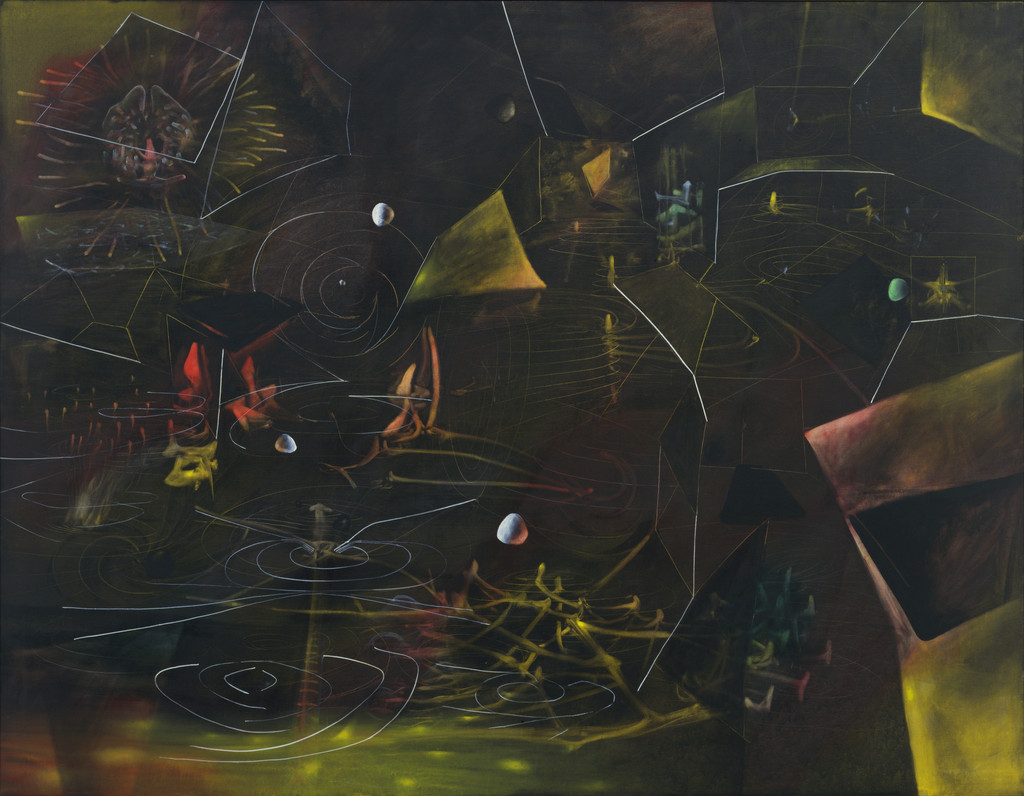
When Matta presented his concept of psychological morphology to the Surrealists during the autumn of 1938, an uncomprehending André Breton requested that he put his ideas in writing. The resulting text, entitled “Morphologie psychologique” (cited in Paris, Musée national d’arte moderne, Matta, 1985, exh. cat., pp. 30–31), shows that one of his sources was Salvador Dalí, whose own passionate interest in morphology was expressed on a number of occasions in the Surrealist journal Minotaure (see, for example, “Première loi morphologique sure les poils dans les structures molles,” Minotaure 9 [1936], pp. 60–61). Morphology – the study of the structures, homologies, and metamorphoses of form in animals, plants, and even language – was a natural arena for the Surrealists and a rich source of inspiration for the visual artists associated with the movement.

Seguir leyendo

Broadly speaking, rather than pursuing the moral and psychological implications of Dalí’s division of forms into hard and soft, Matta tried to convey a maximum conflation of forms, an idea expressed in the characteristic linguistic mergings and neologisms of his writing: “the object, at each risk of interpenetration may oscillate from pointvolume to momenteternity, from attractionrepulsion to pastfuture, from lightshadow to mattermovement” (Matta, “Morphologie psychologieque,” cited in Paris 1985, p. 30). Not only figures and objects, but also space and time are convulsed and pulsate in this new “graphique des transformations” (graphic art of transformations; ibid.).

Matta absorbed ideas from many sources. He was influenced by Albert Einstein’s General Theory of Relativity and by the Russian mystical philosopher P. D. Ouspensky’s Tertium Organum (1911), which Matta and Gordon Onslow Ford read at the same time (see Paris 1985, pp. 27–28). Ouspensky defined four stages of spiritual development related to different perceptions of spatial dimension. He described the fourth and highest stage of perception in terms that must have appealed to Matta’s interest in space as a psychological dimension: “A feeling of four-dimensional space. A new sense of time. The live universe. Cosmic consciousness. Reality of the infinite” (Ouspensky, cited in Charlotte Douglas, “Beyond Reason: Malevich, Matiushin, and Their Circles,” in Los Angeles County Museum of Art, The Spiritual in Art: Abstract Painting, 1890–1985, 1986–87, exh. cat., p. 187).

There are echoes of all these sources in Matta’s short text, “Mathématique sensible – architecture du temps,” a response to Le Corbusier’s Mathématique raisonnable; in it he proposed architectural spaces and objects formed and deformed by human psychological needs and desires, rather than conditioned by rational and utilitarian considerations. Matta described the unexpected psychological dimensions of soft spaces: “We need walls like wet sheets which lose their form and wed our psychological fears” (Matta Echaurren, “Mathématique sensible – architecture du temps,” Minotaure 11 [Spring 1938], p. 43).

Matta and Onslow Ford were also fascinated by the mathematical objects photographed by Man Ray, which were included in the Exposition surréaliste d’objets at the Charles Ratton Gallery, Paris, in 1936 (Paris, Musée national d’arte moderne, André Breton: La Beauté convulsive, 1991, exh. cat., p. 302, ills.), and which Breton described on this occasion as “surprising concretizations of the most delicate problems of geometry in space” (ibid., p. 229). But it was not a matter of simply translating scientific, pseudoscientific, or mystical ideas into visual form. Matta’s psychological morphologies and “inscapes” are essentially visual: only on canvas can these mental and physical universes come into being.

The two-stage process that led to paintings such as this was described by Onslow Ford in relation to a canvas closely related to the Bergman painting, now known as Morphology of Desire (1938, Gordon Onslow Ford, on deposit at the San Francisco Museum of Art; Paris 1985, pp. 90–91, ill.), but reproduced in 1939 as Morphologie psychologique 37 (André Breton, “Des tendences les plus récentes de la peinture surréaliste,” Minotaure 12–13 [May 1939], ill. between pp. 17 and 23): in the first stage, “the canvas was begun with multicolored marks of the palette knife and the rapid manipulation of paint, to create in a few minutes an automatic base.

Second stage: the automatic ground was considered at leisure and, over days and weeks, the subject took shape [s’esquissa] in the painting and was brought to light to reveal a gelatinous field of blue-space-time-matter where a drama was played out between personages and objects” (Onslow Ford, in Paris 1985, p. 29). In the Bergman painting, Matta has only lightly worked over the initial automatic manipulation of paint, compared to other paintings of the period: sexual imagery is visible in male and female forms (for instance, the vertical shape at right and the opening at lower center), and other objects are faintly detectable, such as a tree at upper left and a female profile at lower left. These readings are not intended as definitive, for the configurations in this and other paintings of the period are meant to remain ambiguous.

Rather, they are indications of the complexity of Matta’s imagery, which shifts freely between abstraction and the figurative evocation of objects, people, and landscapes; it was in the tension between these modes of representation and the ensuing images that the “jamais vu” (the never seen), as Onslow Ford recalled (in ibid., p. 28), might be found.

— Entry, Dawn Ades, Surrealist Art: The Lindy and Edwin Bergman Collection at the Art Institute of Chicago, 1997, p. 188-89.

Instituto de Arte de Chicago · CC BY 4.0

Ficha

1939 · a los 28 años
19112002
Número de inventario
2018.297

En el catálogo

PinturaÓleoPintura francesaModernismoSiglo XXSurrealismoModern Latin American ArtChile

Fuentes

  • Instituto de Arte de Chicago
  • Imagen: Instituto de Arte de Chicago — © the artist or rights holder

Más obras de Matta

Todas las obras
Genesis, Matta, 1942

Genesis

1942 · Galería Nacional de Arte

The Vertigo of Eros, Roberto Matta, 1944

The Vertigo of Eros

1944 · MoMA

The Earth Is a Man, Matta, 1942

The Earth Is a Man

1942 · Instituto de Arte de Chicago

Untitled, Matta, n.d.

Untitled

n.d. · Instituto de Arte de Chicago

Untitled, Matta, 1938/39

Untitled

1938/39 · Instituto de Arte de Chicago

Untitled (Flying People Eaters), Matta, 1942

Untitled (Flying People Eaters)

1942 · Instituto de Arte de Chicago

Drive in the Knife, Matta, May 1943

Drive in the Knife

May 1943 · Instituto de Arte de Chicago

Medraumonde, Matta, 1945/46

Medraumonde

1945/46 · Instituto de Arte de Chicago

En la misma sala · Gallery 397, Instituto de Arte de Chicago

Página del museo
Juan Soriano De Lacandón, Leonora Carrington, 1964

Leonora Carrington

Juan Soriano De Lacandón, 1964

Untitled (Butterfly Habitat), Joseph Cornell, c. 1940

Joseph Cornell

Untitled (Butterfly Habitat), c. 1940

Untitled, Balthus, c. 1972

Balthus

Untitled, c. 1972

Untitled (For Trista), Joseph Cornell, c. 1969

Joseph Cornell

Untitled (For Trista), c. 1969

Untitled (Satie and Ravel), Joseph Cornell, March 14, 1968–early September 1969

Joseph Cornell

Untitled (Satie and Ravel), March 14, 1968–early September 1969

The Tiara, Joseph Cornell, 1966/67

Joseph Cornell

The Tiara, 1966/67

Untitled (L'Abeille), Joseph Cornell, April 7, 1966

Joseph Cornell

Untitled (L'Abeille), April 7, 1966

Now, Voyager, Joseph Cornell, 1966

Joseph Cornell

Now, Voyager, 1966