Edgar DegasFrancia, 1834–1917
The Millinery Shop
¿Se puede contemplar?
Sí, recibe visitas

Instituto de Arte de Chicago
Sala226Chicago, Estados Unidos
Expuesta al público. Quién lo avala figura más abajo.
- Comprobado
- En este estado desde
- Fuente
- El museo
Sobre el cuadro
En la sombrerería es una pintura realizada por el maestro francés impresionista Edgar Degas alrededor de 1884-1885, en óleo sobre lienzo, con unas dimensiones de 100 x 110,7 centímetros. Representa a una joven trabajadora en una sombrerería de París, rodeada de varios sombreros de mujer cuidadosamente arreglados por el artista. La pintura se encuentra actualmente en la colección del Instituto de Arte de Chicago.
En palabras del museo
Of at least fifteen pastels, drawings, and paintings that Edgar Degas created on this subject during the 1880s, The Millinery Shop is the largest and perhaps the most ambitious. As a result of its unusual cropping and tilted perspective, it seems to capture an unedited glimpse of the interior of a small nineteenth-century millinery shop. The identity of the young woman in the painting remains unclear: she may be a shop girl or a customer. In an early version of the composition, the woman is clearly intended to be a customer; she wears a fashionable dress, though her hat—a prerequisite token of bourgeois culture—is absent. In the final painting, however, the woman appears with her mouth pursed, as if around a pin, and her hands gloved, possibly to protect the delicate fabric of the hat she holds. Degas seems to have deliberately left her role as a creator or consumer ambiguous.
Seguir leyendo
She is totally absorbed in her activity and, like most of the women in Degas’s paintings, seems unaware of being watched. The bonnets that are displayed on the table next to her like a still life present an analogy to the artist’s creative process: where they are unfinished, so too is the painting.
Instituto de Arte de ChicagoCC BY 4.0
Ficha
Lo que muestra
En el catálogo
Fuentes
- Instituto de Arte de Chicago
- Imagen: Wikimedia Commons — Public domain (PD-Art)
Mientras tanto, en la vida de Edgar Degas
La vida entera1870s
From “de Gas” back to plain “Degas”
The archives disproved the legend of an ancient noble line: the artist's paternal ancestors were bakers, and the name “de Gas” was invented by his father, who commissioned a false genealogy. In the 1870s Edgar returned to the plain spelling, Degas.
second half of the 1870s
Pastel becomes his main medium
Degas increasingly chose pastel, often combining it with monotype, lithography, etching or gouache. To keep the colour from darkening under ordinary fixatives he devised his own method of fixing and applied pastel in layers.
1877
Friendship with Mary Cassatt
Degas invited Mary Cassatt to show in the third Impressionist exhibition, having admired her portrait “Ida” at the Salon of 1874. He introduced her to pastel and engraving, while she helped him sell paintings and promoted his reputation in the United States.
autumn 1879 – April 1880
The prints journal: Degas abruptly withdraws
In the autumn and winter of 1879–1880 Degas and Cassatt worked closely together on a prints journal; he owned a small printing press. In April 1880 Degas abruptly withdrew, and without his support the project folded.
by 1880
The end of his financial crisis
By 1880 Degas had fully overcome his financial crisis and become a respected figure in the Paris art world; the Impressionist exhibitions, which proved commercially useful to him, helped.
1881
“The Little Dancer of Fourteen Years” on show
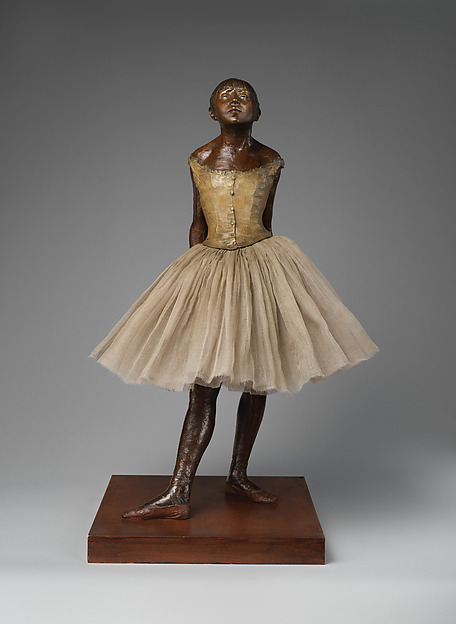
The nearly life-size wax figure with real hair and a cloth tutu, modelled on Marie van Goethem, provoked a strong reaction: critics found its realism extraordinary, but many denounced the dancer as ugly. It was the only sculpture Degas showed in his lifetime.