Georges SeuratFrancia, 1859–1891
El circo
The Circus
¿Se puede contemplar?
Se desconoce: el museo guarda silencio

Museo de Orsay
París, Francia
Se sabe quién es el propietario. Si hoy está expuesta, el museo no lo dice, y a adivinar no nos enseñaron.
- En este estado desde
- 29 sept 2026
- Fuente
- Los datos de colección del propio museo
About the painting
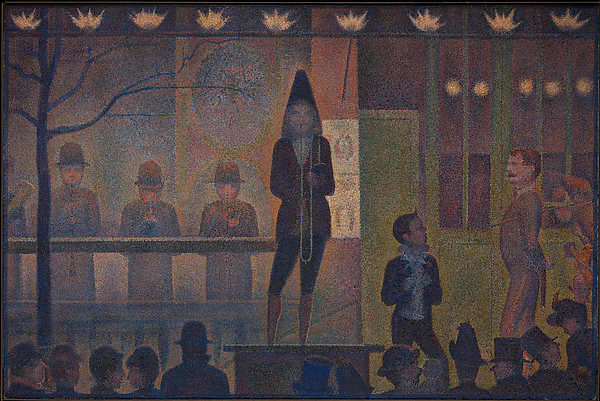
El circo (en francés: Le Cirque pronunciado /lə siʁk/), es un cuadro del pintor francés Georges Pierre Seurat. Está realizado en óleo sobre lienzo. Mide 180 cm de alto y 148 cm de ancho. Fue pintado en 1891. Se encuentra en el Museo de Orsay, París, Francia.
Seurat representa el circo, con su atmósfera festiva.
Este cuadro trata el tema del circo, frecuentado en esos mismos años 1880 por otros autores como Renoir, Degas y Toulouse-Lautrec. Seurat lo trata con la técnica puntillista, en un cuadro en el que predomina el color amarillo. Seurat redujo su paleta a cuatro colores principales, con sus tonos intermedios, en estado puro; predominan el amarillo y el violeta, complementarios. Usaba esos colores en estado puro, mediante pequeños toques yuxtapuestos que se fundían en la retina del espectador.
Read on
Es la última obra de Seurat, empezado un año antes de morir de difteria. Realizó numerosos bocetos para esta obra y la dejó incompleta. Fue adquirido por Paul Signac que luego la revendió al coleccionista estadounidense John Quinn, con la promesa de dejarlo al Museo del Louvre.
La obra fue expuesta, aunque no estuviera terminada, en el séptimo Salón de los independientes, y durante el tiempo de la exposición murió Seurat.
Ficha
- Número de inventario
- RF 2511
Fuentes
- Wikidata · obtenido hace 6 días
- Imagen: Museo de Orsay — Georges Seurat · Public domain · Wikimedia Commons
Mientras tanto, en la vida de Georges Seurat
La vida entera1880s
Charles Henry's lectures at the Sorbonne
In the 1880s Seurat hears lectures by the mathematician Charles Henry at the Sorbonne on the emotional properties and symbolic meaning of lines and colour; there remains controversy over how far he adopted Henry's ideas.
1880s
The colour theorists: Chevreul, Rood, Blanc
Seurat finds the idea of separate strokes of pure colour that blend optically in the viewer's eye in “Modern Chromatics” (1879) by the American physicist Ogden Rood and in the chemist Michel Eugène Chevreul's work on the law of simultaneous contrast of colours; according to his friends, his bedside book is Charles Blanc's “Grammaire des arts du dessin” (1867).
1889
Madeleine Knobloch moves into Seurat's studio
Seurat conceals his relationship with the artist's model Madeleine Knobloch (1868–1903); in 1889 she moves in with him in his studio on the seventh floor of 128 bis boulevard de Clichy.
16 February 1890
The birth of his son Pierre-Georges
When Madeleine becomes pregnant the couple move to a studio at 39 passage de l'Élysée-des-Beaux-Arts (now rue André Antoine), where on 16 February 1890 she gives birth to their son, who is named Pierre-Georges.
29 March 1891
Death at thirty-one: the cause remains uncertain
Seurat dies in his parents' home in Paris at the age of 31; the cause of death is uncertain and has been variously attributed to a form of meningitis, pneumonia, infectious angina and diphtheria. His son dies two weeks later from the same disease.
29 de marzo de 1891
Died