 Édouard ManetFrancia, 1832–1883
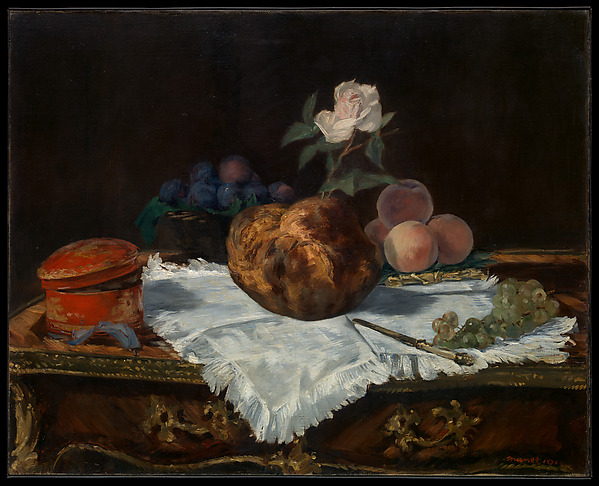
The Brioche
¿Se puede contemplar?
Sí, recibe visitas

Nueva York, Estados Unidos
Expuesta al público. Quién lo avala figura más abajo.
- Comprobado
- En este estado desde
- Fuente
- El museo
Sobre el cuadro
The Brioche is a painting completed in 1870 by the French artist Édouard Manet. Done in oil on canvas, the work depicts a brioche loaf resting on a table. It is in the collection of the Metropolitan Museum of Art.
Manet was inspired to paint it after a painting of a brioche by 18th-century artist Jean Siméon Chardin was donated to the Louvre in Paris. In Manet's work the brioche is accompanied by peaches and plums. It is singular among Manet's still lifes for its formality, and mark the last time he would paint such an elaborate tabletop composition.
Ficha
- Número de inventario
- 1991.287
Lo que muestra
En el catálogo
Fuentes
- Museo Metropolitano de Arte
- Imagen: Museo Metropolitano de Arte — Open Access (CC0)
Mientras tanto, en la vida de Édouard Manet
La vida entera1868
Friendship with Berthe Morisot
In 1868 Manet became a friend and colleague of Berthe Morisot; she is credited with convincing him to attempt plein air painting, to which Camille Corot had introduced her. Through Morisot, Manet became friends with Degas, Monet, Renoir, Sisley, Cézanne and Pissarro.
1869
Meets Eva Gonzalès
In 1869 Manet met the young painter Eva Gonzalès and offered that she pose for a portrait; she became his only formal student.
1870
The siege of Paris: Manet in the army
During the siege of Paris Manet, a convinced republican, sent his family to Oloron-Sainte-Marie in the south of France, while he himself, with many fellow artists, joined the army and took part in the defence of the capital; he was lucky to survive.
1870s
Refuses to exhibit with the Impressionists
Although his own work influenced and anticipated the Impressionist style, Manet resisted involvement in Impressionist exhibitions: he did not wish to be seen as the representative of a group identity and held that modern artists should seek to exhibit at the Salon.
1871
Manet's name on the Commune's Fédération des artistes
In his absence his friends added his name to the Paris Commune's “Fédération des artistes”; he himself stayed out of politics and perhaps returned to the city only after the “bloody week” — in a letter to Berthe Morisot of 10 June he writes that they had come back a few days earlier.
1871
Oloron and Bordeaux: letters to Bracquemond
In January 1871 Manet travelled to Oloron-Sainte-Marie in the Pyrenees and then visited Bordeaux, the provisional seat of the National Assembly, where Émile Zola showed him the sights. On 18 March he wrote to Félix Bracquemond that he had never imagined France could be represented by such doddering old fools.