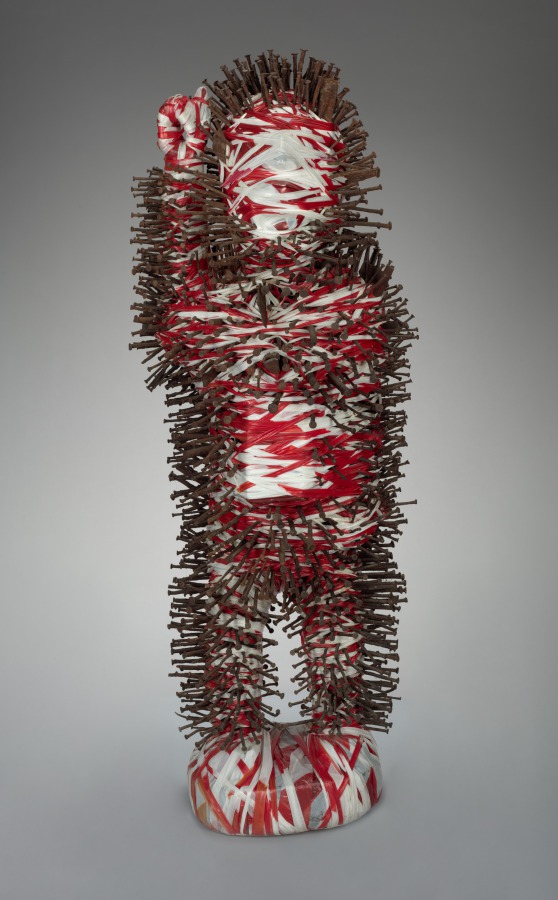
Tears for Eros
¿Puedo verla?
No expuesta por ahora
¿Dónde está «Tears for Eros» hoy? Colección: Instituto de Arte de Chicago, Chicago. No expuesta por ahora. Comprobado 29 de septiembre de 2026.

Chicago, Estados Unidos
Pertenece a la colección, pero ahora mismo no está expuesta.
- Comprobado
- En este estado desde
- Fuente
- El museo
Sobre la obra
Kendell Geers is known both for his activist-inspired performances and conceptual, politically charged, and often controversial artworks. Like other contemporary artists such as William Kentridge and Yinka Shonibare, who also address issues relating to the history of Africa, Geers draws on firsthand experience of the traumas of colonialism while reflecting on wider issues of global culture. A white man from a working-class Afrikaans family, the artist has developed a practice that engages with the turbulent revolution surrounding the downfall of apartheid and the burden of his country’s past. In the late 1990s, he began creating intense, unsettling video installations that reshape imagery from Hollywood films to delve into themes of collective guilt, confrontation, and violence.
Leer más
Tears for Eros consists of five video monitors supported by scaffolds, an arrangement that Geers refers to as “information towers.” Each channel presents close-up footage, appropriated from David Lynch’s debut film Blue Velvet (1986), of a severed human ear lying in a field of grass. In quickly edited sequences, an army of black ants moves in and around the ear, accompanied by the ambient noise of cicadas and chirping crickets. Although the color balance and tone of each monitor is different, the sequence appears to be nearly identical on all five channels, generating a relentless, numbing effect.
Careful scrutiny reveals that the respective visuals are in fact composed of many different edits of the sequence, and the audio—similarly misleading—is a manipulated version of the movie’s soundtrack that incorporates electronic noise and recordings of heavy industry. In this chilling tableau, hints of violence and decay are inextricably linked to the natural landscape. The image of a severed ear itself is hardly coincidental: through manipulations of one powerful moment from Lynch’s film, Geers suggests a condition in which we are stripped of our own senses, bereft of an ability to discern truth from fiction.
Instituto de Arte de ChicagoCC BY 4.0
Ficha
- Número de inventario
- 2000.48
En el catálogo
Fuentes
- Instituto de Arte de Chicago
- Imagen: Instituto de Arte de Chicago — © the artist or rights holder