ART WIKI32.963 en sala
MapaColecciónArtistasMuseosExposicionesRevista
Acceder

ART WIKI

Dónde cuelga la obra maestra y cuándo le dejan pasar.

Colecciones: Galería Nacional de Arte, Galería Nacional de Dinamarca, Galería Nacional de Retratos, Galería Tretiakov, Harvard Art Museums, Instituto de Arte de Chicago, Instituto de Artes de Mineápolis, MoMA, Museo de Arte de Cleveland, Museo de Victoria y Alberto, Museo del Hermitage, Museo del Louvre, Museo Estatal Ruso, Museo Hirshhorn y Jardín de Esculturas, Museo J. Paul Getty, Museo Metropolitano de Arte, Museo Pushkin, Museo Smithsoniano de Arte Americano, Museo Whitney de Arte Estadounidense, National Museum of Asian Art, Rijksmuseum, Villa Getty, Catálogo Estatal del Fondo Museístico de Rusia (274 museos), Europeana (19 museos), Wikidata (6 museos), Paris Musées (12 museos) y Joconde, la base de museos del Ministerio de Cultura de Francia (495 museos). Las imágenes pertenecen a sus titulares de derechos.

Secciones

  • Mapa
  • Búsqueda
  • Colección
  • Obras maestras
  • Expuestas ahora
  • Artistas

Más

  • Museos y galerías
  • Exposiciones
  • Revista
  • De dónde salen los datos
  • Privacidad y cookies
InicioMapaCatálogo
  1. Colección/
  2. Museo de Arte de Cleveland/
  3. Section of a Coffin Platform: Horizontal Panel
Section of a Coffin Platform: Horizontal Panel, 550–77

Section of a Coffin Platform: Horizontal Panel

550–77 · Sculpture

¿Se puede contemplar?

Por ahora no recibe

Museo de Arte de Cleveland

Cleveland, Estados Unidos

Pertenece a la colección, pero ahora mismo no está expuesta.

Comprobado
anteayer
En este estado desde
19 ago 2026
Fuente
El museo
En el mapaPágina del museo

Sobre la escultura

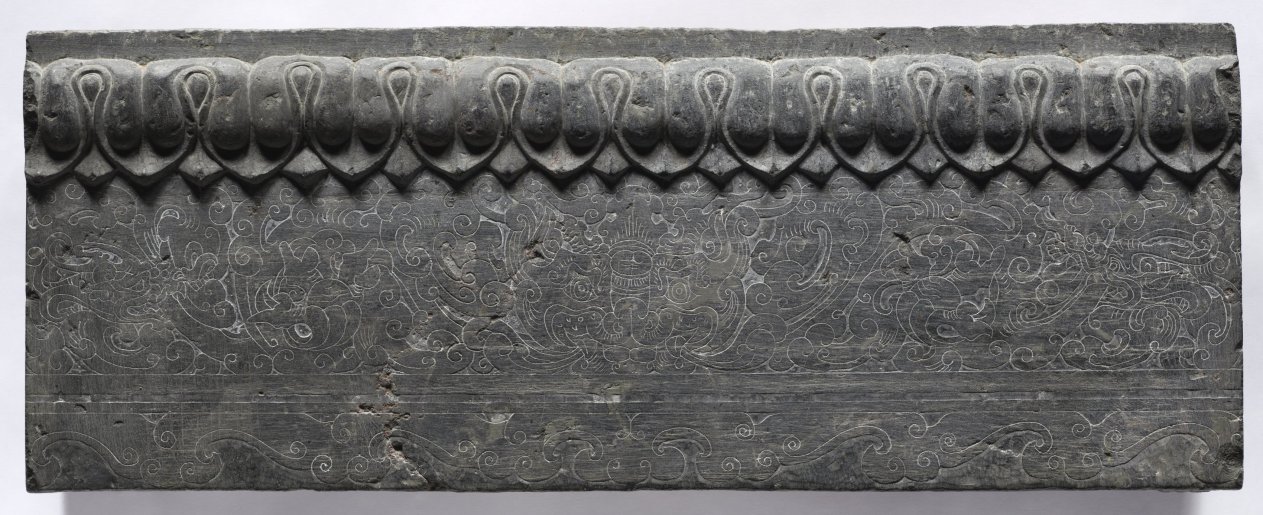
This richly ornamented stone construction is the long, front side of a coffin platform ultimately derived from raised wooden beds that are still popular in China today. Now in five pieces (presumably cut to facilitate transportation after it was excavated in the 1900s), the three legs and horizontal spans may have originally been created as a single massive slab. Sockets cut in the top of the stone (some of which overlap the modern divisions) show how this slab would have been linked to the back with crosspieces also capable of supporting a top surface of flat stone planks.

Seguir leyendo

Like the few examples discovered intact in northern Chinese aristocratic tombs, the most elaborate decoration occurs on the front surface of the coffin platform. The design is dominated by the three large vertical panels, corresponding to the legs, that contain animated high-relief depictions of three directional guardians: the White Tiger of the West, the Red Bird of the South, and the Green Dragon of the East. These three, along with the Snake-Entwined Tortoise of the North and the Yellow Dragon of the Center, were mainstays of Chinese cosmology linked, in a system devised as early as the Han dynasty, to elements (wood, fire, earth, metal, and water), functions, planets, and musical tones, among others.

Not only illustrating the persistent appeal of these traditional apotropaic symbols, this scheme suggests that the platform was placed against the back, northern wall of a tomb that would have been entered from the south. The layered carving technique of these principal motifs as well as the shallow relief dragons, masks, and tendrils engraved in the horizontal spans recall forms found in both imperially sponsored tombs and cave chapels of the late sixth century.

Museo de Arte de Cleveland

Ficha

Número de inventario
1982.260.d

En el catálogo

EsculturaPiedraChina, Northern Qi dynasty (550–577)

Fuentes

  • Museo de Arte de Cleveland
  • Imagen: Museo de Arte de Cleveland — Museum open access
Bajo el mismo techo: Museo de Arte de Cleveland

Página del museo
The Red Kerchief, Claude Monet, c. 1868–73

Claude Monet

The Red Kerchief, c. 1868–73

Melencolia I, Albrecht Dürer, 1514

Albrecht Dürer

Melancolía I, 1514

The Virgin and Child with the Pear, Albrecht Dürer, 1511

Albrecht Dürer

The Virgin and Child with the Pear, 1511

The Nativity, Albrecht Dürer, probably c. 1509/1510

Albrecht Dürer

The Nativity, probably c. 1509/1510

The Virgin and Child on a Crescent with a Starry Crown, Albrecht Dürer, 1508

Albrecht Dürer

The Virgin and Child on a Crescent with a Starry Crown, 1508

The Lamentation, Albrecht Dürer, 1507

Albrecht Dürer

The Lamentation, 1507

Large Horse, Albrecht Dürer, 1505

Albrecht Dürer

Large Horse, 1505

Nemesis (The Great Fortune), Albrecht Dürer, c. 1501/1502

Albrecht Dürer

Nemesis (The Great Fortune), c. 1501/1502