Albrecht DürerAlemania, 1471–1528
Nemesis (The Great Fortune)
¿Se puede contemplar?
Sí, recibe visitas

Expuesta al público. Quién lo avala figura más abajo.

Colección: Galería Nacional de Arte, Washington D. C.
- Comprobado
- En este estado desde
- Fuente
- Los datos de colección del propio museo
Sobre la obra
Némesis o La gran Fortuna es un grabado sobre cobre de 33,2 x 23,2 cm del artista renacentista alemán Alberto Durero, datable hacia 1502 y conservado, entre las mejores copias existentes, en la Staatliche Kunsthalle Karlsruhe y en el museo arqueológico Villa Pisani Dossi de Corbetta (Milán); en Francia, se conserva una copia en el museo Condé de Chantilly.
In the museum's words
In this print Dürer combines Nemesis, the classical goddess of retribution, whose goblet and bridle represent favor and castigation, with the traditional winged figure of Fortune standing on a globe. The landscape beneath the figure has been identified as a view of the South Tyrolean town on Chiusa (or Klausen), which Dürer presumably drew during his first journey to Venice in 1494-95. In his landscape, Dürer combines both a panoramic vastness and an amazing amount of identifiable detail. It looks remarkably like a view a modern traveler has from an airplane.
Galería Nacional de Arte
Ficha
- Número de inventario
- 1943.3.3485
What it shows
En el catálogo
Idas y venidas
Expuesta · 101B Prints & Drawings
Museo de Arte de Cleveland · 2 oct 2026 — hoy · Verificado
Expuesta · 101B Prints & Drawings
Galería Nacional de Arte · 29 sept 2026 — 2 oct 2026 · Verificado
Expuesta · 101B Prints & Drawings
Museo de Arte de Cleveland · 29 sept 2026 — 29 sept 2026 · Verificado
Expuesta · 101B Prints & Drawings
Galería Nacional de Arte · 29 sept 2026 — 29 sept 2026 · Verificado
Expuesta · 101B Prints & Drawings
Museo de Arte de Cleveland · 28 sept 2026 — 29 sept 2026 · Verificado
Expuesta · 101B Prints & Drawings
Galería Nacional de Arte · 28 sept 2026 — 28 sept 2026 · Verificado
Expuesta · 101B Prints & Drawings
Museo de Arte de Cleveland · 27 sept 2026 — 28 sept 2026 · Verificado
Expuesta · 101B Prints & Drawings
Galería Nacional de Arte · 26 sept 2026 — 27 sept 2026 · Verificado
Expuesta · 101B Prints & Drawings
Museo de Arte de Cleveland · 19 ago 2026 — 26 sept 2026 · Verificado
Fuentes
- Museo de Arte de Cleveland: the museum's own open data · obtenido hace 7 días
- Imagen: Galería Nacional de Arte — Museum open access
Mientras tanto, en la vida de Albrecht Dürer
La vida entera1500
Jacopo de' Barbari and the secret of proportion
The Venetian Jacopo de' Barbari, whom Dürer had met in Venice, came to Nuremberg, and Dürer said he learned much from him about perspective, anatomy and proportion. Feeling that de' Barbari would not explain everything he knew, Dürer began studies of his own that became a lifelong preoccupation.
1501–1502
In the circle of Nuremberg's humanists
Through his lifelong friend Willibald Pirckheimer, Dürer entered the circle of Nuremberg's humanists. He engraved illustrations for Conrad Celtis's editions of Hrotsvitha (1501) and of his Four Books of Love (1502), and decorated 14 books in Pirckheimer's library with drawings.
1502
Death of his father
Albrecht Dürer the Elder died, and his son took on the care of his mother and his two younger brothers, Endres and Hans.
1504 · Lugar de trabajo
Lutherstadt Wittenberg
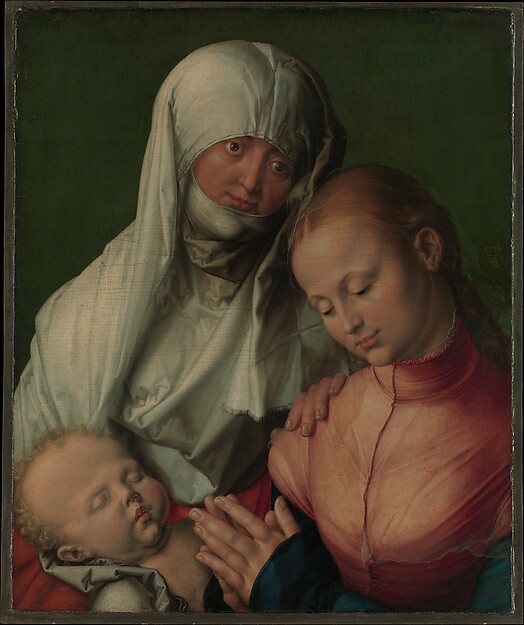
![Madonna and Child [obverse], Albrecht Dürer, c. 1496/1499](https://api.nga.gov/iiif/878db7e6-10ae-4cae-ba5d-6d6f5c413ae8/full/!2400,2400/0/default.jpg)
![Lot and His Daughters [reverse], Albrecht Dürer, c. 1496/1499](https://api.nga.gov/iiif/7565a449-f82a-414b-9bda-c93f55a51b4d/full/!2400,2400/0/default.jpg)