ART WIKI32.963 en sala
MapaColecciónArtistasMuseosExposicionesRevista
Acceder

ART WIKI

Dónde cuelga la obra maestra y cuándo le dejan pasar.

Colecciones: Galería Nacional de Arte, Galería Nacional de Dinamarca, Galería Nacional de Retratos, Galería Tretiakov, Harvard Art Museums, Instituto de Arte de Chicago, Instituto de Artes de Mineápolis, MoMA, Museo de Arte de Cleveland, Museo de Victoria y Alberto, Museo del Hermitage, Museo del Louvre, Museo Estatal Ruso, Museo Hirshhorn y Jardín de Esculturas, Museo J. Paul Getty, Museo Metropolitano de Arte, Museo Pushkin, Museo Smithsoniano de Arte Americano, Museo Whitney de Arte Estadounidense, National Museum of Asian Art, Rijksmuseum, Villa Getty, Catálogo Estatal del Fondo Museístico de Rusia (274 museos), Europeana (19 museos), Wikidata (6 museos), Paris Musées (12 museos) y Joconde, la base de museos del Ministerio de Cultura de Francia (495 museos). Las imágenes pertenecen a sus titulares de derechos.

Secciones

  • Mapa
  • Búsqueda
  • Colección
  • Obras maestras
  • Expuestas ahora
  • Artistas

Más

  • Museos y galerías
  • Exposiciones
  • Revista
  • De dónde salen los datos
  • Privacidad y cookies
InicioMapaCatálogo
  1. Colección/
  2. Museo de Arte de Cleveland/
  3. Satyress
Satyress, Giovanni Maria Mosca, c. 1525–1528
GGiovanni Maria MoscaItalia, 1493–1574

Satyress

c. 1525–1528 · Sculpture

¿Se puede contemplar?

Sí, recibe visitas

Museo de Arte de Cleveland

Cleveland, Estados Unidos

Sala117A Italian Renaissance

Expuesta al público. Quién lo avala figura más abajo.

Comprobado
hace 3 días
En este estado desde
19 ago 2026
Fuente
El museo
En el mapaPágina del museo

Sobre la escultura

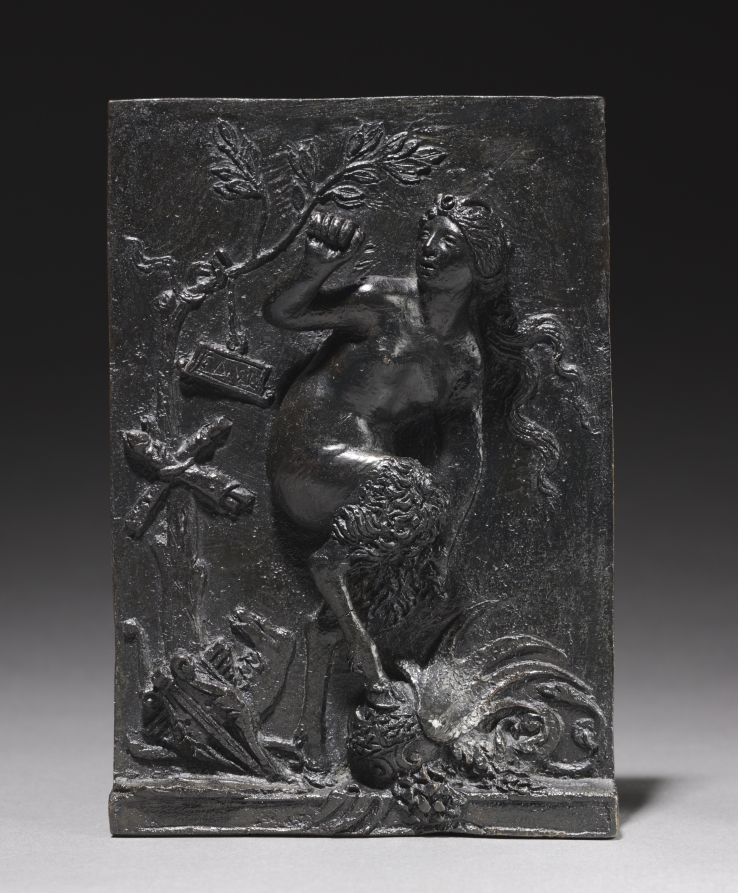
In antiquity, satyrs were lustful woodland deities who delighted in wine and revelry. Renaissance artists adopted them as symbols of vice and carnal love; the female satyr, or satyress, on this bronze plaquette, recently reattributed from Riccio to Mosca, was probably derived from a copper engraving of a Roman sarcophagus by Marcantonio Raimondi (c. 1470/82-1527/34). Both the sarcophagus and subsequent engraving depicted a bacchanalia, or scene of orgiastic carousal; the peculiar objects surrounding the satyress have been added by the artist, possibly in an effort to remove the figure from her lewd original composition and give a more refined meaning. The satyress rests her right hoof upon a plumed helmet. A coiled shape, possibly a snake, winds out of the helmet. To her left, a laurel tree stands with only half of its branches in bloom.

Seguir leyendo

Two severed animal legs are tied around its trunk and an illegible plaque hangs from one of its branches. A lyre, a pan pipe, an animal jawbone and a bow are gathered at the base of the tree. The highly allegorical nature of the work uses obscure symbols, rather than a distinct narrative, to convey meaning and could possibly be read as an allegory of physical pleasure overcoming virtue.
Museo de Arte de Cleveland

Ficha

c. 1525–1528
14931574
Número de inventario
1947.29

En el catálogo

EsculturaBronceRenacimientoSiglo XVIItaly, 16th century

Fuentes

  • Museo de Arte de Cleveland
  • Imagen: Museo de Arte de Cleveland — Museum open access

Mientras tanto, en la vida de Giovanni Maria Mosca

La vida entera
  1. 1515–1530 · Lugar de trabajo

    Venice

  2. 1515–1530 · Lugar de trabajo

    Padua

  3. 1530–1553 · Lugar de trabajo

    Kraków

Más obras de Giovanni Maria Mosca

Todas las obras
Le Jugement de Salomon, Italie, vers 1510 - 1520

Le Jugement de Salomon

vers 1510 - 1520 · Museo del Louvre

Mucius Scaevola, Giammaria Mosca

Mucius Scaevola

Skulpturensammlung Dresden

Kleopatra, Giammaria Mosca

Kleopatra

Museo Palacio de Arte de Düsseldorf

Philoctetes on the Island of Lemnos, Giovanni Maria Mosca, c. 1510–1515

Philoctetes on the Island of Lemnos

c. 1510–1515 · No expuesta · Museo de Arte de Cleveland

Bajo el mismo techo: Museo de Arte de Cleveland

Página del museo
The Red Kerchief, Claude Monet, c. 1868–73

Claude Monet

The Red Kerchief, c. 1868–73

Melencolia I, Albrecht Dürer, 1514

Albrecht Dürer

Melancolía I, 1514

The Virgin and Child with the Pear, Albrecht Dürer, 1511

Albrecht Dürer

The Virgin and Child with the Pear, 1511

The Nativity, Albrecht Dürer, probably c. 1509/1510

Albrecht Dürer

The Nativity, probably c. 1509/1510

The Virgin and Child on a Crescent with a Starry Crown, Albrecht Dürer, 1508

Albrecht Dürer

The Virgin and Child on a Crescent with a Starry Crown, 1508

The Lamentation, Albrecht Dürer, 1507

Albrecht Dürer

The Lamentation, 1507

Large Horse, Albrecht Dürer, 1505

Albrecht Dürer

Large Horse, 1505

Nemesis (The Great Fortune), Albrecht Dürer, c. 1501/1502

Albrecht Dürer

Nemesis (The Great Fortune), c. 1501/1502