ART WIKI32.963 en sala
MapaColecciónArtistasMuseosExposicionesRevista
Acceder

ART WIKI

Dónde cuelga la obra maestra y cuándo le dejan pasar.

Colecciones: Galería Nacional de Arte, Galería Nacional de Dinamarca, Galería Nacional de Retratos, Galería Tretiakov, Harvard Art Museums, Instituto de Arte de Chicago, Instituto de Artes de Mineápolis, MoMA, Museo de Arte de Cleveland, Museo de Victoria y Alberto, Museo del Hermitage, Museo del Louvre, Museo Estatal Ruso, Museo Hirshhorn y Jardín de Esculturas, Museo J. Paul Getty, Museo Metropolitano de Arte, Museo Pushkin, Museo Smithsoniano de Arte Americano, Museo Whitney de Arte Estadounidense, National Museum of Asian Art, Rijksmuseum, Villa Getty, Catálogo Estatal del Fondo Museístico de Rusia (274 museos), Europeana (19 museos), Wikidata (6 museos), Paris Musées (12 museos) y Joconde, la base de museos del Ministerio de Cultura de Francia (495 museos). Las imágenes pertenecen a sus titulares de derechos.

Secciones

  • Mapa
  • Búsqueda
  • Colección
  • Obras maestras
  • Expuestas ahora
  • Artistas

Más

  • Museos y galerías
  • Exposiciones
  • Revista
  • De dónde salen los datos
  • Privacidad y cookies
InicioMapaCatálogo
  1. Colección/
  2. Museo de Victoria y Alberto/
  3. Painting
Painting, Miskina, ca. 1590-95
MMiskina

Painting

ca. 1590-95 · Painting · 38.1 × 22.4 cm

¿Se puede contemplar?

Por ahora no recibe

Museo de Victoria y Alberto

Londres, Reino Unido

Pertenece a la colección, pero ahora mismo no está expuesta.

Comprobado
hace 12 días
En este estado desde
25 sept 2026
Fuente
El museo
En el mapaPágina del museo

Sobre el cuadro

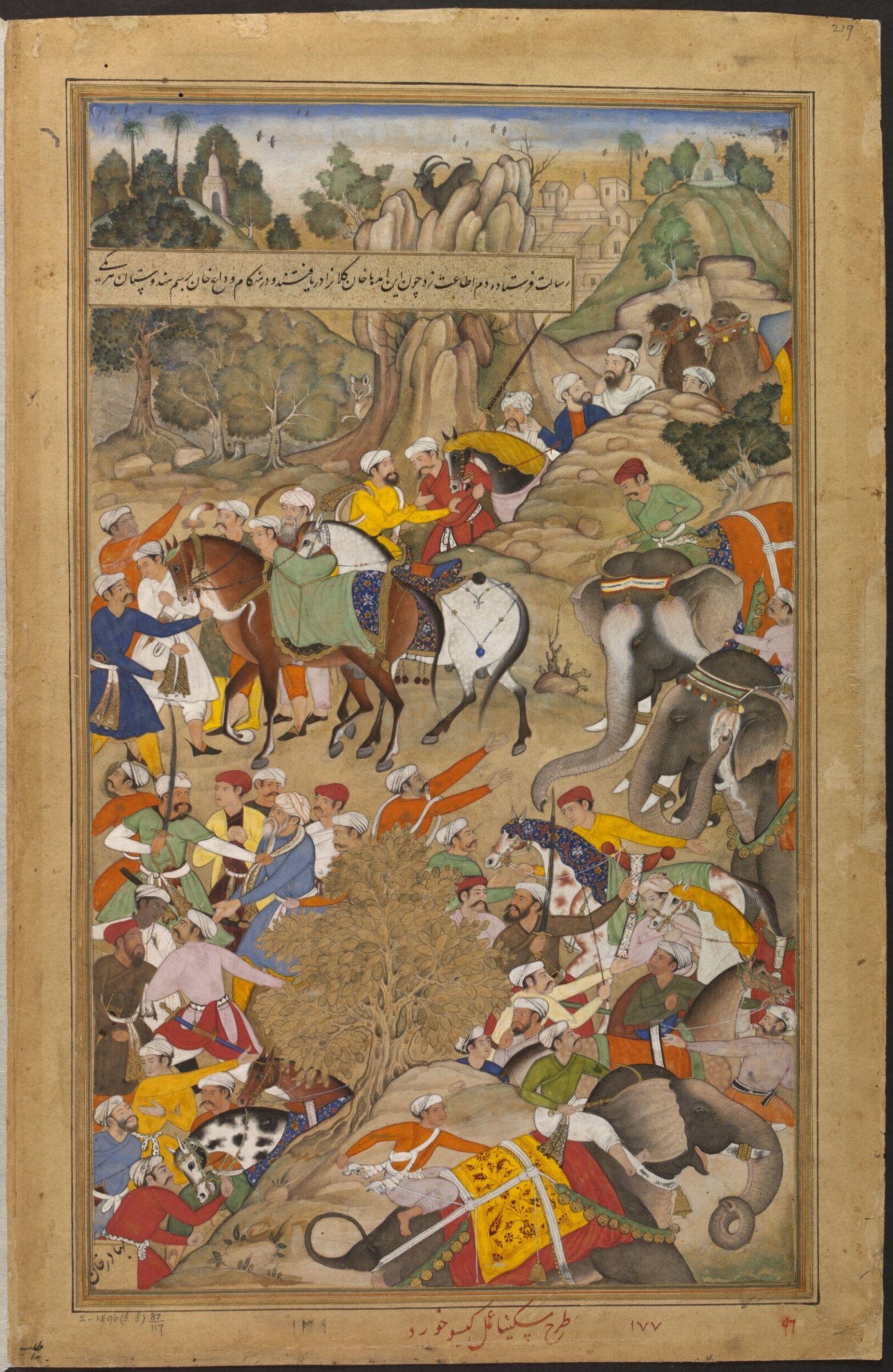
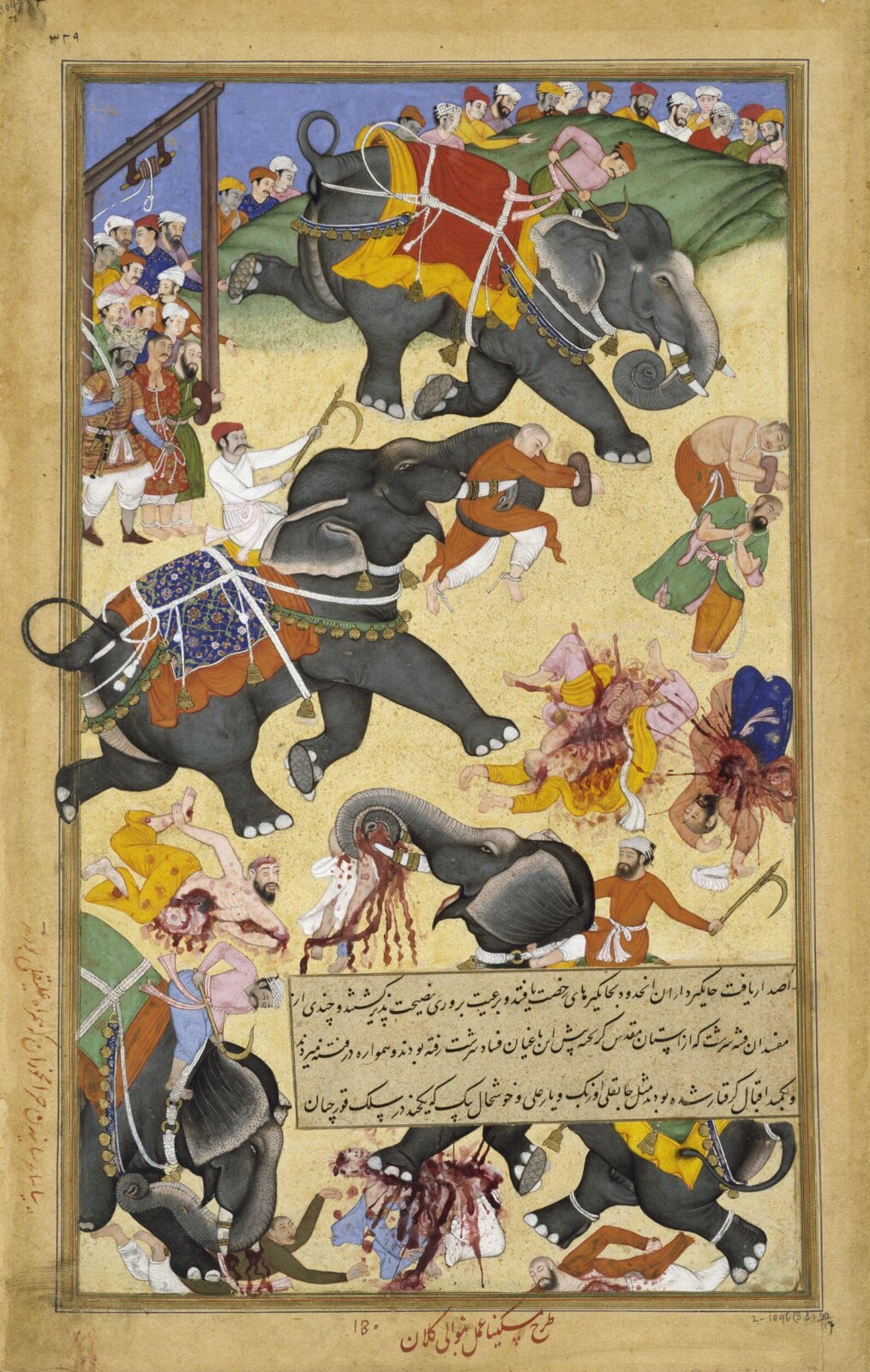
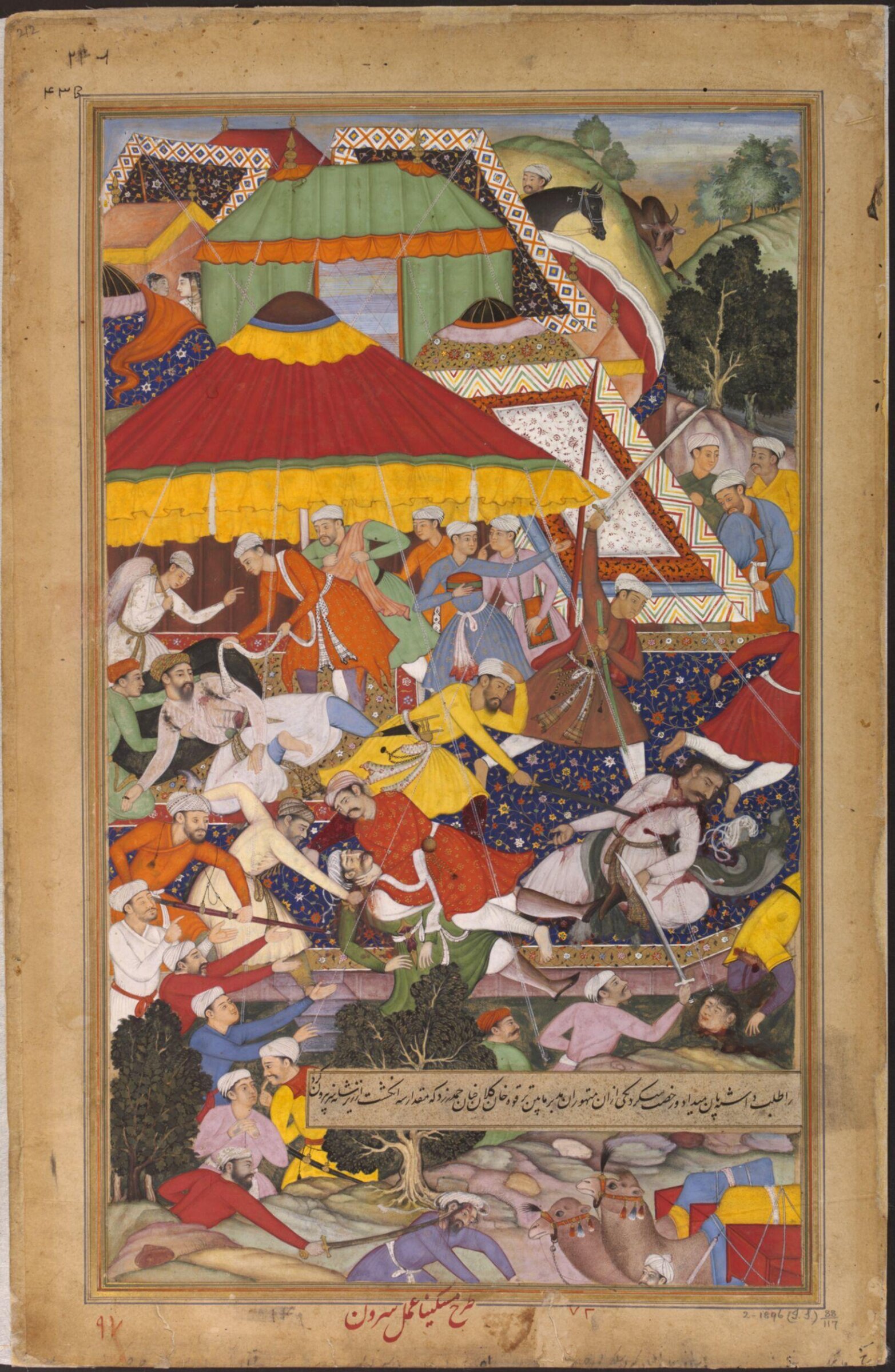
The composition of this painting was designed by the Mughal court artist Miskina and the details painted by Banwali the Elder. It is from the Akbarnama (Book of Akbar) .

Seguir leyendo

Elephants played a crucial part in Mughal warfare, breaking through fortifications and killing enemy footsoldiers. They were also used to deliver capital punishment, as this painting vividly demonstrates. Ali Quli Shaibani had served Humayun, and his bravery in the early military campaigns of Akbar’s reign earned him a title and a valuable grant of land. However, his very public affair with Shaham Beg, formerly one of Humayun’s bodyguards, scandalised the court. He fell further into disgrace by marrying a prostitute who had also been Shaham Beg’s lover and living with both in a ménage a trois. Abu’l Fazl, writing with the benefit of hindsight, claimed that Ali Quli’s apparent loyalty was always insincere, though he did not rebel outright until 1566. Nevertheless, Akbar pardoned him after Mirza Rezavi Mirak, a close follower, begged forgiveness on Ali Quli’s behalf.

The following year Ali Quli again rebelled, forcing Akbar to lead a small force to crush him. Ali Quli died in the battle, and his leading supporters were captured and executed by elephants before the emperor. Mirza Rezavi Mirak was among the captives but the elephant’s mahout was ordered not to kill him. Instead, the huge animal simply played with him. This terrifying ordeal was repeated for five consecutive days until Mirza Rezavi Mirak was freed.

[AKbarnama, English translation: Beveridge, vol. II, pp. 398, 426-36]

The Akbarnama was commissioned by Akbar as the official chronicle of his reign. It was written in Persian by his court historian and biographer, Abu’l Fazl, between 1590 and 1596, and the V&A’s partial copy of the manuscript is thought to have been illustrated between about 1592 and 1595. This is thought to be the earliest illustrated version of the text, and drew upon the expertise of some of the best royal artists of the time. Many of these are listed by Abu’l Fazl in the third volume of the text, the A’in-i Akbari, and some of these names appear in the V&A illustrations, written in red ink beneath the pictures, showing that this was a royal copy made for Akbar himself. After his death, the manuscript remained in the library of his son Jahangir, from whom it was inherited by Shah Jahan.

The V&A purchased the manuscript in 1896 from Frances Clarke, the widow of Major General John Clarke, who bought it in India while serving as Commissioner of Oudh between 1858 and 1862.

Museo de Victoria y Alberto

Ficha

Número de inventario
IS.2:90-1896

Lo que muestra

ElephantExecutionAkbar

En el catálogo

PinturaGouacheRenacimientoSiglo XVIMughalImperio mogol

Fuentes

  • Museo de Victoria y Alberto
  • Imagen: Museo de Victoria y Alberto — © Victoria and Albert Museum, London
Más obras de Miskina

Todas las obras
Khan-i Kilan, Miskina, ca. 1590-95

Khan-i Kilan

ca. 1590-95 · No expuesta · Museo de Victoria y Alberto

Akbar, Miskina, ca. 1590-95

Akbar

ca. 1590-95 · No expuesta · Museo de Victoria y Alberto

Painting, Miskina, ca. 1590-95

Painting

ca. 1590-95 · No expuesta · Museo de Victoria y Alberto

Pir Muhammad Khan, Miskina, ca. 1590-95

Pir Muhammad Khan

ca. 1590-95 · No expuesta · Museo de Victoria y Alberto

Akbar and Hamid Bakari, Miskina, ca. 1590-95

Akbar and Hamid Bakari

ca. 1590-95 · No expuesta · Museo de Victoria y Alberto

Painting, Miskina, ca. 1590-95

Painting

ca. 1590-95 · No expuesta · Museo de Victoria y Alberto

Akbar and Asaf Khan, Miskina, ca. 1590-95

Akbar and Asaf Khan

ca. 1590-95 · No expuesta · Museo de Victoria y Alberto

Khan Kilan, Miskina, ca. 1590-95

Khan Kilan

ca. 1590-95 · No expuesta · Museo de Victoria y Alberto

Bajo el mismo techo: Museo de Victoria y Alberto

Página del museo
Bird of Paradise, Hashimoto Chitaka, 2026

Hashimoto Chitaka

Bird of Paradise, 2026

Torsion 2, Taruma Shoko, 2025

Taruma Shoko

Torsion 2, 2025

Fu, Someya Satoshi, 2025

Someya Satoshi

Fu, 2025

Bow Before the Curtain Falls, 2024

Bow Before the Curtain Falls, 2024

Summer, 2024

Summer, 2024

Red Flow, Ishizuka Genta, 2024

Ishizuka Genta

Red Flow, 2024

3D replica of Michelangelo's Prisoner (4117-1854), Factum Arte, 2024

Factum Arte

3D replica of Michelangelo's Prisoner (4117-1854), 2024

Sculpture, ‘Co-Existence – the Man and the Monkey’, Zhao Lin, 2024

Zhao Lin

Sculpture, ‘Co-Existence – the Man and the Monkey’, 2024

Sobre el mismo tema · Elephant

Todas las obras sobre el tema
The Rat and the Elephant, Marc Chagall, 1927/1930

Marc Chagall

The Rat and the Elephant, 1927/1930

No expuesta · Galería Nacional de Arte

Le Chariot de terre cuite, Henri de Toulouse-Lautrec, 1895

Henri de Toulouse-Lautrec

Le Chariot de terre cuite, 1895

No expuesta · Galería Nacional de Arte

Le Chariot de terre cuite, Henri de Toulouse-Lautrec, 1894

Henri de Toulouse-Lautrec

Le Chariot de terre cuite, 1894

No expuesta · Galería Nacional de Arte

Plate Number 733. Elephant walking, Eadweard Muybridge, 1887

Eadweard Muybridge

Plate Number 733. Elephant walking, 1887

No expuesta · Galería Nacional de Arte

Plate Number 732. Elephant walking, Eadweard Muybridge, 1887

Eadweard Muybridge

Plate Number 732. Elephant walking, 1887

No expuesta · Galería Nacional de Arte

Plate Number 734. Two elephants walking, Eadweard Muybridge, 1887

Eadweard Muybridge

Plate Number 734. Two elephants walking, 1887

No expuesta · Galería Nacional de Arte

Plate Number 735. Two elephants walking, Eadweard Muybridge, 1887

Eadweard Muybridge

Plate Number 735. Two elephants walking, 1887

No expuesta · Galería Nacional de Arte

Plate Number 733. Elephant walking, Eadweard Muybridge, 1887

Eadweard Muybridge

Plate Number 733. Elephant walking, 1887

No expuesta · Galería Nacional de Arte