ART WIKI32.963 en sala
MapaColecciónArtistasMuseosExposicionesRevista
Acceder

ART WIKI

Dónde cuelga la obra maestra y cuándo le dejan pasar.

Colecciones: Galería Nacional de Arte, Galería Nacional de Dinamarca, Galería Nacional de Retratos, Galería Tretiakov, Harvard Art Museums, Instituto de Arte de Chicago, Instituto de Artes de Mineápolis, MoMA, Museo de Arte de Cleveland, Museo de Victoria y Alberto, Museo del Hermitage, Museo del Louvre, Museo Estatal Ruso, Museo Hirshhorn y Jardín de Esculturas, Museo J. Paul Getty, Museo Metropolitano de Arte, Museo Pushkin, Museo Smithsoniano de Arte Americano, Museo Whitney de Arte Estadounidense, National Museum of Asian Art, Rijksmuseum, Villa Getty, Catálogo Estatal del Fondo Museístico de Rusia (274 museos), Europeana (19 museos), Wikidata (6 museos), Paris Musées (12 museos) y Joconde, la base de museos del Ministerio de Cultura de Francia (495 museos). Las imágenes pertenecen a sus titulares de derechos.

Secciones

  • Mapa
  • Búsqueda
  • Colección
  • Obras maestras
  • Expuestas ahora
  • Artistas

Más

  • Museos y galerías
  • Exposiciones
  • Revista
  • De dónde salen los datos
  • Privacidad y cookies
InicioMapaCatálogo
  1. Colección/
  2. Instituto de Arte de Chicago/
  3. Painting
Painting, Franz Kline, 1952
FFranz KlineEstados Unidos, 1910–1962

Painting

1952 · Painting

¿Se puede contemplar?

Sí, recibe visitas

Instituto de Arte de Chicago

Chicago, Estados Unidos

Sala398

Expuesta al público. Quién lo avala figura más abajo.

Comprobado
hace 3 días
En este estado desde
28 sept 2026
Fuente
El museo
En el mapaPágina del museo

Sobre el cuadro

Until the early 1940s, Franz Kline painted realistic landscapes, portraits, and cityscapes that were inspired by the textures and forms of New York City. Around 1949 he began to make black-and-white canvases such as Painting, which, while abstract, continue to suggest the invigorating energy of urban street life. The artist’s preparation for his paintings included making numerous sketches on newspaper or telephone-book pages. He then translated a small-scale drawing onto canvas, as, what he called, “strokes expanding as entities in themselves.” Utilizing housepainters’ brushes, Kline tacked his canvases to a wood panel in order to obtain the hard surface that he needed to paint his world of eternally colliding forces. Though the many visible drip marks imply a quick, spontaneous execution, the artist returned to this work several times over a two-month period to refine and strengthen its rhythm and spacing.

Instituto de Arte de Chicago · CC BY 4.0

Ficha

1952 · a los 42 años
19101962
Número de inventario
1984.521

En el catálogo

PinturaÓleoPintura estadounidenseArte de posguerraSiglo XXEstados Unidos

Fuentes

  • Instituto de Arte de Chicago
  • Imagen: Instituto de Arte de Chicago — © the artist or rights holder

Mientras tanto, en la vida de Franz Kline

La vida entera
  1. 1948–1950

    The turn to black-and-white abstraction

    Over the next two years Kline's brushstrokes become completely non-representative, fluid and dynamic, and he begins painting only in black and white: for him the white is just as important as the black. Viewers also see references to Japanese calligraphy in these paintings, through his exchange with the avant-garde group Bokujinkai and its leader Morita Shiryu, although Kline later denied the connection.

  2. 16 October – 4 November 1950

    First solo show at the Charles Egan Gallery

    At the Charles Egan Gallery in New York Kline's first one-man show opens: eleven abstract paintings with very little colour — brown underpainting near the bottom of “Nijinsky” and fleeting hints of green in “Leda”. Afterwards he is dubbed the “black and white artist”, a label by which he sometimes feels restricted.

  3. early 1950s

    An affinity with Pierre Soulages

    In the early 1950s Kline's work appears very much inspired by the French painter Pierre Soulages, who had exhibited at Betty Parsons' gallery in New York in 1949.

  4. 1951

    Taking part in the 9th Street Art Exhibition

    A year after his first solo show Kline takes part in the 9th Street Art Exhibition.

  5. 1952–1961

    The Whitney Annuals and Biennials

    Kline's work is included in the Whitney Museum of American Art's Annuals and Biennials in 1952, 1953, 1955 and 1961.

Más obras de Franz Kline

Todas las obras
Chicago, Franz Kline, 1959

Chicago

1959 · Instituto de Arte de Chicago

Untitled, Franz Kline, 1950s

Untitled

1950s · No expuesta · Galería Nacional de Arte

Untitled [recto], Franz Kline, 1950s

Untitled [recto]

1950s · No expuesta · Galería Nacional de Arte

Untitled [verso], Franz Kline, 1940s-1950s

Untitled [verso]

1940s-1950s · No expuesta · Galería Nacional de Arte

Standing Man, Franz Kline, 1940s

Standing Man

1940s · No expuesta · Galería Nacional de Arte

Untitled, Franz Kline, 1940s-1950s

Untitled

1940s-1950s · No expuesta · Galería Nacional de Arte

Untitled, Franz Kline, 1950s

Untitled

1950s · No expuesta · Galería Nacional de Arte

Standing Female Nude Seen from Behind, Franz Kline, 1940s

Standing Female Nude Seen from Behind

1940s · No expuesta · Galería Nacional de Arte

Bajo el mismo techo: Instituto de Arte de Chicago

Página del museo
The Bedroom, Vincent van Gogh, 1889

Vincent van Gogh

The Bedroom, 1889

A Sunday on La Grande Jatte — 1884, Georges Seurat, 1884–86, border added 1888–89

Georges Seurat

Tarde de domingo en la isla de la Grande Jatte, 1884–86, border added 1888–89

Paris Street; Rainy Day, Gustave Caillebotte, 1877

Gustave Caillebotte

Calle de Paris, dia de lluvia, 1877

Two Sisters (On the Terrace), Pierre-Auguste Renoir, 1881

Pierre-Auguste Renoir

En la terraza, 1881

The Basket of Apples, Paul Cézanne, c. 1893

Paul Cézanne

Cesto de manzanas, c. 1893

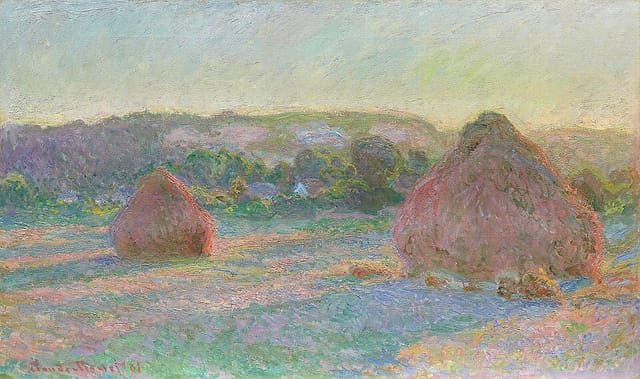
Stacks of Wheat (End of Summer), Claude Monet, 1890–91

Claude Monet

Stacks of Wheat (End of Summer), 1890–91

American Gothic, Grant Wood, 1930

Grant Wood

American Gothic, 1930

Nighthawks, Edward Hopper, 1942

Edward Hopper

Noctámbulos, 1942