
 Frederic Edwin ChurchEstados Unidos, 1826–1900
Niagara
¿Se puede contemplar?
Sí, recibe visitas

Expuesta al público. Quién lo avala figura más abajo.
- Comprobado
- anteayer
- En este estado desde
- 29 sept 2026
- Fuente
- Los datos de colección del propio museo
About the painting
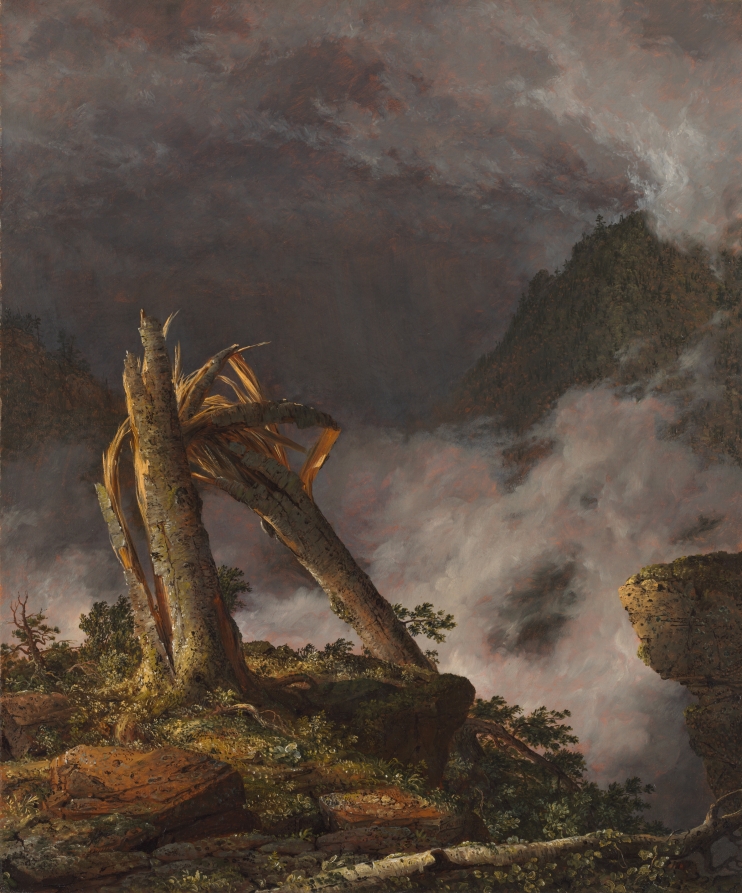
Niágara es una obra de Frederic Edwin Church, un pintor paisajista estadounidense, y figura central de la Escuela del río Hudson. Esta pintura, fechada en 1857, fue considerada como su obra más importante hasta aquel momento, y confirmó su reputación como el mejor pintor estadounidense de su tiempo.
Ficha
- Número de inventario
- 2014.79.10
What it shows
En el catálogo
Idas y venidas
Expuesta · Sala 71 · Edificio Oeste, planta principal
Galería Nacional de Arte · 29 sept 2026 — hoy · Verificado
Expuesta · Sala 72 · Edificio Oeste, planta principal
Galería Nacional de Arte · 19 ago 2026 — 29 sept 2026 · Verificado
Fuentes
- Galería Nacional de Arte: the museum's own open data · obtenido hace 5 días
- Imagen: Galería Nacional de Arte — Museum open access
Mientras tanto, en la vida de Frederic Edwin Church
La vida entera1854–1856
Canada, New England and Mount Desert Island
Church travelled in Canada and New England; like Cole, he was among the first city dwellers to summer on Mount Desert Island in Maine, now Acadia National Park.
1857
Second South American journey, with Louis Rémy Mignot
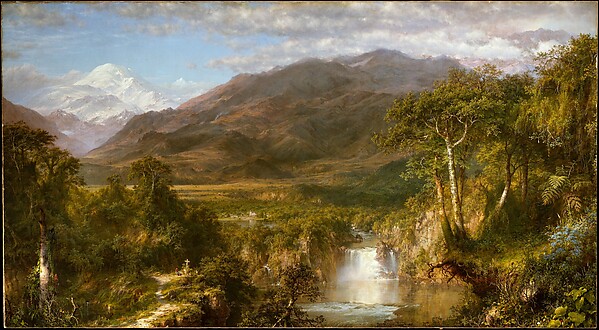
Church returned to South America with the painter Louis Rémy Mignot and added to his sketches; the two journeys produced “The Andes of Ecuador”, “Cayambe”, “The Heart of the Andes” and “Cotopaxi”.
1859
A one-picture show: “The Heart of the Andes” in New York
Thousands paid to see the canvas: its huge floor-standing frame served as a window onto the Andes, visitors sat on benches and studied the details through opera glasses, and Church arranged the room so that light from the skylights fell on the picture. It was an instant success; at this exhibition Church met his future wife, Isabel Carnes.
1859
To the icebergs: Newfoundland and Labrador
His friendship with the Arctic explorer Isaac Israel Hayes stirred Church’s interest in the far north, and with his friend the Rev. Louis Legrand Noble he travelled to Newfoundland and Labrador. Noble chronicled the trip in “After Icebergs with a Painter” (1861), published shortly before “The Icebergs” went on display.



![Ginevra de' Benci [obverse], Leonardo da Vinci, c. 1474/1478](https://api.nga.gov/iiif/8f29e3c9-a289-4d53-abf0-31a66e9e98fa/full/!2400,2400/0/default.jpg)
![Wreath of Laurel, Palm, and Juniper with a Scroll inscribed Virtutem Forma Decorat [reverse], Leonardo da Vinci, c. 1474/1478](https://api.nga.gov/iiif/ff62e8d0-45c4-498f-ad36-6358de827e04/full/!2400,2400/0/default.jpg)


